Tuesday, June 06, 2006

Hair, or Hair Not

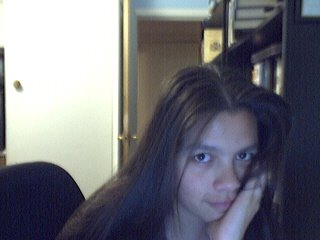
I was going to hold of with the pikchurs, as I've already run down the batteries on my camera, and it's too cold for me to seriously consider walking outside to buy some more. You'll have to be content with shonky webcam pikchurs instead.

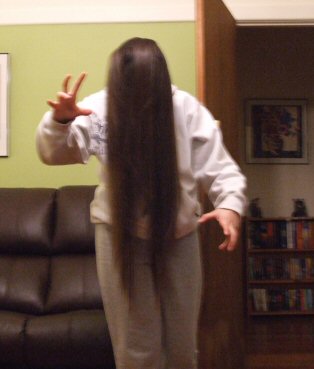
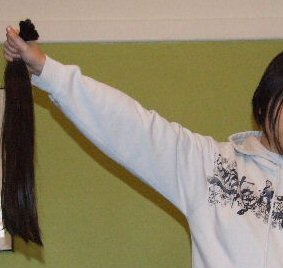
Before:


I didn't realise my hair was that long till I saw this photo. I mean, wow. That's a lot of hair. What are you supposed to do with a mop like that? Do monster impressions on request -


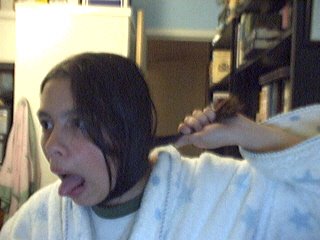
- or strangle myself -


- the possibilities aren't endless.

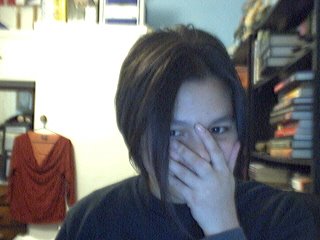
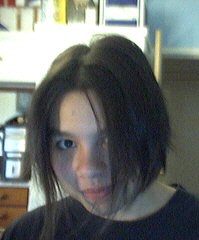
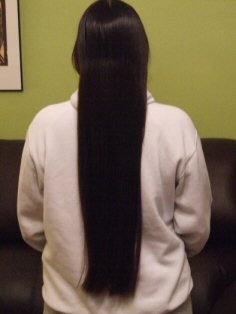
After:


I have emo hair! Or anime hair. And every now and then, I look like a boy (if you ignore those things on my chest).

Things I've learned:

:: I have a back of the neck? I do? I do!

:: Damn it's cold in here. That's what having a back of the neck and not having your own personal hanging blanket does.

:: You can't towel dry your hair, that's just dum- OMG I CAN TOWEL DRY MY HAIR.

:: I turn my head, and I can't feel it in my scalp. My hair isn't moving.

:: 25 years my hair has dictated my movements. The way I put clothes on, the way I sit down, lie, roll over - all these things I do in a certain way to work around my hair. Now I don't have to. Which doesn't stop me reaching around to pull half a metre of hair out of my jumper when I first put it on.

:: Short hair won't stay tucked behind your ears. Dammit.

:: I have too much brush now.

:: Hairdressing salons are strange places. An entire world I've never walked in. I felt like an alien, and sitting in the waiting room weireded me out more than the snip of scissors.

:: My head weighs a quarter of what I thought it did.

:: Product? Oh you're kidding me...

In my head, it was a really big deal. I had short hair when I was born. There are photos of me as a child with shortish hair, only because I hadn't yet been alive long enough for it to grow. 25 year of long hair. No, my whole memory of long hair. No one has ever seen me with short hair aside from my parents. As much as we try not to make our identities physical, I was my hair. People who haven't seen me since primary school recognise me because I haven't changed. Ever.

But when she cut it, and cut and cut and cut it, it wasn't a big deal. I stepped outside, and it really truely was not a big deal. It just felt strange.

So, there you go. I didn't die after all.

Monday, June 05, 2006

Tessa New Year

And lo! It was the Fifth Day of the Sixth month of the Twenty-Fifth Year Of Tessa. Twenty-five years of Tessa On Earth. What a waste of air. Every birthday I reach, I'm suprised I'm still here, moving around, making strange noises. It feels like a triumph, but over who or what, I don't know.

Still, quarter century. Go me.

I spent some time pondering on how to mark this occasion. Chinese New Year involves lion dances (which would be cool, but I have no lions), fireworks (I have no fireworks), red pockets (I have no red pockets), food (hell yes!) and a lot of noise.

Australian New Year seems to involve fireworks (I have no fireworks), barbeques (IT IS SERIOUSLY FUCKING COLD RIGHT NOW), getting utterly smashed and throwing up in the street (I do have some dignity), and lots of noise.

But hey, I like doing things my way, and so to sing in the new year, I indulged in a fair amount of self-mutilation;


I, uh, cut my hair.

Happy New Year.

(I may not have red pockets, but I can give you all this: Drop - by Cornelius. It makes me happy in a playing in the bath sort of way. If you like, JB hi fi are selling the album for $14.)

Sunday, June 04, 2006


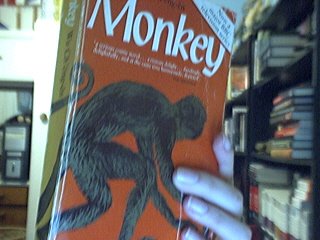
Monkey - Wu Ch'eng-en, translated by Arthur Waley

This translation was first published in 1942, and this particular reprint in 1979. You can see proof of its age by looking at the colour difference between the spine and the cover. Ah, the poor thing, it's faded despite being kept well out of the sun. The recommended retail price on the back is $4.95AUS. I wish.

After finishing Shadows Bite I'd run out of vampire books, so had to turn to the supernatural in general, still seeking out books that wouldn't in any way tempt me to alter my current writing world. I remember just staring at my bookshelves, when I should have left for work a couple of minutes prior, seeing this, and just grabbed it and running. I've been meaning to read it since I was a child. People of my generation talk about growing up on Transformers, Voltron, He-man and She-ra, and the Teenage Mutant Ninja Turtles - I remember them all, but what I adored was the Monkey series that was on ABC after school. Monkey could have kicked all those wannabe cartoons easily (and then be told off about it).

For those of you who aren't familiar with the story (you're not?) Tripitaka is a priest on a mission from Go- Buddha to fetch the holy scriptures from Thunderclap temple in India, and save all the lost souls in China. To aid him in his incredibly long journey, he has King Monkey, Great Sage, Equal of Heaven, Pigsy, Ex-Grand Marshal of all the Heavenly Hosts, and Sandy, Ex-Supreme Commander of the Heavenly Hosts. While the three of them possess all sorts of magical abilities, Kuan-yin, the Compassionate Bodhisattva, couldn't have picked less suitable dweebs. Along the way, they're beset by all sorts of demons and monsters, and Tripitaka has is work cut out for him making good buddhists of his disciples.

Unfortunatly, the first thing I discovered upon reading the introduction was that this particular version was not a complete translation - the entire of Journey to the West is some hundreds of chapters long, whereas this is much abbrieviated, being a mere thirty chapters. Oh well.

I read it anyway, and the cheekiness I thought was a modernisation designed to pander to a current TV audience turned out to be taken straight from the original story. Oh my goodness. All folktales need to be like this. It's so rude and immature, no wonder I loved/love it.

(On second thoughts, most folktales are gruesome and cleaned up for a modern audience. But gruesome is an entirely different kettle of fish to immature/cheeky/mischievious/omigod did he just DO that?)

For example, at one point Tripitaka and his disciples come to the kingdom of Crow-cock, which has come under the sway of three spirits, who in turn have outlawed Buddhism and raised Taoism high. In the middle of the night, Monkey, Sandy and Pigsy decide to sneak into the Taoist temple. They stick the portraits of the Taoist Trinity in the toilet, eat all the offerings, and when the Taoist monks come to investigate all the noise, pose as the Taoist Trinity come to earth. The three spirits see this visitation as a prime opportunity to ask Lao Tzu for some of his life elixr. The disciples decide to oblige them, and on sending them out of the room, piss in three jugs, and hand that over. At which point I was just about in tears laughing, because that wasn't the first time urine featured in the story.

The greater part of this translation concerns itself with Monkey running amok in Heaven. Heaven being something of a great celestial bureaucracy, is in no means prepared to deal with the Great Sage, Equal of Heaven, and falls apart much as bureaucracies do. The Jade Emperor's complete lack of leadership made me giggle, and their inability to do anything other than send more people to fight and lose to Monkey made me giggle more.

Interestingly, while it is evident what unwholesome qualities both Monkey and Pigsy are supposed to depicte, I'm never quite sure what the go with Sandy is. Neither, it turns out, was Waley. The TV series made him something of a wannabe-intellect, a know-it-all who doesn't, but the others are guilty of the same often enough.

(I did love Tripitaka in the book. Every time they come to a river, or mountain, or something that might be difficult to cross, he bursts in to tears and gives up all hope there and then.)

Reading this, combined with an impending nightshift, led me to go out and buy the complete Monkey series on DVD.

Alas, while there was no feeding pee to Taoists, it stands the test of time, and my god, is possibly the greatest TV series EVAH. It has a mad genius that allows for Buddhist teachings among non-stop bickering between the three.

Now I need to get myself a copy of the full translation of Journey to the West, as the transition between Cheeky Monkey to Enlightened Monkey is far too fast in thirty chapters.

Verdict: Great, great fun, terribly amusing. You'd have to have a pretty unfit sense of humour not to enjoy this, and even if you did, there's still a lot to learn about both Chinese culture and history.

Friday, June 02, 2006

Shadows Bite - Stephen Dedman


Now, if I'd know this was the sequel to The Art of Arrow Cutting I would have held off reading it. But I'd run out of junk books, and was still on a vampire kick, and the blurb just rocked, so my reasons not to read it weren't particularly pressing.

Still, it was a stupid thing to do. One day, I will not just know, but understand, that vampires scare the willies out of me, and so NOT start a vampire book in the middle of the night. I got the willies in the first chapter, and got them bad. I slept with the light on.

The basic plot is; a powerful sorceror's son goes and falls for a girl who really wants to be a vampire, becomes one, is kept around because powerful sorceror likes to indulge his son, and because vampires run amok, the vampire runs amok. Los Angeles suffers for it. An attorney, stuntman and photographer who are totally badarse find it up to them to save the day. It's incredibly fun.

Dedman's characters are fully fleshed and potty-mouthed (just how I like them), sad and hopeless and pathetic, and megalomanic and world-domineering, and even those housemates who only flittered briefly through the paragraphs were fascinating creatures all on their own. Everyone is the star of their own movie, and Dedman makes this true.

I was particularly taken with his vampire lore, and the many different types of vampires available. In this particular case, the vampire can feed by drinking her own blood, which in turn takes blood from those she shares blood with, like her parents, or anyone she'd had a transfusion from. It enabled her to kill and create without even going near her family, and came with all sorts of horrible implications that made it worse than just another vampire story. How many of you know who your blood came from? The other side of the country? Eeeee, and so it just spreads and spreads.

Unfortunately, while the whole book was great fun and more than well written, it never quite lived up to those first few chapters detailing The Photo. That photo was creepy as fuck, and I never recovered from it. Creepiness of that magnitude is hard to follow up with, and when it came down to shotguns in a cafe, the creepiness was sadly irrelevant.

(I still believe shotguns are purely for zombies.)

I'm going to have to hunt out the first book now. Drat.

Verdict: Yah, I know these aren't great write ups, but I'm reading faster than I'm noting, so I need them done. This book is great fun, a fantastic oddball take on a vampire story, and fantabulously written.
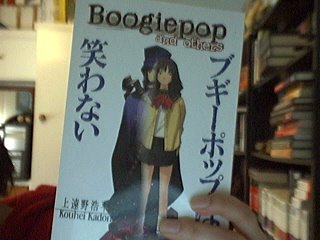
Boogiepop and Others - by Kouhei Kadono, translated by Andrew Cunningham


It's a weird name, I know. Boogiepop is a secret saviour, a knight who comes to the protection of the world when such protection is required. He doesn't exist outside these circumstances; he is a split personality. In his own words, he's bubbles. He floats to the surface now and then. Hence, he's a boogie...pop. Like soda.

It's a weird name.

In this particular case, he floats the the surface of Touka Miyashita, a highschool girl, who does not and never will know of Boogiepop's existance, and all the time she looses to him. As if adolescance isn't hard enough.

I first encountered this in anime form. We were sending the DVDs back to head office in an overstock recall, and I thought 'why not?' and grabbed them. Good call on my part. While the production was lackluster, the storytelling was incredible. Each episode was from the point of view of a different character, detailing an incident that was important to them. Some of the episodes overlapped, and some just passed each other by, so that three episodes later I finally understood what the two seconds of random stranger screaming on a corner actually meant. The story was a jigsaw puzzle to piece together for yourself, and by the end, I had the larger picture. Most of it, anyway. It was different, and challenging, and my god I loved it.

I've been waiting for the novels to be translated ever since then, because there were points I wasn't sure about that I wanted clarified, so I ate this book as soon as I saw it. (And also because I was still on a junk book kick.)

The anime, as it turns out, was following the same storytelling method as the book - each chapter is from a different character's point of view, and not necessarily following them through the same time period. Again, this was occasionally confusing, but the challenge of teasing out the chronology of the narrative was intriguing. It didn't turn me off, it made me work harder.

The writing style/translation was plain and simple, neither a work of art or something to be mocked. Although I would like to state that 'gotten' is not a word. Dammit. Unfortunately, for a book in which there are several POVs, and each of them key, there was no discernable difference in voice between them, something which felt like an enormous wasted opportunity.

One day, I will figure out why japanese school kids are forced to save the world so much.

Did I get the rest of the larger picture? Yes, and no. Turns out, this is one of many novels.

Verdict: Although it isn't the greatest of art works, it will offer any writer an interesting study on storytelling, and what you can get away with not saying. For everyone else, well, you probably already know if anime/manga type works are your thing.
Oh. My. God.

Wednesday, May 24, 2006

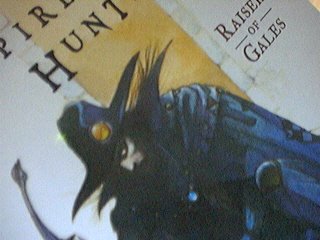
Vampire Hunter D vol 3: Demon Deathchase - by Hideyuki Kikuchi, translated by Kevin Leahy Don't worry, that's not D on the cover; he's too cool to wear something like that. You probably know the drill by now; wobbly writing + wobbly translation = awesomeness. There is a special genius to these books. They have 'it', that infectious creative flare that blinds me to all the other flaws. Some of the time. That flare can't be faked, you either have it, or you don't. This particular volume was the basis of the movie Bloodlust, where I first met D. (I thought he had no personality then too.) It was interesting noting the differences between the two, and there were a lot. For example, in the book Leila, current female lead, is much the same as every other female lead so far. She's beeeeautiful, she's turrrf, she's full of sass and attituded and she don't take no crap from nobody, except D, because she can't help but fall madly in love with him at first sight. She's also in continual danger of sexual horrors, except this time, such threat doesn't come from whatever monsters they may be facing, but from her brothers. I kinda choked when this came out. The Marcus clan consists of four brothers and Leila. One night, they all decided to rape her. I have no idea why. I don't know many brothers who find the idea of boning their sisters appealing, so to find four such people in the one family is a bit high. Nevertheless, they do this. Instead of, I don't know, LEAVING THEM, she stays, and they go around hunting vampires with a happy family dynamic that is not the least bit messed up, and she can't have been that scarred from the ordeal. Fine, maybe it was a one off, only not. They jump her every single time they need to give Grove, who has mad super powers, a seizure. And she still sticks around. They say they need her: why exactly? If it's arousal, wouldn't any woman do? Why don't they just give him handjob? So, yes. Insert a fair amount of disbelief and disgust. This guy does NOT know how to write women, and I worry for those in his life. In the movie, all that has been taken out, and Leila is a more solid and structured character. Who hides her love well. I actually found this very hard to get past. The rest of the book receeds behind that ridiculous bit of characterisation, if that's what it was. The heart of the story is a vampire and a human woman have fallen in love, and are making an escape to a fabled starport, where they hope to find a ship still functioning, and make for the stars. D and the Marcus clan are hunting them due to a comission from the girl's father, although they're not exactly for working together. Thrown into this mix are a few demons of Barborois, who are all for killing everyone, and there you have the essence of the story: everyone fights everyone else. This felt like the weakest of the three I've read, even taking into consideration that the last one was full of fog that I never saw through. Here, it was all just one excuse for a supposedly jaw-dropping fight after another, over and over. By now, I'm well aware of exactly how cool D is, and I really don't need it demonstrated this often. At least in the last there was something of an interesting dynamic between characters. I did prefer the ending in the book over the movie. Much sadder, with much less hope, but it felt right. And to finish on a random tangent, at some point one of the Marcus brothers and Mayerling, the vampire, have a show down in an ant nest. These ants (at least, I thought of them as ants) were especially savage flesh eaters, who would strip your bones before you knew it. But they were called 'mints'. I couldn't help seeing the two of them covered by minties and screaming. Verdict: One day, he'll have a female lead that isn't a mere device for getting his joneses on.

Friday, May 19, 2006

Vampire Hunter D Vol 2: Raiser of Gales - by Hideyuki Kikuchi, translated by Keven Leahy


HE CAN SEE YOU.

Look, this book sucks. It's badly written, and not particularly well translated, and I totally utterly love it. Some shit is so bad it's brilliant. I know it isn't good for me, just like chocolate, but do you think I can stop?

In this book, strange things are happening in the frontier village of Tepes. Ten years ago, children vanished up by a ruined castle, and returned a week later with no memory of where they had been or what had happened to them. Now, vampires plague the village (which is to be expected when reading a book about a vampire hunter), only these vampires can move about in daylight.

Shock! Horror!

I have no idea why it's called 'Raiser of Gales'. As much as that is a great title, it has bugger all to do with anything. It rains a bit, but not because anyone made it rain.

D wanders in, and takes the job. There's a pretty girl involved who (to me) is a right irritating brat, but never the less has this astonishing power to, OMG!, make D at loss for words. 'cause she's pretty. And terrible intelligent. And pretty. She (as with all female leads in these books) is in constant peril of being raped (because all males apart from D are rapists at heart), and is regularly taken advantage of by her foster father. I'm not sure whether or not this is rape, because apparently despite hating it, she can't help but be terrible aroused. I call BULLSHIT. This relationship also does not fuck her up, which I find hard to believe. Her greatest act of rebellion, when being confronted by all these sexual predators, is to stick out her tongue, which must mean something quite different in this world, as it is often more than enough to drive the person having the tongue stuck out at into a VIOLENT RAGE OF INDIGNATION. Seriously. Racial slurs don't have the same affect.

This girl, Lina, is one of those children who went missing, and is of course the key to everything.

Beyond that...this is one hell of a muddled story. It shambles around like a sad lost little zombie, not entirely sure of where it's going but finding some monsters to fight along the way anyway. I believe the end message is that these failed experimental vampires that walk in day were supposed to be a way of saying that even the Nobility knew they were dying out, and were trying to further themselves, but to create a new perfect race of human-vampire hybrids with all the strengths of both and none of the weaknesses, to make everyone happy, because vampires are essentially nice people.

I call BULLSHIT.

It's never really clear who was responsible for what. There are too many mysterious shadows that whisper little secrets but never reveal their identity, so I'm not sure who's what.

Everyone takes the hue of paraffin again, which instead of making me think 'pale', makes me think 'lamp', which isn't a great look. D is gorgeous this, gorgeous that, so pretty that all these red-blooded hetrosexual rapist men want to get in his pants too. In fact, at one point, a band of brigands are frozen at the sight of this "gorgeous God of Death", which had me in tears.

Thankfully, everyone dies. Except D. Because, you know, he's too cool to die.

I will say this; the illustrations are beautiful. Yoshitaka Amano is a striking artist, and his pictures are eye catching, not in the standard anime way. He'll be at Worldcon in Japan, which may or may not have been a deciding factor on my attending.

Verdict: THE SHIT IS BANANAS. AND BANANAS ARE DAAAAAMN GOOD.

Tuesday, May 09, 2006

The Boats of the "Glen Carrig" and Other Nautical Adventures: The Collected Fiction of William Hope Hodgson


Don't ask how long it's been since I read this. I'm terrible. I know.

The collection opens with Hodgson's title novel, The Boats of the "Glen Carrig", which I can only descibe as an odd, quirky, fabulous and strangley pointless affair. The Glen Carrig met some bad luck, and now what remains of the crew and passengers are gathered on two life boats, having finally sighted land of some description. They row and row and row upriver, and find nothing but mud, more mud, some more mud, and strange cabbage trees. At night, strange wailing/sobbing/growling surrounds them.

They find a derelict ship, and use it as a base while they look for water. During this time, they're attacked by some meaty demon slug thing, and angry cabbage trees. It doesn't take long for them to decide they were better off being lost at sea, and make moves to remedy the situation.

The cabbage trees and meat slug are never mentioned again, and absolutely no explanation is given of them.

Once back at sea, the real meat of the story begins, with a storm sweeping one of the boats into the sinister Sargasso Sea, a region of ocean that Hodgson makes good use of, and demonises most brilliantly. The rest of the novel involves the seamen finding a small island amid the giant banks of weed, and how they deal with the terrible creatures that assail them, and their efforts to gain a larger boat, and find civilisation again, if ever.

At first, this was quite hard to read, as Hodgson uses a very old fashioned vernacular, possibly even so when it was first published. Not so much the words that have fallen from popularity, but basic sentence structure. He did things with his narrator's voice that resulted in me reading more than a few lines several times before figuring out what was being said. It took approximately three, four chapters before I became accustomed to this. Interestingly enough, the rest of his stories were far more accessible.

He also, for chapters at a time, gets distracted by technicalities. For example, at some point, the seamen go about building a giant bow and arrow (look, just go with me on this), and he does spend a whole chapter carefully details exactly how this was accomplished. If ever I'm stuck on a dead island with only bits of ships for company, at least I'll know how to build a giant bow and arrow. Just in case.

There's also exactly zero characterisation. Well, that's not entirely true. There are a couple of lines that hint at it. All the seamen remain nameless, being 'the big sailor', or 'the boson', for the whole book. Unless they have no identifiying features whatsoever, at which point they're given single sylabell names so that when they die, the reader is aware of exactly who did the dying. At one point, the boson gives the narrator a pat on the shoulder, because he was brooding on a cliff top about being stuck in the middle of a weed-strangled ocean on a dead island, and that right there is the height of characterisation. Silverberg wasn't entirely wrong, however, because anything more than that would have got in the way of the nasty squid monsters/exploding mushrooms/angry crabs/derelict ships/etc.

Their final escape from the Sargossa is sadly anticlimactic, but the narrator gets to keep the boson, whom he was quite clearly in love with, calling him the greatest of men every other paragraph.

Don't get me wrong, I had fun with this.

Following the novel was a collection of further short stories Hodgson wrote based around the Sargossa Sea. Given they all involve ships becoming trapped in the weed and being unable to escape, with the passengers unable to leave the ship lest they be eaten, these stories tend to be very lonely, hopeless affairs, full of menace and threat. Although all people stranded in such situations appear to show a great degree of resourcefulness, their every action is nevertheless overshadowed with futility. These are not stories that uplift the spirit.

I would like to take a moment to recommend everyone read one specific short story, being From the Tideless Sea Part 2: More News from the Homebird, a very creepy and unsettling story. Read it, and then ask yourself, 'are crabs scary?' Aye! They are! Ye who doubted my giant crabs, repent! Repent!

I wasn't sure how much further I wanted to continue, having been throughly mired by the Sargossa Sea, so thankfully the next section was entirely different. The exploits of Captain Gault were, and possibly will always remain, my favourite of Hodgson's work. A series of short stories detailing the adventures of Captain Gault, one of the greatest smugglers of all time. He makes Han Solo look like a rank amateur. All his schemes involve a great deal at stake, and the authorities, who have never actually caught him, desperate to finally nail him. And yet, despite their greatest efforts, Gault always prevails. And he always, always, always lets the authorities, specifically the one main officer he has managed to hoodwink, know exactly how easily they were fooled, because he's an arrogant smug smarmy bastard like that, and I absolutely totally developed a crush on him. If you read these stories, you'll start crushing on him too.

(That said, the last story involved him fighting Nazis, which was....odd. They were the nicest Nazis I've met in fiction.)

These were followed by the not quite as exciting adventures of Captain Jat, who I didn't really like, and his sidekick Pibby Tawles, the ship boy. Desert islands populated by mutant animal savages and buried treasure, oh my! Not quite as much love for Jat as, when it comes down to it, he was an idiot. Stealth does not involve yelling in outrage. Pibby, cunning little rat, I had plenty of time for.

Lastly, two stories of Dot-and-Carry Cargunka, who was much like Gault, a terribly amusing character. Born lame, he runs his own ship, and takes the position of cook so he doesn't have to pay anyone else to do it. He has quite the love for Lord Byron, and fancies that the two of them are kindred spirits, in more ways than one. That said, as amusing as Cargunka was, the stories themselves didn't grab me. Unfortunatly, it's been so long since I read them, that I'm not sure I can remember why.

I'm out of practice writing up books. Sorry this sucks so much.

I can't help thinking of Hodgson as being like Lovecraft Lite, with Seawater, an impression that I know is soley based upon the Sargossa stories. In actual fact, Hodgson is a much better writer than Lovecraft (don't hit me), and has a greater repertoire in his stories. The lack of characterisation in his Sargossa stories he more than makes up for with his various captains, and he uses his personal knowledge of the sea and sailing well.

I love me some weird shit. I love me some Age of Sailing. And I love me some captains. I'd recommend you get this collection even if you only read the Gault stories.

Verdict: Salty sea dogs! Nyaaaaaaaaar! This be bootay, aye! Not everyone's cup of tea, but if so inclined, well worth it.

Saturday, April 29, 2006

Metal Rooster: an Orderly Thing of Beauty

Feb 8, 1921 to Jan 27, 1922
Feb 5, 1981 to Jan 24, 1982

Rooster is often seen as the original strong silent type, not unlike the Humphrey Bogart and Greto Garbo prototypes.


Heh. Hehehehe.

Most people consider them quite eccentric. Sad to say, relationships with other people are often strained.

I know. What can I say? I'm an arsehole, and an eccentric one at that.

They are quite moody and can be too outspoken.

Moody, yes. Don't know about outspoken. Possibly only in the written word. You know, with shift work being the way it is, there are days I realise I haven't said anything to anyone other than to ask a supervisor to delete something.

Although, there has been mention of a Tessmonster of late, who is apparently quite fierce and kind of scary.

They are often self-centered, but can be quite brave when the situation calls for it.

Yes! Self-centered! Braveness depends on situation! I shall certainly fight to the death for that red bean bun!

On the other hand, Rooster People are quite talented and capable. They are always devoted to their work and have a reputation for being the hardest of workers.

Yeah. For the wrong reasons, unfortunately. I go hard at work, so that I can a) say I'm better than all these other people doing the same job, and b) possibly get a pat on the head. Competitive. King of the castle.

Rooster People are deep thinkers and are pioneers in spirit.

HAAAAAAAAAHAHAHAHAHAHA! Whatever.

They can experience the greatest of joy in complete solitude. Even though often alone, they rarely experience loneliness. Instead, they enjoy their own company and feel solitude helps them in their quest after knowledge.

I don't know about my 'quest for knowledge'. I just don't like people. That includes you. You suck. And you smell like beans. You're adopted, and now I'm sending you to go live with your robot foster family.

(Mostly, I'm just hiding.)

Shark-tail Soup and fortune cookies are among the keys to good health.

I'm not sure what this has to do with anything. While shark fin soup is most scrumptious, it's also expensive.

Sometimes this one walks around with its head in the cumulus clouds, higher than the stars.

It's called daydreaming. It's called continual internal escapism, with a side order of idealism. (Have I not told you that despite my short stature, I am a great towering intellect?)

You see, this rooster struts around with peacock feathers and they never ever ruffle.

Wrong. My feathers ruffle very easily. It's their nature state.

So much arrogance can make it hard to get along with others, especially when the Rooster is also intolerant of those who are less talented and a bit slower than normal.

Yep. It ain't attractive, but I'm aware it's there, and try to smother it. Although I tell people I'm a nasty person, I'd like to try and be a nice one.

On the other hand, the Metal Rooster is extraordinarily talented. Of all twelve Zodiac signs, this one is probably the most high-minded of them all, with a very clean line of thought.

AAAAAAAAAAAAHAHAHAHAHHAAAAAAAAAAA!!!!!!!!! HAHAHAHAHAHAAAAAAA!!!!! AAAAHahahahahaaaa...hahaaaa....ha...aaah.

Clean line of thought my arse. For that matter, I'm not entirely sure what 'high-minded' actually means.

The Metal Roosters can distinguish right from wrong very clearly and it doesn't matter which direction they pursue, they always wind up going the right way. If they confront a maze, or big problem, they will immediately see a solution because of their analytical, logical way of thinking.

Well, that's a giant pile of horse shit, that is. Right and wrong are rarely so clean cut, and if I always wind up going the right way, then why don't I own a castle in the mountains with a bat cave and all the space I could possibly want for my books? I'm a 24 year old with a useless university degree doing data entry, I don't own a car, and I still live with my parents.

And I haven't finished writing a book. Any book.

Through their perseverance, any hurricane becomes an orderly thing of beauty, just like that!

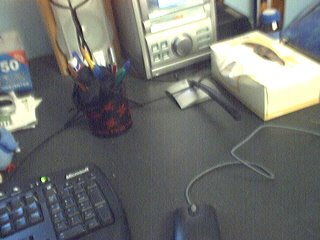
Okay. So it took me an hour to tidy my desk. Behold!


An orderly thing of beauty!


You don't believe me, do you? Look closely at those pictures. Notice something? Like, the surface of the desk is actually visible?

When it's time for romance, the male Metal Rooster has no trouble at all, love just abounds; the female has a tendency to keep to herself, making connections less freely, but lastingly when they happen.

Uh huh.

Saturday, April 01, 2006

As [not many] young girls do, I went through an astronomy phase. Space was great, space was awesome, it was all happening out there. I read up all the over-simplified and not actually true information on black holes and red giants, and felt terribly claustrophobic pondering the fact that I'd never get off this little rock called Earth.

Then, I found out the universe was expanding, and everything was going further away.

That crushed me, as only 8 year old girls can be crushed. Eventually, there would be no more stars in the sky. (As I hadn't thought it through properly, and while the universe may be expanding, the galaxy isn't.)

Then I grew out of astronomy, and moved on to horses and dolphins, as a great many young girls do.

Now I'm a big girl. Possibly I'm even a woman. When I walk home in the middle of the night, the street lights, building lights, house lights, car lights, drown the stars, and I can barely see any in the sky. They don't have to run away, we're pushing them out of the night all on our own.

And this crushes me, as only a 24 year old girl/woman can be crushed.

Thursday, March 30, 2006

Mountains and Molehills

It isn't eventful here on Planet Tessa at the moment, thus 'breaking news' isn't going to be riveting, must-read blogging.

It involves getting more excited about my payslip than my pay.


My last payslip stated my annual salary was 29somethingK. Now it's Officially More Than That. Sorry for harping on about it so much, but there's just something absurd and amusing about pay raises getting thrown at my lap for no effort on my part. It's just data entry! Admittedly, ridiculously complicated data entry that does take months of training, but data entry is data entry. $17 an hour instead of $14.

You know in my last job, I was getting $20 an hour. And 6 hours a week. Ha! No amount of money would make me go back to retail! NEVER! (Except, you know, if there's no alternative. Or it's a bookshop.)

Afternoon Delight

See, this is the part I lurv about ordering items from far away. It means coming home to a surprise package on the bed. It's a mini-birthday! Except without cake, and no one is giving me presents, I paid for them myself, which makes it a pretty sad present.


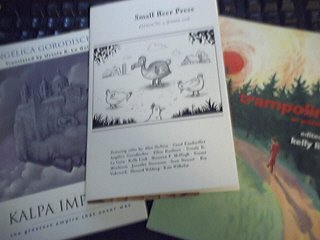
These I ordered about mid-February, from the Small Beer Press sale. I shouldn't have, but with on $7us for air mail, golly gosh, I'd have found something to buy anyway. Unfortunately, their sale was so popular that they ran out of books, and had to wait for restocks before shipping mine. Congratulations on a sale that works, I say. I schnaffled Kalpa Imperial (which has been on my wishlist for who knows how long), and Trampoline. Due the fact that I'm not going through a reading phase right now, they have been consigned to the shelf, where they shall sit for an unknown amount of time. Looking at me.

Haha!

At last! Amazon has paid attention to all those "I own it" boxes I ticked, and has stopped trying to sell Lone Wolf and Cub to me. It was all, "Oh, you have vol 15? Well, how about 7? No, what about 23? You own that to? Well, how about-" and so on.

The Insecurities of a Mongrel

Around pay day I like to treat myself to some munchies. Specifically, I wander into Melbourne Central and get myself a red bean bun, and some honey dew milk tea with pearls. And as I'm wandering around with my milk tea and my bun, I can't help thinking that I'm a poser. I'm not real Chinese. I'm just faking it. All the true Orients are laughing at me, toddling along with nothing but an Australian accent in my mouth, and some Cantonese picked up from watching too many kung fu films. (Because being able to yell "NO SHADOW KICK!" is essential to international communication.)

I'm willing to bet your standard totally completely NOT Chinese person doesn't have any of these hang ups over food.

Weeeeeeeeeeeeeee!

I felt great the past two weeks. Migraines aside, everything was chocolate cake. Nothing was hard, nothing was upsetting, there were no triggers, and nothing was triggered. The easiest indicator that I'm doing better than okay is I think about sunshine a lot. Strange, but true, and really nice.

I realised this might have been because I was getting enough sleep. Two weeks of afternoon shifts, two weeks of getting up in my own time. Brilliance. But then, haha, yesterday and today I had a quick change over. That means starting at 3pm, then then next day starting at 9am, and then today starting at 7am.

And I didn't do so well. Nor do I entirely understand WHY I had a quick changeover, considering I start nightshift on the weekend.

What's even more confusing is I don't understand why I didn't notice this when I got my roster, think 'wow, that's going to make you cry', and then, oh, I don't know, SWAP OUT OF IT.

TESSA! YOU MAKE NO SENSE! WHAT IS WRONG WITH YOU?!

("I'm sorry! I'm tired! Everything is funny right now!")


My Art Suffers For Me!

Since the migraine-asaurus paid me a visit, I haven't written. It made me a bit leery of all computers actually, and although I know it isn't entirely true, I can't help connecting writing with intense pain. Even now I keep taking little 30 second breaks to go and, I don't know, look at the wall. Just in case the migraine-asaurus is watching.


And thus ends this not-news bulletin from Planet Tessa. Rock the kazbar.

Thursday, March 23, 2006

Sir Tessa: Hey World.
World: You! Off! Fuck! Intervention order says you can't come near me, especially not after that hedgehog incident!
Sir Tessa: Yeeeah. That was pretty funny.
World: Yeah! Only, NOT. What do you want anyway?
Sir Tessa: Despite the fact that I've been messy in the head recently, I feel I should acknowledge that you haven't been mean to me.
World: That would be because I have an intervention order telling you to sod off.
Sir Tessa: Sorry about that.
World: Ha.
Sir Tessa: You really are a nice place to live.
World: ...
Sir Tessa: That's all. I'll be going now.

Saturday, March 18, 2006

I worked the phrase 'giant space sphincter' into my story.

There is nothing left for me to achieve today. I may as well go to bed.

Wednesday, March 15, 2006

THE MYSTERIOUS FLAME OF QUEEN LOANA - Umberto Eco, translated by Geoffrey Brock


I wish I could say I liked this book, and thus have some sort of claim to literary taste. But it frustrated the bejeezes out of me, so I can't.

I started reading it at about 1am, when I was in one of my more distraught frames of mind, and it was wonderful. Yambo wakes up in hospital, and although he can remember such things as toothpaste, how to use a fork, the works of Shakespeare, he has no memory of himself. His memories of the world remain, but nothing of his life. Although it is never said, hints throughout the book lead me to assume he had a stroke. It is beautifully done, a lovely blend of familiarity, curiosity, and yet being entirely adrift in a world that knows him, but which he doesn't remember. There is no threat in this unknown world, no fear, menace or danger, and with the guiding hand of his wife, Yambo comes to one mundane little delight after another. These ordinary things that he now, as an adult, experiences for the first time. The joy he experiences from discovering how it feels to clean his tongue with a toothbrush is one of my favourite scenes in the book.

But it isn't enough for him to pick up his life, he needs to rediscover who he is, was, might be. And so his wife sends him to his childhood home in Solara, so that he might go through all the detritus of his past. And so begins the seccond section of the book.

It is this second section that had me gnashing my teeth. While the first section swept me off my feet and left me feeling calm and excited at the same time, the section left me nothing but bloody impatient. Yambo spends his time eating salads, and rummaging through the boxes in the attic of the estate. It is his 'paper memory', all the books he read as a child, his school work and badly written poems. I felt I should have enjoyed this section, as discovering what makes a person who they are is something of an obsession of mine.

But.

There was no coherance. Yambo goes through his paper memory as we all do, picking up whatever catches our eye, again, and again without creating a structure. It was infuriating. Fog is a theme prevalent throughout the book, and this felt like reading in fog, with a whole lot of not going anywhere involved. I tried to approach it from another direction, and stead of learning about Yambo, learning about some of the recent history of Italy, but that too failed. Now I am possibly more ignorant of Italy than ever, as I have some pieces of a jigsaw, although possible not from the same puzzle. I gained no knowledge, only a deeper understanding of my ignorance.

It reminded me of year 12 specialist maths. It was like trying to understand physics all over again. I never did get the hang of physics.

Thankfully, he goes and gives himself another stroke, and so begins the third section

Here, in that fleeting second of brain spasm, Yambo remembers everything. All the questions he discovered in the first and second sections are answered, and my flagging interest picked up, but only so much. The fog finds its source. And Lila just explodes on the scene; she who was his childhood crush, one of those crushes that follows you for life, that you end up comparing every partner to, she, introduced TWO THIRDS of the way into the book just takes over. It stops being about Yambo finding himself, and is entirely about him trying to find her.

It has its moments. It is beautifully translated, so much so most of the time I forgot that it was a translation. The pictures provided add all sorts of layers and textures to the writing itself, and there are some lovely moments of revelation.

But ultimately, I felt like I was standing in fog. Frustrated and blind, and going absolutely nowhere.

Verdict: So, I think this one passed me by.

Monday, March 13, 2006

FITZPATRICK'S WAR - by THeodore Judson


OMGGREATESTBOOKEVAH!!!!

For those of you who possess the stamina, courage, will and fortitude to actually read and finish my book postings, you already know what this post will say. A good amount of brain frothing on my part, which will make up for the lack of coherance. You'll nod your head, and say, "Ah yes, Sir Tessa like that book so much she had its babies," and go about your business.

Coherance factor lowered by four morning shifts in a row. And a towel on my head. I just can't think with a towel on my head.

This book is an historical analysis of the memoirs of Sir Robert Mayfair Bruce, who lived through one of the bloodiest wars of history, which despite being victorian/colonial in mindset and steam-powered, is some centuries in the future.

It has footnotes. Therefore, it must rock the kazbar.

The footnotes play an important role in the story, as instead of being an interesting aside about the history of the world, they provide an excellent juxtaposition of Sir Robert's personal experiences and views, and that of what History Says Is True. As the memoir is first person from Robert's point of view, we cannot help but emphathise with him, and the myriad of predicaments he faces, which in turn gives the reader a strong bias. We're on his side already, which always makes it just a bit harder to admit any flaw or mistake in a protagonist. Fortunately, the historian doing the analysis sits side by side with us, and with his useful little footnotes (it is most certainly a he, as such an exercise is well beyond the capability of a mere woman) points out exactly where Robert is wrong, is lying, and is downright blasphemous and heretic and should have been impaled for even thinking such a thing.

As much as Mr Footnote was downright annoying in his inability to entertain a 'what if', he nevertheless provides a very good insight to the workings of society; regimented, conservative, narrow, rigid, and bigotted to the point of hilarity.

(It was in Mr Footnote's introduction to the piece that I realised where I'd gone wrong with a short story of mine, which also endeavoured to swim around in a colonising mindset, and all the discrimination that comes with it. When dealing with characters that are racist, religionist, sexist, and everything-that-isn't-them-ist, the trick is to hold no punches. Don't be afraid of offending the reader - go all the way, and make that mindset, in all its seriousness and well meaning ignorance, a total joke. It makes fun of itself without even trying. Not that I'm quite game to try such a thing yet. Possibly why I enjoy stories styled as such; the absurdity of it all is so ridiculous it makes me giggle.)

(I'm pretty sure giggling is frowned upon.)

Robert is one of Fitzpatrick the Younger's chosen friends, which in this case means not just being part of an elite clique at school, but being bribed and bought with easy passes in said school, then being showered in promotions to ensure he does in fact build this mildly illegal airbases in good time, and then further showered with medals and awards for saving said airbases from being blown up when the war started, and by then, he was so far in there was nothing else he could do but keep holding his tongue.

It isn't a nice war. It's the sort of war that, should I ever be in a position to rule the world via hostile take over, I'd hope to wage. Brutal. Nasty. Efficient. Over in the space of a few months. Although the war was just the beginning of Fitzpatrick's downfall. In the aftermath, he took his whole empire down with him. And Robert sat by, and held his tongue.

Although the book could be swamped with moral lessons, (and thanks to Robert's brilliant wife Charlotte, is to a degree), it has draws no conclusions. Although Robert is consumed by guilt regarding everything he did and didn't do, he's not a bad man. Nor, given his actions and decisions, is he a good man. He is just a man. I like to think he was a kind one.

The relationship between Charlotte and Robert, while utterly lovely to read, irked me. Just around the edges. It's just one of those personal 'meh!' reactions to books that portray women as being strange, mysterious, enchanting and controlling creatures which men completely fail to understand. And yet, it was a beautiful relationship, and as a pair they worked perfectly, in terms of their lives and for the story.

However, my favourite character was Winifred Pularski. A complete thug of a man with a metal arm and a natural aptitude for killing, Fitzpatrick allowed him into his inner circle purely to act as a body guard. Too simple and loyal to ever betray him. He's a murderous brute. And such a lovely gentle man. It sounds a cliche, the killer who is actually a kitten, but Pularski was wonderful. He loved to fish, but wouldn't use hooks because he didn't want to hurt the fish he caught. He'd stroke them, in love with them, before releasing them. He loved Robert because Robert didn't buy him, but was a true friend. In a world almost entirely developed, he longed to see a tiger. He'd protect Robert, and Robert's wife, yet still assassinate for Fitzpatrick. He was such a nice man. My favourite gentle murderer.

Alas. The footnotes need EDITING! And CHECKING! To ensure they fall on the right page, aren't riddled with spelling errors, and if they reference another footnote, check that footnote actually EXISTS. I never did find out what the 'not men' were.

I cried in this book. I did my school girl giggle. I fell in love, fell in hate, and had too much fun with footnotes. There were dirigibles! There were steam powered battle ships! It was great. You should have been there.

VERDICT: You want this book. No, really, you do. You like Victoriana, steampunk, secret societies, world wars, and the downfall of empires. The footnotes want you baby, they want you bad.

Saturday, March 11, 2006

SADNESS

Today contained no triggers. Nothing. But I feel sad anyway.

Sadness is not depression. Depression is uglier. Sadness is softer.

But if I don't know what causes a mood, then I don't know what to do about it. I've sat and stewed for some hours now, and managed to figure out that I feel as though I've lost something. I couldn't tell you what.

Sadness is -

A wee little blue goblin with long droopy ears, soft little paws, and dry eyes that will never smile. She says not word.

- just sitting on my shoulder, patting my hair with her soft little paw. When I asked her why she was here, she just nodded, and pat pat pat.

Wednesday, March 08, 2006

SCHWING

Yesterday, I saw a naked man.

Naked men don't feature largely in my life, so there was a certain amount of snorting and giggling involved, being that I was on a train, and he was walking down the sidewalk of a street alongside the train tracks. He seemed quite happy, in that he was striding wide and swinging his arms with much gusto.

And then, because I've been in my job too long, I thought-

WILFUL AND OBSCENE EXPOSURE IN PUBLIC PLACE

-which is offence code 139somethingsomething, and proceeded to write the narrative:

BATAD RP obs u/k off walking easterly along street beside trainline b/w 4gb and 4mm. off obs to be totally naked. off n/k to rp. Nil other wit, nil susp. Nil further. Enq pending.

I probably should have actually reported it. There's a lot of elderly folk along that road. Wouldn't like to think any of them had a weak heart.

Friday, March 03, 2006

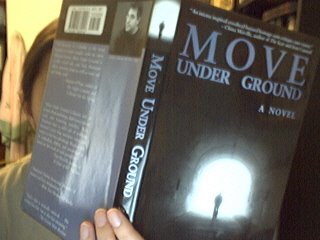
MOVE UNDER GROUND - NICK MAMATAS


I got this book.
Only, I didn't get it at all.

And thus I put off writing it up, for fear of making myself look foolish. Then I posted that ninja pic, and the whole foolish aspect seemed rather pointless.

R'lyeh has risen, Cthulhu is dreaming loudly, and all the world has gone to shit. Jack Kerouac, a writer with a loose grip, traipse about what is left of nonsense America looking for Neal Cassady, who may or may not have the fate of the whole world in his pocket. William S. Burroughs comes along for the ride.

That's what the book is, but I'm not sure I could tell you what it was about.

It's a little piece of brilliance, I know that much. That, is a voice. A well sculpted and consistant and unique voice that will hang around narrating your life if you let it. Without that voice, the story would just dribble away. The lines on the back say its bebop, jazz and the like. I liked it. At first, it seemed it was all telling, and then so much telling that I couldn't pause to take a breath and was drowning in this weird funky world, but by then it didn't matter. It had started, and wouldn't let me stop reading.

(I have occasionally been accused of keeping information from the reader. This book does that, and does it very well. After all, what is there that you can really be certain of when the Elder Gods come knocking?)

There were moments when it reached wonderful leverls of absurdity, with Jack throwing Bill at trains, Bill poking around the edges of an orgy, the little devil bugs screaming "Nooooooo!" as the bug spray of the end of the world hit them.

But I still didn't get it. I'd guess it is because I've never quite grasped what the bohemian/beatnik movement really meant. I've never quite been able define it to my satisfaction, and I probably never will, because I missed it entirely. As a result, I can see entire layers of cake that just passed me by.

Possibly I don't get America, either.

Cthulhu, however, I get. Got all that, and adored it. Throwing the map out the window was fantastic. The portray of actually walking through such an event was great, really great. Perhaps I'll be a mugwump when R'lyeh rises.

Verdict: Good book? Yes. Mildly obfusccated? Yes. Does it matter? Hell no.

Monday, February 27, 2006

Context

I've had this post sitting in my drafts for a week. I've added to it, removed from it, had my finger hovering over the delete button and the post button alternatively. First worried it was too personal, then that it wasn't personal enough, and at last that no one cared any way. Doubt, second-guessing, insecurity, etc.

I made this blog, all those years ago, as a place to vent. A place I could say all the things I will never ever say. Hence the title. It's not so easy to do now, given most of you reading this actually know me. There are a great many things I'm not saying that I really, really, really, REALLY need to say.

I know what happens when I let silence rule me. Silence is yet another of those goblins that harass me. So this is venting. You all know someone who isn't a happy person, and this is a little bit of what it's like. Give them a tap.

Suffering From Depression vs Being Depressed

I have been discussing depression with a couple of friends recently, and was informed that apparently there's a difference between being depressed, and suffering depression. I didn't realise, although if I had thought about it for long enough, it should have been obvious.

Everyone, at some time in their lives, becomes depressed. No one has a good time all the time.

That doesn't mean one suffers depression. Being depressed, even for those suffering depression, is usually circumstantial. After a while, the circumstances go away, and the depression does to.

For me, being depressed is-

DEPRESSION

A grey, wet blanket. Wool, so it is heavy, and scratchy.

-which differs from person to person. For Winston Churchill, depression was a black dog that followed him around.

Suffering from depression means that that grey, wet blanket never goes a way. It sits just there. Every. Single. Day.

When depressed, it covers my whole head, so that I can't see or hear, I can't speak, and sometimes, I can't breathe. It's paralyzing. On the good days, it pulls back to just sit there, being heavy, cumbersome, but not in the way. But it never goes away.

It means that, on the good nights, you have trouble sleeping, and on the bad nights, you can't sleep because you're crying, and have been for hours.

It means on good days you're enjoying yourself, having a glimpse of what it feels to be a normal person, and yet waiting for that one look, pause, sentence that will ruin it all and bring you back down. And it does.

It means you spend a lot of time avoiding people, because people hurt you. Never intentionally, but you're sensitive, and you can hear everything that isn't said as well as the many inflections of what is said, and you can read between lines to entire universes that don't exist, and the strength of your insecurity and doubt has the power to destroy even the happiest of bubbles.

It means you spend a lot of time in your head, to hide from these people who mean you no harm. You take refuge in your warmest memories, and then, because you cannot help yourself, you systematically tear them apart, and poison them with doubt, and tell yourself that it never meant anything to anyone else but you.

It means you know yourself well, very well. You get tired of your own company, and when you're not avoiding all contact with the human race, you're obsessively checking your phone or email, to see if anyone feels any need to acknowledge your existence.

It means when you need help, you're incapable of asking for it. You sit there with the phone in your hand, staring at the wall, playing through your mind all the conversations you might have with all the people you could call, but you don't. You say it's because you don't want to impose, but really, it's because you're terrified they won't understand, or won't care, and that the slightest rejection will make you crumple.

It means you look at the days, weeks, years, decades, minutes of your life stretching out before you, and the sheer length of it sucks the breath from your lungs, because the thought of having to go through every one of those days is crushing, is more than you can handle. So you don't think about it.

It means on good days you don't like yourself, and on bad days you hate yourself.

It means when people ask 'how are you?', you give nothing answers, 'okay', 'alright', because the truth takes too long, and no one wants to be burdened with someone elses darkness, and they never know what to say anyway.

It means you carefully push your friends to arm's length. Words are so very cheap, and not matter how well meant, words don't mean anything to you anymore. So you'd rather nothing was said.

It means you need some sort of acknowledgement that you're not a worthless sack of meat as much as you need air, because you can't convince yourself otherwise.

It means you're constantly tired, because every day is one long battle with yourself, to not assume the worst of the world, to acknowledge that it isn't personal, to remind yourself that there is nothing wrong with your life and you have no reason to for all this anger, and hatred, and misery. And why are you crying on the train?

It means you're strong, because you've had to carry a heavy burden for a long time. But its a strength like glass; easy to see through, easy to break. There is no armour thick enough.

It means you spend most of your life alone, because you're afraid of what the world might do to you. You're hard to get to know, so a lot of people don't try.

It means the walls are always up. The walls are always down. You're nothing but contradictions, and no one knows what the weather is like in your head from one minute to the next.

It means you see life as an ocean. Everyone else seems to have a boat, and they coast about on the surface as if it were fun. You lost your boat. Perhaps you never had one, and now you're in the water, and every day you struggle to keep your head above water, with this grey, wet blanket tangling you up and dragging you down.

Somtimes, it means you drown.

Someties, it means you're very good at treading water.
Wednesday, February 22, 2006

PMS [demon] -

No one knows what colour she is, as she is always covered in the Blood Of Her Enemies. She doesn't speak, but screams.

  1. The PMS card, once played, cannot be used again for one month.

  2. When PMS is in play, the player takes a negetive fifty penalty to Charisma, Fortitude, and Happy Beans.

  3. When PMS is in play, INSECURITY receives a plus fifty bajillion bonus to attack power.

  4. If the player chooses to invoke chocolate, PMS has decreased attack power by thirty percent for twenty minutes. After that time, PMS regains full attack power, and INSECURITY receives an additional ten percent bonus due to feeling guitly for eating chocolate.

Yep. I'm feeling that fifty bajillion extra attack power.

(Promise I'll stop messing around with my demons and make a sensible post soon.)

Monday, February 20, 2006

INSOMNIA [noun] (phonetic AAAARRRGGGHHH!!!): a small goblin, white and pasty skinned, with spindle limbs, an enormous fat gut, and a mouth that takes up more than half her head. It is the sort of mouth that indicates should you displease her by going to sleep, she will eat your face. INSOMNIA sits on a would-be sleeper's pillow, and talks to them, all night long.

INSOMNIA has been an unwanted guest for three nights.

EXHAUSTION: [noun] (phonetic ...mmmrrgh): a small goblin, mushroom mouldly brown in colour, totally emanciated. Big bags and shadows under eyes. In fact, face is all eyes, bloodshot, somewhat twitchy. EXHAUSTION exudes a definite air that does not require you to look at him funny for him to shank you with his shiv.

On the third night, EXHAUSTION crawled out from under my bed.

INSOMNIA gave EXHAUSTION a funny look.

EXHAUSTION went super saiyan and evolved in to TOTAL FREAKING EXHAUSTION, and shanked INSOMNIA with his shiv.

SIR TESSA promptly fell into a coma.

Friday, February 17, 2006

Viator - Lucius Shepard


Fabulous cover, isn't it? I am quite in love with it. Nightshade do make beautiful books. The novellas especially, as this one is, are lovely to hold. It fits so nicely in my hand, with good weight, but not too much. The pages are nice to touch, and they even imprint the naked hardcover.

Originally, I'd started to read this book in the middle of a night shift. Shepard writes damn long sentences, and I mean long. They take up the whole page. He has control of them, and it isn't hard to follow them, but it was way more than I could handle at the time. So, take note: don't read on night shift.

VIATOR is the story of a ship of the same name, whose crew abandoned her, and whose captain went made and drove her into the coast of Alaska, ploughing on at such a speed that only the very stern of the ship remains on the beach, the rest of her steel carcass marooned high in the forest.

(I loved this book just from the blurb.)

Wilander is hired to join a ragtag crew of men who are assigned to the landlocked ship, to evaluate her worth in order to be stripped. They're a bit kooky when he arrives, and throughout the book descend even further into kookiness.

But Viator is not all that she seems. Something is happening with the ship, something violent and mysterious and wonderful. Not content to be cannablised, she is changing herself and those who crew her, and although trapped on land, she is still travelling, pushing her way through to somewhere else.

Wilander strays between Viator and the town of Kaliaska, between an alternate reality and one that is all too real, between his derranged crew members and the woman who could ground him in his life, in his soul.

Shepard is brilliant in shifting Wilander and the reader from what is familiar and sane, to what is unfamiliar, yet seems to make more sense. He exercises impressive control over narrative tension, and builds it up at a perfect rate of knots, exactly what is needed for the story at any given time.

I felt somewhat alien from his characters, even Wilander whom the story rides on. Perhaps, methink, this is because they're mad.

In fact, Viator herself was the character I loved most. She had grace, that banged up old ship, grace, strength, courage and cunning. And most of all, she had mystery. Not necessarily menace, but mystery.

Unfortunately, the ending sucks. After the breath-stealing build up Shepard had woven, the end was as exciting and as satisfying as scooping wet fluff bits out of the washing machine. According to a thread on the Nightshade boards, he was in dire straits himself when writing, and didn't have the capacity for anything else in him. This I can understand, but doesn't make the fact any less disappointing. Apparently, Nightshade will be releasing a paperback of the book later this year, rewritten, with an additional 10k. I am as yet undecided whether or not to acquire it, as I'm not entirely happy with the thought of buying a book twice, even if the story is changed. I've already read it once.

Verdict: A very powerful book, one whose images will stay with you for some time. Just...pity about the end. Real pity.

Thursday, February 16, 2006

EXT. STREET. DAYTIME.

Enter right, SIR TESSA, going about her daily business, whatever that may be. She pauses and waits for an opportunity to cross the road.

SIR TESSA
...


Enter right, INSECURITY, cloth in one hand, chloroform in the other. INSECURITY soaks the cloth in chloroform, pounces on SIR TESSA from behind, and clamps the cloth over her face. SIR TESSA makes the appropriate surprised noises, and then passes out.

INSECURITY cavorts.

INSECURTY produces cuts SIR TESSA open, climbs inside, and sews her up from within.


LATER. EXT. STREET. DAYLIGHT.

SIR TESSA wakes up. Sits up. Gets up.

SIR TESSA
...what was that?


Exit left, SIR TESSA.

Sunday, February 12, 2006

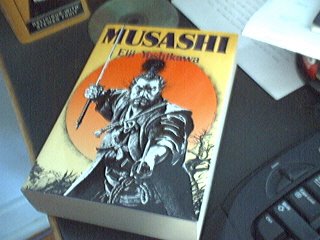
MUSASHI - EIJI YOSHIKAWA, TRANSLATED BY CHARLES S. TERRY

(Originally, I tried to get my hair in a topnot, as pictured on the cover. You'll just have to do without, as I have too much hair, and not enough hands.)


This is the second time I've tried to write up this book, and I'm not sure I'll succeed. There's too much contained between the two covers for me to handle, because I'm not a reviewer, just someone who gets excited about books and feels the need to share/inflict this excitement.

This isn't a story, it's great handfuls of stories that end, start, twist, change, mature, overlap, entwine, split, and makes it just about impossible for me to provide any sort of overview. But, I shall try.

It begins in the aftermath of the battlefield of Sekigahara, with Takezo and his friend Matahachi lying among the corpses. They were not on the winning side, and there are limited options for the losers of great battles, being branded as traitor to be killed on sight, and having not a scrap of honour with which to return home.

Their paths diverge; Matahachi runs off with a praying mantis like widow and her daughter, despite being betrothed to the beautiful Otsu back in his village. But the widow Oko doesn't care for him, merely understands the need to have a man about the house in these times, and after breaking his engagement with Otsu and thus disappointing his mother, he cannot return home. He sits in the back room, and drinks sake. At some point, he finally plucks up the courage to leave, but instead of making steps to amend his wrongs, he goes on to pursue some imaginary easy life of money, sake, women, and respect. He makes no effort to work for this life, but instead waits, and waits, and waits for it to drop in his lap. From stealing from dead men, impersonating heros, kidnapping women, and estranging his mother, he drops from on depth to the next, until, at last, he learns. In taking responsibility for his actions, he finds strength, and more importantly, peace.

Otsu at times I wished to dismiss as nothing other than a silly girl, but she of all characters proves the strongest. An orphan consumed by the loneliness of having no family, abandoned by her betrothed, and then after saving Musashi, further abandoned by him, she spends the book travelling across the country, largely alone. She doesn't have the physical dominance that rules so many people, nor does she have the safety of a powerful clan to shelter in. What she does have, is a willpower that is unmatched by any of the enormous cast of this book. It carries her through all sorts of horrors, and in the end, she triumphs.

Osugi, Matahachi's demonic mother, also possesses an incredible force of will, but it is that blind, raging, destructive willpower, that hinders her more than anything else. She won't consider that her son is less than perfect, refuses to acknowledge the dissolusion of the betrothal and as such, considers Otsu her propert as daughter in law and slave, and blames everything, possibly even the weather, on Musashi. The years she spends chasing around the countryside after him, determined to have revenge for something that she can barel remember, see her lose her family, her meagre friends, until she is nearly beyond redemption. For her cause is perhaps the worst, in that she fully believes in her righeousness in all things.

Takezo, who becomes Musashi, goes through the greatest transformation of them all. As a selfish and angry young man, he decides to find the Way of the Sword, and over the ten years covered in this book, learns that the Way does not merely mean becoming an expert swordsman, but an entire way of living, inside and out. In his travels he makes many mistakes, but he learns from them, and in doing so becomes a mature and wise man worthy of the respect he commands, and humble enough not to accept it.

As I said in a previous posts, through his insights I learned a little about myself, and how much further I have to go.

Those are but a few of the immense cast in the book. There really are too many key characters to count, and their tales are so complex and so tangled with each other, than I won't try to unpick it.

The translation is the best translation of japanese I've come across yet, but given how highly regarded the book is, I'm not surprised. It still suffers here and there, as I cringed at 'okay', and an awful lot of samurai have fire shooting from their eyes, but they are very minor things. Interestingly, I think this is one case where a shifting POV works. Currently butting heads with omni POV as I am, it was interesting to note Yoshikawa's use of head jumping, which is seemless and well used.

Finally, this is a japanese samurai story written by japanese, for japanese. I learned a lot, both in terms of a history and culture I know very little about. I can't help wondering how things would be if Australia had a folk hero like Musashi to idiolise. Instead of the honour, respect, wisdom and kindness that comes from trying to emulate Musashi, we have...well, Ned Kelly I suppose. Who was not about honour, respect, wisdom, and kindness, but fighting for the underdog.

I'm all for underdogs, but there's an inherent conflict involved in standing up for one.

Verdict: An astonishingly complex and wonderful story that is less about grand bloody battles (although they happen) and more about people, the way they are, and the way they learn. It is one of those books that will make you stop and think hard about yourself, and perhaps grateful to be given the chance to change for the better.

I'm looking for my Way. May I never achieve perfection.

Wednesday, February 08, 2006

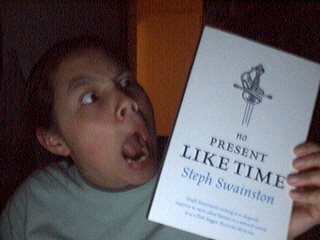
No Present Like Time - Steph Swainston

Dear UK Publishers,

I realise that in order for speculative fiction books to do well within your marketing environment, there is a need to get books off the genre shelves and onto the mainstream shelves. I don't have a problem with that.

I do have a problem with the fact that, apparently, in the UK publishing world, 'mainstream' is another word for 'shit boring cover'.

See Exhibit A:


While I am a fanatic book preservation cultist, I am well aware that by eating this copy, I could go out and buy a prettier one, with a cover that had something resembling personality.

I even find that the original Wheel of Time covers, with all their whacky proportions, are preferable to the new super bland masks they wear now.

Think on that,

Sir Tessa


Right! Onward!

I had an odd relationship with The Year of Our War. Aside from dealing with the mild fork in the eye that is discovering one of your favourite story ideas is already in someone else's book, it just didn't....there wasn't...the chemistry-

-I felt that I really should like it, yet I didn't.

That initial feeling didn't dispel in the first few pages, chapters. The new pieces of world introduced, Jant's relationship problems, politics; it all felt like a set up for a sequal, not a story that appeared on its own. The Insects were pushed back, so Swain needed to devise a new enemy. There's nothing wrong with the story as it is, it just didn't sit right with me.

And while I love stories of long sea voyages, and discovering new lands, and giant sharks and serpents, I found that this time around the wonders of the world did even less to woo me, something that I feel is partially due to the characters.

Characterisation is Swain's trump card. Jant, an immortal junkie academic, is a hard character to nail down, but she staked him out well and good. As protagonists and narrators go, she brings out his unreliability, selfishness, obsessiveness, neediness, etc, and instead of making him an utterly dispicable character, she made him fascinating. That is skill, right there. I fell a little bit in love with Jant, in an I-want-to-throttle-some-sense-into-you way.

Which is pretty much all the book had going for me, because nothing else has stuck. Not the giant monsters, not the sieges or the flying or the fighting or the sneaking. Just one brilliant character.

Taking half a minute to dredge up what else I thought while reading; the title irked me. A third of the way in, a new country is introduced, and this country's currency is time. This coin here, is worth half an hour. This note, is a day of labour. You work, you get paid. It's a lovely idea, and given all the stalling and shirking and waiting for everything to sort itself out Jant was doing, I expected time to play a larger role, but instead it got lost in the smoke and the blood and the drugs.

Guess I like my themes to stick around, instead of wandering off.

Verdict: Yeah, it's an okay read. It didn't displease me at all, but neither was I burning through the pages. I do believe there is a lot to be learned from Swain's use of voice and character, which is of value to any writer.

Tuesday, February 07, 2006

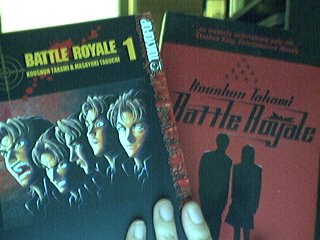
BATTLE ROYALE - Koushun Takami, translated by Yuji Oniki

Spoilers? Hell yes.


It started with the one on the left. Actually, that's a lie. It started with Peek rabbitting on and on about how awesome the book was, and the movie (which I have yet to see anywhere at all) and how I needed to go read it.

FINE.

Couldn't see the novel anywhere, so I started on the manga. When I discovered that I just could not read it in public due to the sudden and frequent appearance of double page spreads of boobies and or motion capture close ups of students getting their jaw blown off, I got hooked. Anything I can't read RIGHT NOW I want to read.

I devoured it when I got home. It was awful, horrible, shocking, and the next day, I went out to get the second book.

It wasn't there, but hey presto, the novel was.

It's a big mother of a novel. There are bigger and thicker books on my shelves, but this thing has density. I think it's fitting that the book have adequet mass to be a murder weapon.

Set in an alternate universe in which Japan is one of the ruling powers of the world, it focuses on one of the products of this strict, regimented society; The Program. Random year 9 classes are selected from all the schools in the empire, and are sent to remote areas - in this case an island - with absolutely no way of escaping. There, they are fitted with explosive collars. These collars trigger if a student wanders into a forbidden zone (the island having been divided up into grids, and a good method of keeping the students from attacking their captors), if the collars are fiddled with in an attempt to remove them, and if no one has died within a 24 hour period.

The aim of the Program is survival. Of a sort. The class is set loose on the island, each student with rudimentary supplies an a random weapon. Then, they're expected to kill each other. There is only ever one winner for the Program. (There Can Be Only One.)

The reality of the situation and the total lack of say the students have in this is hammered home by a) the presentation of their teacher's corpse, he who was against the class being selected for the Program, and b) the killing of two students, in the class room, right in front of everyone else.

The story is like that. Brutal. No holding back, no kittens spared.

Initially, I had some reservations about the book. 42 students, and they all had to die. There was no way I was going to keep track of 42 charcters, but that turned out to be quite well handled. There are a handful of main characters: Shuya, Shogo, and Noriko stick together through the larger part of the book, as do Shinji and Yutaka, with Mitsuko and Kazuo being lone predators who are most definitely playing the game. The rest of the class appear, and after an introduction as to their history and character, proceed to die in all sorts of horrible ways. Morbid as it sounds, this book is one of those parge-turns because finding out who dies next, and how, is addictive.

And considering that for the first half of the book, the 3 Stooges (Shuya, Shogo, Noriko) do nothing but sit around and talk, argue, agree, until the next scene where they hash over the same conversation again, it's a good thing that there are plenty of other students running around doing things. Sad to say that in the manga, the 3 Stooges are being just as uninteresting at this point.

I wouldn't say this book is well written, and it's not something that can be palmed off on translation. Takami labourously follows the structure of; new character, state what they've been running around doing for the past few hours, go into great detail about what sports they play, or what subjects they liked, or who they had a crush on (Shuya, everyone has a crush on freakin' Shuya), then summarise the past two pages with something throwaway like "Basically, she was just your average girl," (I've never met an average anybody), and then go back to the present, where they die. As most of the characters are alone, they all spend a lot of time talking to themselves, and thinking the most unlikely things for the sake of the story. They're also the most unlikely teenagers I've ever encountered. Cliched doesn't begin to cover it.

But they rock.

Mitsuko especially.

Because Takami defied wobbly pacing, cliched characters and lacklustre writing by coming up with one hell of a good idea. This idea, setting a class of ordinary students - friends - to kill each other off on an island has more tension than anything I have ever read. Lots more. If I put all my high paced scary books on a shelf together, Battle Royale would just laugh at them. There is a lot to be learned about ideas in this, with time limits within time limits, and characters that you'll like despite it all.

Because I think, no matter what age we are, we can all relate to high school students. We've all been there. And reading this, there's a part of me thinking "That could be me."

(I don't think I would have lasted very long.)

I acknowledge that this is not at all a book that will appeal to all audiences. Far, far, far from it. If gratuitous violence is not your thing, turn away. If brutality isn't your thing, turn away. If very ordinary prose and lousy structuring isn't your thing, turn away. If cliched school kids (seriously, what is up with Shinji?) aren't your thing, run screaming.

If you don't have a problem with any of the above, if you have even the slightest interest in this book, my dogs above, hie thee hence to a book store and get this book now. It isn't a story. It's an experience.

Verdict: You know how half way across the road you look up to see oncoming traffic oncoming very fast, and you make it to the other side with time to spare, but your heart is hammering anyway, because you didn't see that when you first stepped out, and you nearly died, and it wasn't good, but damn what a rush.....
People chop up Battle Royale and snort it. It's that good.

Sunday, February 05, 2006

Liquor - Poppy Z. Brite

See this?


Signed. Normally, I go giddy over having a book signed. It feels like acknowledgement, putting the author's book in the author's hands, that I loved the book that much to go giddy fan girl on them. Well, this time it felt like cheating, because at the time I hadn't yet read Liquor.

Now I have, and I'm glad I took the opportunity to have it stamped.

Prior to this, the only Brite I'd read was her collection of short stories, The Self-Made Man. This book and I, we didn't get along that well. I haven't had a problem with horror in the past, but Brite does her sex, violence, and gore that well, that it got under my skin and left me feeling decidedly unsettled. Her writing was excellent, I just didn't enjoy the content.

Liquor isn't horror. It's restaurants.

Possibly a much crueler environment.

Set in New Orleans, it follows the lives of Rickey and G-man, two kitchen workers who are taking that mad leap into opening a restaurant of their own. In fact, that's the entire story. There is an evil nasty antagonist of sorts, but he's almost incidental, and given how much appears to be involved in opening a restaurant, there's material for many more novels in there.

Brite's biggest strength is her characterisation, no, not just her characterisation, but the dynamic between characters. She is a master at that which I take too much pleasure in messing around with: chit chat. The seemingly idle banter of her characters disguises itself as random shit talking while moving the plot steadily along. (My random shit talking, while amusing, tends to actually be random shit talking.) Rickey and G-man are fascinating guys, their relationship especially. That of two people who have known each other so long that it doesn't really matter (but it does), and that the act of not being overly intimate in public occasionally intrudes on their private life, these things have truth to them.

I can't comment on whether or not she captured the restaurant scene, or New Orleans, knowing very little about either, but I do know that I learned a lot about kitchens and cooking from this slim little book. And every second page made me hungry.

As an aside; this book has fantastic flop. The pages aren't stiff, and the cover is lovely.

No, I don't have a lot to say about this book. Partly because I read it a while ago, and most of it has slipped from my mind, but mostly because it was a straight forward story that was very well told. Given my normal reading habits, it was a wonderfully refreshing romp in a world I know nothing about, and a fantastic example of characters driving a story, something I'm becoming more obsessed about.

I'm saving the second book for the next time I need something different, with boys boys boys who swear swear swear and a good story.

Verdict: I don't think this will change your life, but it is very well written, and the characters will stay with you. So will risotto. Mmmm.

Friday, February 03, 2006

Nails and Shells

To his way of thinking, he had had a battle with a nail, and the nail had won. As a student of the martial arts, he was humiliated at having let himself be taken unawares. "Is there no way to resist any enemy of this sort"? he asked himself several times. "The nail was pointed upward and plainly visible. I stepped on it because I was half-asleep -- no, blind, because my spirit is not yet active throughout my whole body. What's more, I let the nail penetrate deep, proof my reflexes are slow. If I'd been in perfect control, I would have noticed the nail as soon as the botom of my sandal touched it."
His trouble, he concluded, was immaturity.


Taken from Musashi - Eiji Yoshikawa.

Although it is arrogant and egotistical to compare myself with Musashi, right now, this is how I approach the world. Everything is a battle. Some battles are small, such as seeing that I get my quota of 40 reports a shift. Some battles are large, such as retaining a positive outlook. Some are fleeting and exhilerating, such as climbing cliffs to fish off dangerous rocks, as was involved last weekend. (I didn't fall to my doom or hurt myself, so I defeated the cliffs.)

This is, however, Musashi at his young, reckless, and very immature stage. At about 24, to be precise.

I'm not trying to find the Way of the Sword, yet still trying to find a way. Any way. My way. Maybe I'll grow out of this need to conquer the world around me, but not, I think, anytime soon.

Right now, I'm not sure what it is I'm battling. I have the vague suspicion that it's me, and the not-so-vague suspicion that I'm losing.

"To tell the truth, I myself have run up against a wall. There are times when I wonder if I have any future. I feel completely empty. It's like being confined in a shell. I hate myself. I tell myself I'm not good. But by chastising myself and forcing myself to go on, I manage to kick through the shell. Then a new path opens up before me.
"Believe me, it's a real struggle this time. I'm floundering around inside the shell, unable to do a thing."


I've kicked through a lot of shells in my life, but they've been easy to identify, as far as shells go. External problems, internal issues, things that determination will get the better of.

This time, I do wonder if I have any future, or more precisely, what I want my future to be. I don't know. I'm not sure what I'm aiming at anymore.

Do not merely pinch off the leaves
Or concern yourselves only with the branches.


At this point, Musashi has acknowledged that he has failed to kick through the shell, and he is now seeking, from the outside world, this one thing that will untangle the mess, break the dam, unlock the door, kick through the shell. Just one thing, one simple, obvious and beautiful that will open his eyes, and give him that new path.

I think I'm spending all my time with leaves and branches. I'm fretting over the leaf mould when right beside me is the tree itself.

Eventually, I will find the trunk again. But this time, looking inward can help me no longer.

Thursday, January 12, 2006

I am not the droid you're looking for.