Showing posts with label verdict. Show all posts

Monday, February 20, 2017

The Great Wall (of Deep, Deep Sighs)

Yeah, look. Just. Look. I went and saw it at the cinemas because I wanted to. Ancient Chinese fantasy and wuxia films are dear to my heart. The consumption of media which is problematic as fuck is normal to me, because the production of media/narratives which aren't problematic is rare. Those of us who don't see ourselves on the screen or on the page are used to balancing enjoyment and criticism simultaneously.

I wanted to like this film, and to an extent, I did like it. But I also wanted - if it was going to be a massive appropriation of history, culture and narrative - it to be a gateway drug, because wuxia films are The Best. Don't argue with me. There's no point. I love these narratives and I wish more people around me shared the love. At the very least, this film could serve as an entry point.

Except it isn't a wuxia film.

Spoilers ahoy.

Having now consumed my problematic media, I chowed down a few articles addressing its problems. Oddly, the two mostly widely accessible articles I've found which do a passable job of addressing the films problems (on BuzzFeed and Vox) both state that it isn't yet another White Saviour Film.

Ummm. Yes, it is. The presence of Badass Commander Lin (played by the badass Tian Jing WHO HOLY SHIT IS GOING TO BE IN PACIFIC RIM 2 HAAAAAAAIIIIIIII) at the end of the film and the fact she strikes the final blow does not in any way cancel out the fact that it took Matt Damon's ability to think outside the box to capture a Tao Tei (more on them later) and the plan to eliminate the Queen Tao Tei was his idea.

No, his character doesn't swan around being overtly smarter, stronger and swifter than those around him. He (thankfully) doesn't go around attempting to enlighten anyone. There's honestly not enough depth in the film to allow for that.

But the narrative still centres him. It is to him that the narrative gifts heroic acts, unorthodox inspiration and the opportunity to masterfully save the lives of the extras around him with some super slick moves.

The first time this happened, I felt my heart break. Those moments of preternatural reflex and anticipation in battle are something particular to martial arts, and to see them granted first to Matt Damon and not any number of the warriors around him - who have all allegedly been training their whole lives for this - was...well. It set a tone from which the film did not deviate. The White Hero was portrayed as impressive. As cool. His counterparts were not, save one.

Commander Lin is awesome. Like, so awesome. Like, her entire command is also comprised of badass women who bungee jump from the wall to impale the Alien Lizard Dogs from Space on spears and then spring back up to get another spear and do it all again. How badass? So badass. The ideals of Chinese beauty being just as narrow of as those of Western beauty aside, her character is solid, steady, and not swayed by the charms of the white man. I cannot tell you how important this is. There is a mere hint of romance present in a lingering and shared look which never develops further than that. She is sure of herself, of her abilities and her convictions, and it is she that teaches him a thing or two about the world, not the other way around.

There is a trope in wuxia of the tragic lovers, who for one reason or another cannot be together and yet spend so much time gazing at each other and admiring each other and respecting each other up until one of them dies. Tragically. Usually in the act of protecting the other from death. I feared this was Commander Lin's fate, BUT IT WASN'T. SHE AIN'T GOT TIME FOR THAT. SHE GOT ALIEN LIZARD DOGS FROM SPACE TO VANQUISH. NOR DID SHE LEAVE HER LIFE TO GO WITH MATT DAMON ONCE THE WAR WITH THE ALIEN LIZARD DOGS FROM SPACE WAS OVER. She was all, like, I respect you, we've been through some shit together, wish you well, baaaai. Like at the end of Pacific Rim, their last interaction could be viewed as unspoken romance...and can also be viewed as not. Commander Lin has an agency, life and destiny all of her own, which exists beyond the narrative of the white man, and FUCK. YES.

(As an aside, despite the film being about a war with Alien Lizard Dogs from Space who just want to eat everything, despite the majority of the cast being male, the only time the camera lingered on soldiers being torn apart, literally torn apart by the Alien Lizard Dogs from Space, was when Lin's all-female soldiers were diving from the wall. And I do mean the camera lingered. Other soldiers also met this fate, but the camera barely gave them a moment's notice. It could be argued that this was because those women were the first casualties during the first assault, thus the long, horribly violent and emphasised deaths were presented to highlight how terrible a foe they faced, but it honestly came across as gratuitous violence against women.)

She's the best thing about this film. It's only redeeming feature you might say. I mean, she's a character with a bit of depth, just a bit, which is more depth than anyone else had. There are no other characters, really. Well, I guess Matt Damon is a character. His character's name is William, but all I saw on the screen was Matt Damon. He gets to learn, make some life altering choices, but this isn't a deep film. Between the two of them, I reckon there's one character. Everyone else is a plot device or a prop. Poor Andy Lau. As Strategist Wang, his sole purpose was to be the mission statement at the start of every chapter telling everyone what had to happen next. Dafoe's character isn't even one dimensional. Pedro Pascal is a foil for Matt Damon and that's his sole purpose, and everyone else has colour coordinated costumes to indicate who is who on the set.

It's worth noting that those dismissing the White Saviour narrative overlook the fact that he saves a nameless foot soldier (who was marked for a tragic death the moment that happened, and yep, no surprises there), he saves Lin when she was surrounded and about the be eaten, and he saves his Spanish Offsider from gaol. Like I said, the final blow may not have been from his hand, but he's the one running around saving everyone.

Did you get that Pedro Pascal's character was Spanish? From Spain? Because just in case you didn't get it, he waves a big swathe of red silk at an Alien Lizard Dog from Space like a matador to a bull. Because he's Spanish. From Spain. He also makes questionable moral decisions because while he's European, being Spanish he's not a proper White European. Which is an important distinction that highlights how good Matt Damon is. Pascal does great with what he has to work with, which is very little. He's as wasted as Andy Lau.

As for those Alien Lizard Dogs from Space...look. Just. Look. Director Yimou Zhang is quoted as saying, "What makes our film unique is that these are ancient Chinese monsters."

Kinda? I mean, the Tao Tei / Taotie are a thing. Not a particularly defined thing, as it were, but definitely the idea of a monster from China's history.

Shakespeare wrote, "A rose by any other name would smell as sweet." Palahniuk also wrote, "Sticking feathers up your butt does not make you a chicken." Giving them a name from Chinese history doesn't change the fact that they were Alien Lizard Dogs from Space (seriously, in the film they're from space) and sporting an entirely Hollywood CGI monster aesthetic. I'm not yet able to articulate exactly what it was about them as a whole or as individuals, but when these monsters appeared, I knew I was not looking at a Chinese monster. Others may disagree.

Much as this film is billed as being co-created by China and Hollywood (I find it interesting that Hollywood gets to exist as an entity separate from the USA, but the Chinese film industry doesn't), many of the names in the closing titles who were responsible for the look and detail of the film were not Chinese names. Perhaps that's how we end up with monsters that look like they wandered into the wrong set.

Also they were from space.

Is that police-y of me? Possibly. Probably. This film is, however, the appropriation and sanitisation of a history and culture for the purposes of Western consumption. The Chinese movie industry wants some of those juicy Western audiences. There have been in roads made; a lot of credit must be given to Jackie Chan, and since Crouching Tiger, Hidden Dragon, the great Chinese epic has had moderate success. But, the Western audience doesn't like subtitles. Living in a monolingual world leaves one feeling rather entitled about the communication around them, mostly being that it should be in their language or GTFO. Subtitles turn so many viewers off, which breaks my heart. (Dubbing is an industry which I believe could be an amazing thing. Look at any English dub of anime! Yet so many foreign language films are given dubs which do a great deal to throw the viewer out of the viewing experience. Lip sync being a trivial issue.)

Damon himself has defended his role in the film by pointing out that the film was written with a Western lead in mind, which mostly indicates the lack of critical thinking involved in his response.

Subtitles is one battle. The other is representation.

The recent Jackie Chan film Dragon Blade is another amalgamation of Western and Ancient Chinese epic narratives, which features Jackie Chan being his usual charming, honourable, goofy self and becoming entangled in a feud of succession in the Roman Empire, which has come to play out in his stomping ground. It featured Adrien Brody and John Cusack as Imperial Romans, and as with The Great Wall, featured a great deal of spoken English scenes.

The Romans, however necessary to the conflict, weren't the centre of the film. Jackie Chan was. Even as well known and well loved as he, the box office takings for this film in the USA made 0.1% of the total takings around the world.

The idea that only stories centring around white men, Western white men, will sell to Western audiences, appears to hold true when viewed from the outside. The Chinese film industry wants in on the Western audience. So, the writing of a Western character being central in the film is a marketing move, and a ghastly one. It further compounds the idea that a narrative only counts when it hangs from a white man's shoulders. It is complicit with and practically gives permission for Hollywood's continued appropriation of Asian concepts and culturescapes (the casting of Dr Strange and the live-action Ghost in the Shell being the most current examples of this) whilst erasing the very people to whom these ideas are foundations of identity.

This film is nothing short of a perpetuation of the problems of racism in Western media. It isn't for China's film industry to amend their ways - that is a whole different conversation. It is for the Western world to seriously, meaningfully, no seriously, get with the whole picture when it comes to representation, when it comes to who should be the vehicle for what narrative.

I hoped it would be a gateway drug. But it isn't. It's an empty narrative full of costumes and design which signal something that isn't there.

I was hoping, maybe the film would be a mix of two worlds, the way I am. But it isn't. It's set dressing and posturing. (Maybe that's all I am too.)

I was hoping it wouldn't be what it looked like it was going to be.

Sigh.


No seriously, from space? Why?

Sunday, March 23, 2014

Quick Book Verdicts

I thought I'd about finished packing my books away (this time I haven't been counting, because I really don't want to know), and just found a swathe I'd put aside because, having read them, I intended to post my impressions of them. Oh, intentions. You mean so little. Most of these books I read last year. I won't be able to do any of them justice now. Nevertheless.

Crandolin - Anna Tambour


buy :: author

Tambour is an exceptionally luscious, rich, textured, decadent, and enchanting writer, and this book is no exception. It is the story of a monster, which takes the form of a stain found on a page in an ancient cook book, and for which time is not linear, or acknowledged. It spans ages, this story, myriad lives in myriad cultures and walks of life. It is a thick, sumptuous affair that I found incredibly hard to withdraw from, much like treacle. Beyond this, I honestly don't know how to explain this book to you. Like a spell, it affects without letting you understand how. So very incredibly recommended.

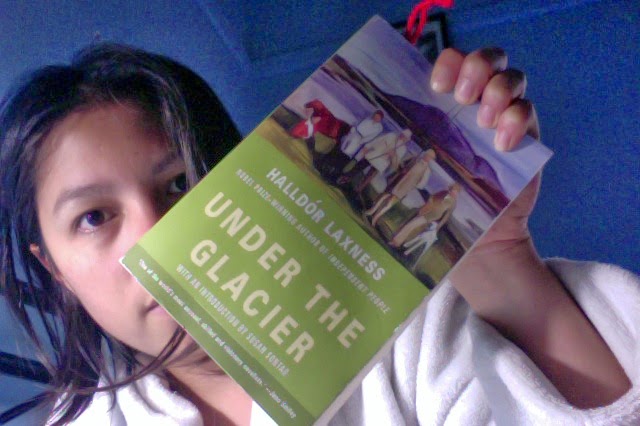
Under the Glacier - Halldór Laxness

buy :: author

Purchased in Reykjavík after experiencing how very exalted he is in this City of Literature. He's a Nobel Prize winner, and widely translated with English copies of his works available in nearly all bookshops there. This I selected as it is blurbed by Susan Sontag as being "one of the funniest books ever written." And it is, although a very precise sort of funny which comes from being an outsider of a culture's geographical and religious history, and having only a passing understanding of how this history shapes a nation and such a people. It is one surreal and absurd event after another, with structured religion befuddled by the organic beliefs of those who live under the Glacier. Curious characters, a landscape that didn't require my own memories to be evocative, a bemusing tale. Worth reading.

A Wrinkle in the Skin - John Christopher


buy :: author

I've already established a gobsmacked love of Christopher, and this book met those expectations. Brutally. Here, a massive shift in the continental plates changes the world, the shapes of the land, moving the seas and so completely destroying all infrastructure and civilisation. Following Cotter, who lived on in of the Channel Islands at the time, this book explores the various ways in we (well, the English) adapt to or fall apart when presented with the end of civilisation. It's harrowing, brutally honest and never looks away. Refreshingly minimal in sexism as well. Left it wide-eyed with horror and so excited at having read something so incredibly perfectly well crafted. Worth reading for the sake of it, also as an example of sparse and effective story telling for writers.

The Kraken Wakes - John Wyndham


buy :: author

Okay, my advice to you is don't read these two books back to back. In fact, don't read apocalypse books by older English writers back to back. Ever. At all. Your world view will cop a beating and you'll be left wandering around asking what the point is, we're all going to die horribly anyway, humanity is doomed, etc, etc, etc. In this one, something seems to take up residence at the bottom of the oceans, and from there, shit goes from bad to incredibly fucked up to someone is going to be extinct by the end of this. Just like Christopher, is powerful, sparse, and doesn't ever avert its eyes. I loved it, and I won't be reading anything by either Christopher or Wyndham for a long while yet. That's quite enough.

Rant - Chuck Palahnuik


buy :: author

I've always loved Palahniuk's work, so didn't fight too hard when J insisted insisted insisted I read this. As much as I feel that Palahniuk is something of a one-trick pony in that I know exactly what I'm getting in any story of his, he's an incredibly talented pony, and that trick is fucking amazing, and even so, even so, this, this, is just...wow. WOW. HOLY FUCKING SHIT DID YOU SEE THAT. It is a masterpiece in which he subverts the narrative and the reader over, and over. I just. You know, with all the reading, writing, and editing I've done I think I have some qualifications backing me up when I say this is a work of genius. The ways it can be read, interpreted, are manifold. It left me open-mouthed with astonishment and J going "You see!? You see?!" I just. Wow. WOW. No, I can't actually tell you anything else about the book. Much like Crandolin above, it defies easy summation. Read it. READ IT.

The Honey Month - Amal El-Mohtar


buy :: author (Ebooks, ey?)

Full disclosure, I am friends with and love this woman to bits. The concept behind this book is simple; she sampled a different honey every day for a month, and wrote a piece based on that. That she managed to sustain production every day for a month is amazing. That all her pieces remain fresh, individual and plump is incredible. There are fables, poems, vignettes, heart-break, joy, sadness, homes found and lost. She walks through these narratives. Her prose is wonderful and breath-taking, which is what happens when poets write stories. A rich, wonderful and warm collection. Just like honey.

Decay Inevitable - Conrad Williams


buy :: author

Full disclosure: I am friends with and love this man to bits, and have a long history of babbling delighted about his writing. This book is sneaky, in that it begins quietly, ordinarily, to the point that I forgot I was reading horror and expected crime, but the horror creeps in softly, and then, not so fucking softly. Amid all the "Oh shit oh shit oh shit-" is a truly warm and loving relationship, which I've rarely encountered in horror. The apocalypse plays second fiddle to the personal.

I really hope I don't find any more books just lying around. Oh, what do you mean I can't have that many tags? GRRRRR.

Monday, February 10, 2014

Island of Wings - Karin Altenberg


buy :: site
This book came to me at the Ullapool Book Festival, during which the B&B I was working at was packed full to the brim of authors, editors and publishers. The café was full of book talk. The upstairs lounge was left in an immense disarray every night, as it appears genre writers and literary writers are much the same in their ability to drink and debacle when left unsupervised in large groups.

Karin Altenberg was one of the guests, and I attended an interview with her based solely on the subject of her latest book: St Kilda. The timing was serendipitious. I'd just been there, and still had the ghosts of gannets in the corner of my eye.

It's a beautifully written book. I deliberately let it sit a while, so my memories of the island were not so close, but Altenberg herself has visited the island, and lived for a while on a Swedish island, and there is some intangible but instantly recognisable truth in her prose which captures the essence of island life. That even if you have no contact with the sea, being neither fisher, hunter, sailor nor swimmer, it rules your world with an indifference and benevolence that is at once comforting and horrifying.

This is the story of Elizabeth MacKenzie, wife of the minister Neil MacKenzie, who took it upon himself to save the poor souls of St Kilda. She arrives on this island pregnant with her first child and discovering that no English is spoken, only Gaelic, is completely isolated from everything she has known.

Altenberg spoke of the extensive research she had done prior to writing this book, as there is plenty of historical documentation and correspondence regarding the minister's time on the island. I recall quite strongly that, in all the accounts and letters and records and diaries, she found only two mentions of Elizabeth MacKenzie. One saying she served tea, the other a passing comment on her appearance.

"The forgotten women of history," Altenberg said.

What develops in the pages is a rich narrative full of that which is unspoken, of being trapped in vast spaces and finding peace and strength in being the stranger. It is at once heart-wrenching, both Elizabeth's tale and the circumstances of the people of St Kilda, and uplifting. The island, unforgiving as it is, is a singularly stunning place. A perfect combination of "oh heavens no I wouldn't want to live as the St Kildans did or be so chokingly isolated like Lizzie," and "Perfect wilderness, I want to walk those slopes again." There is no moderate space within St Kilda, and that is how the lives of those who live on her are shaped.

We'll never know who Elizabeth MacKenzie was as a person, never know a thought that passed through her in the long dark winters or the idyllic summers. She's two short sentences in all of history.

It could be that the Elizabeth that Altenberg has summoned to the page is completely inaccurate, and we'll never know. But what Altenberg succeeds in doing is writing of this overlooked woman with respect, warmth, and an understanding that, when reading of her plight and all her trials, is a necessary emolliate for a reader stricken by empathy.

I love everything about this story, even as I despair the historical events which bracket it.

Verdict: Most excellent.

Wednesday, January 22, 2014

The Blue Fox - Sjon

Buy ::: Author Wiki

I don't know why I've always wanted to go to Iceland. Perhaps simply because it's remote and still contains wilderness in a world where that which is wild seems to be ever increasingly distant. My love affair with the island only increased upon at last visiting it, and I was excited to receive and read this book.

Being I think the second book of Iceland written by an Icelandic writer I've consumed post-visiting, and perhaps it was coincidence but both stories rooted themselves in the same era of Iceland's history, in the same manner of community. I don't know that you need to be familiar with Iceland's history to ground yourself within this story, but it doesn't hurt.

A pastor hunts a fox. The fox may or may not be a truth. A woman is buried.

And the book ends.

Did the story end? It didn't feel like it. The conclusion felt like a small cheat, to be honest. The language used is sparse and precise, painting with a few deft strokes a landscape both personal and political, topographical and mythic, across which fox and pastor traverse. But it's thin. So thin. It was almost like reading a ghost book: all the while I was enjoying those sentences and paragraphs, and the deeper story criss-crossing the twinned streams, and all the while I could see so much more this story could have been. As if the writer was a bird just skimming the top of the water, the story doesn't leave shallow water.

In doing a quick google to find the above links I saw many a review for the book on all manner of high-circulation and well regarded publications, all positive. This book has won an award. Perhaps the fault lies with me, and choosing to read it on a 40+ degree day while in a hospital room with no underwear on and the flow constantly interrupted by nurses asking me if I had all my teeth.

It's a wonderful piece of writing. It's a good story.

I just felt it could have been so much more.

As an aside: The two female characters in the story die. One dies off the page, we never see her alive, and she is well and truly painted as 'other'. The other dies on the page. Twice. In fact she doesn't just die, she's destroyed. And is also well and truly 'other'. There are no other female characters.

Getting pretty fed up of encountering this in fiction.

Verdict: Beautiful but thin.

Sunday, April 21, 2013

Cloud Atlas - David Mitchell


Buy - Author Site

This book has been sitting on my shelves for 8 years. The receipt is tucked in the back cover. August 2005, which was when I'd just started my first job with my current organisation. It must have been a celebratory purchase.

(I don't  purchase books to be read instantly. My shelves host a library of books I have and haven't read, so that when it comes time to choose my next meal, I have a wide selection covering all moods and tastes from which I can choose. Having a To Be Read pile that spans shelves is not ideal, perhaps, but it does mean I am always reading a book that I feel like reading right at that moment.)

It was a quiet, subtle reunion. Stepping into this cramped and cluttered room after a year and a half of living out of a bag. All this stuff. All these material objects. And yet, no. There is not so much here that is not a book. I have so missed the presence of books. They are a form of companionship, much similar to the way in which our smart phones mean we are never truly far from contact, although perhaps inverted. A wall of books will hide and protect you from other people. A wall of books is a wall of doors, over which you have absolute control which and when you choose to open and close.

(And they remind me of the direction I hope to take my life in, the purpose to which I have given myself. That anchor, too, is comfort.)

What with the film out Cloud Atlas seemed a natural choice. Despite it having circulated around for more than a decade, when I started in on the first few pages I discovered I actually had no idea what this book was about, other than it was supposed to be extremely good. This was probably the best way to step in, as there is no way to truly describe the accordion of civilisation and souls. It is easy to say what happens, but not what it is about.

What it is, is extraordinarily well written. Wonderfully. I fell in love with the somewhat archaic voice that narrated the journal in the first section, and delight in how thorough that tone and flavour changed in the second. Voice, this book is so much about voice. That middle, pinnacle of reach, in which voice plays a part as strong as the events being narrated. When a voice that is so varied from what we expect of written English and yet the reading of is near invisible, then some truly incredible textures are formed.

(I did have issue with gender roles, especially in the second last histories. Surely, surely, surely by the future such gender typing will have long broken down. Surely. It wasn't something that struck me as a statement the author was making, but simply decisions about characters made according to an unacknowledged bias.)

(Also with the idea of white-skinned people being some sort of apex from which mankind shall fall, and I do say 'mankind' deliberately in this instance. The inversion of race is noted, but whether it was successful in what it attempted to do I withhold judgement.)

It is an incredibly complex, subtle and beautiful piece of work. As far as storytelling goes it is sublime, with an incredibly nuanced cast and intricate thematic weaving. I adored the shit out of it, and as a result I will not be seeing the movie for at least a few years. I don't quite remember if I have anything more of David Mitchell's work in my library here. It is something I will have to amend.

Verdict: Sublime.

Saturday, February 25, 2012

GLEEVOMIT! JOYGASM! YAYSNEEZE!


NO ONE TOLD ME THERE WAS A NEW COMIC SERIES OUT, OR THAT IT HAD BEEN OUT LONG ENOUGH FOR THE FIRST COLLECTED EDITION TO BE RELEASED.

AAAAAAAAHHHHHHH!!!!!!!!!!!!

It is a reboot of the original series, and I have to say, it is ace. The origins of the turtles and Splinter has knit together several antagonists from various, shall we call them, parallel universes that the many many licensed franchises the turtles have evolved in over the years. A good blend of both the original Mirage comic and the 80s cartoon, even featuring "General Krang". Curious to see if Krang remains a gooby brain (I never did like the story arc given to the gooby brain Krang/Shredder character in the new TMNT cartoon series). Art work by Dan Duncan is gorgeous, once again blending the multitude of styles in which the turtles have been depicted in the past. A good balance for the kids new to turtledom, and the kids grew up but never let it go.

NEED NEXT COLLECTION. NOW.

(Funnily enough, I was only this week missing my TMNT comics and DVDs. We all have our comfort stories. Thank you, universe. Don't think I don't appreciate it.)

Friday, December 30, 2011

3 set free, 1 imprisoned


Burnout - Rebecca Donner & Inaki Miranda

From DC's Minx line, comics aimed at girls. Coming of age story, girl with broken family starts up with a new broken family. Decent, but pieces of emotional development felt forced for the sake of the story. Art work palatable. It was exactly what I needed when I bought it, something to dive into, that would not challenge me greatly, and take me out of myself. I release it to the wild (aka, the book exchange shelf in the hostel).


Julius Knipl, Real Estate Photographer: The Beauty Supply District - Ben Katchor

Had I been in a less fatigue-faded state of mind this book would have tickled my absuridism gland into hysterics. Each page a single piece, a sliver of story, or a train of thought before it is derailed, of strange and pointless things that are given accolades and attention. As it was, however, I am tired and more than a little misery prone, and all I could see in the pages was wasted time, wasted lives, mundane small narrow pointless useless valueless worthless. So I closed the covers, and I set it free.


Lori - Robert Bloch

A reprint of a book originally released in 1988, I bought it because I confused the author with Lawrence Block. So. My mistake. Riddled with typos, a plot that made no sense, and shit characterisation. Shit. Like scrotum. Did I mention the plot made no sense? And talk about forced emotional development. UGH. MAKING MASSIVE JUMPS TO CONCLUSIONS LIKE GRASSHOPPAAAAH?! If the book had a face, I would have punched it. Except I am not violent and it does have a face and I respect books, so I did not punch it.

Setting this fucker free. I pity da foo' who picks it up.


The Ganzfeld #3

This, I am keeping. The magazine has since been discontinued, which is a shame. It was full of wonderful odd angled articles that, to me, shared a common focus on examining a point of wonder. Not all wonder is good, nor enlightening, but it is all wonderful and interesting. Particularly taken with the piece by Rick Moody. This was included in the box I just sent home.

All items bought for half price at Modern Graphics, a fabulous comic shop in Kreuzberg. Found it completely by accident. Solid range of German, French and English books available. If they're open tomorrow I may have to go rummage some more.

The 3 free books are going on the shelf at Baxpax Kreuzberg.

I am tired, and although I have barely pecked at the surface, I confess I do not feel any great need to explore Berlin further.

Tuesday, October 25, 2011

Reader Failure

At the beginning of the year I seemed to be making a come back with that whole reading books thing, after the recent drought. Needless to say, that didn't really go anywhere.

Here are the books I read so many months ago. I do not do them justice.

Blonde On A Stick - Conrad Williams


Conrad Williams is one of the most powerful writers out there, and this is has all the power of a cyclone and all the precision of brain surgery. It is a brilliant, cocky, startling narrative that struts about and gets away with murder. Magnificent voice. Absolutely recommended.

Counting Heads - David Marusek


Given to me by a friend who said the fury in Acception reminded him of this, and then couldn't think why. This book blindsided me. It. Is. Brilliant. Stole my breath with its ideas and execution, and made me excited about fiction. Absolutely fascinating critiques of society, technologies and the roles they may play. Meaty, glorious stuff, with stunning characters and plot to boot. So very worth it, so very very worth it.

The Scarring - Geoff Page


The same friend gave me this, a novella in poetry. Very easy to read, with (unsurprisingly) a lovely cadence and rhythm to it. I am no poet so cannot speak of its technical merit, but as far as narrative goes....yikes.

That's...

Fuck me.

Above/Below - Stephanie Campisi & Ben Peek


Two awesome post-apocalyptic-ish novellas that fold in upon each other and bounce off each other in wonderful and interesting ways. I think I'm well documented as being a damn sycophant when it comes to Ben's writing, and this is a prime example of why. Campisi matches the grit and anguish in Below with breathless despair and denial in Above. A very intelligent read.

Guardian of the Dead - Karen Healey


Goddamn I love Ellie. Not a character, a person. So many PEOPLE in this book! Quite a lot of laugh out loud with "I know EXACTLY what you mean, girl!" moments, in amidst all the supernatural creepy shit going on. Of which there is a lot. Christchurch, it turns out, is a pretty menacing place in which to insert fiction. Great stuff, omnomnom.

Sunday, January 23, 2011

The Third Bear - Jeff VanderMeer


buy - author site

I do not have a bear. Well, I do, but I don't know where he is. I do have an Octopus God, however. He is not protecting an island. He is just hanging out on my desk.

The other good thing about my diagnosis is that my Reader's Block has been removed. And when I say 'removed' I mean 'asploded with fifty-million tons of shark dynamite'.

First book of the year!

This book is a soft re-entry into the world of reading, being as it is in essence a reread. I was sent the initial MS to poke at with a stick, and even on that reading many of the stories contained I had already read.

It is well established that I am a touch sycophantic about VanderMeer's writing, and this is why: it's really fucking good.

(It's obvious I haven't done a book write up in a while. I have no idea what I'm doing. Faff, faff, faff.)

(Structure? What structure? Articulate the awesome?)

It opens with the title story, The Third Bear, which is a bit like opening with the experience of being buried alive. It is claw-swipe to the guts, leaving you wretched, hopeless, horrified and inexplicably mournful. The Third Bear is, undoubtedly, a showstopper.

After which the show begins.

Story after story. Should I attempt to single out only the best, I would end up listing and babbling enthusiastic about them all. There is not a weak link in this chain. Each story rises up to completely obliterate the taste of the story that came before, and then be obliterated by that which follows. There is among them an echo, a resonance, of what is noted in the Afterword as "...the search for, or encounter with, the inexplicable." These stories that seek to contain such vast mysteries they are dense with all the unknown unknowns and gently and sadly weigh the reader down with the loneliness that comes with acknowledging all you will never understand, until you, I, the reader, stumble out the end of Appoggiatura and blink, bewildered to find ourselves in such mundane surroundings - these beige walls and beige carpet and beige blinds - and some threshold has been passed through. The grief of knowing that the accumulated learnings of your life will amount to exactly nothing becomes the joy of knowing that there are such inexplicables in the world, and that, in itself, is enough.

These stories speak to each other. Between the covers they have conspired and so the Third Bear can be found later in the stairwells of a story of a different kind, a dead woman's arm goes on beyond its genesis, the colour green, scent of lime, and a name; the stories more than nod at each other, they wink, whisper and play tricks on the reader. It is not merely a collection of short stories, but an obscure and subtle mosaic that upon rereading will give up more of itself to the reader, as teasingly as any reachable mystery.

Errata and Appoggiatura have been staked out as special territory for years. The Tor podcast and podcast by Jason Erik Lundberg having kept me company while I kept insomnia company. I know them word for word, and small edits made me sit up, nodding as a line was joined between a dot here, or some balancing applied there. They are both astonishing feats of art and heart. It is hard to imagine any of the other stories could survive between three such immense, all-consuming, unremittingly powerful pieces, and yet, each story is so sure of itself, so comfortable in its individuality that survive they do.

I don't generally plan on rereading, but that this is already read, reread, and now reread again, and still the stories affect me profoundly, and still I find myself grieving to have reached the end, and sit here wondering if perhaps maybe I could start another reread here and now...that is a mark of the quality of this book. The reflection on the cover is a gorgeous summer day I only just noticed and have not been out in.

Verdict: One of the best, most challenging and ambitious and powerful collections ever. Of all time.

Saturday, December 11, 2010

The Boom of Empty Minutes

The first thing Margo Lanagan did was give us writing exercises. Clarion South is six weeks of writing and criting and little else. Giving us more was a bold, some might say, reckless, move, but it paid off.

She handed out prompts and gave us five minutes to write. First we were given pictures. I don't entirely remember what mine was, I have the vague impression of an oil painting of wheat, or dry grass, and beside it some previous student had doodled a little bird in blue pen. I do recall staring at it blankly for the bulk of the five minutes. It gave me nothing.

The second prompt was a sentence, or half a sentence. Again, I don't remember what mine was, but I do recall it set my brain on fire and when Margo told us time was up, stop writing, I resented her immensely. I wasn't finished, the idea was still moving through me.

It confirmed something that perhaps was beginning to be recognised in my subconscious - the triggers for my inspiration are nested within the written word.

Knowing ones strengths is as important as knowing ones weaknesses.

Sometimes, they're the same thing.

In an effort not to create internal pressure to write, I have


had to

stop


reading.


When people discover this I am inevitably asked what I then do with my time.

I don't know.

I do not want to be at work. As soon as I sit in my cubicle I'm counting down the hours and minutes till I can leave.

I do not want to be at home. I get home, and I sit, and I stare out the window, at the wall, at the carpet, and count down the minutes till it is reasonable to go to bed.

Weekends are an interminable agony. I wake, but do not open my eyes, and lie as long as I can force myself to. I take my time in the shower, getting dressed, making a cup of tea. I linger over the dirty dishes, the washing, the ironing. The grocery shopping is a slow ambling excursion.

And then, I have run out of things that must be done, and my time is my own.

It is all empty time. I cannot write. I cannot read. There is nothing else in my life.

I sit, and stare out the window, at the wall, at the carpet, and count down the minutes till it is reasonable to go to bed. Most of the time, I do not last until 'reasonable'.

Empty time is not a trial I've ever had to navigate. It's...devastating. To quote Tyler Durden, "This is your life, and it's ending one minute at a time."

To be sure, I tested my suspicions, and while undertaking Operation: GTFO III I took The Book of Imaginary Beings by Jorge Luis Borges, as yet unread.


Because that's when you do on holiday; all the indulgences you normally deny yourself.

It was with trepidation and intense anticipation that I picked the book up, made a cup of tea and settled on the hostel couches. It took me some time to crack the cover. Fear of causing myself grief is no easy conquest.

And oh, it was wonderful. I read.

Read!


Read.


And oh, it was brutal. My notebook and pen never left my side, as I had to pause frequently to copy down quotes and jot down questions raised. It had be so long, too long since such nourishment. My mind devoured and tore up the paragraphs, sucked the marrow dry and demanded more, more, more, and as I had feared, eventually stopped taking, and started giving.

I scrawled down a short story idea, one that hit me like lemon juice on an open cut and left me shocked at its state of completeness despite its only having just arrived, and left me excited as only the smell of something new can do, and left me itching, itching, itching to write.

When I got home, I put the book back on the shelf, and stood there a moment surveying all the other glorious books awaiting my appetite.

And I had to walk away.

Logic is not without its loopholes. With so many writers in my life, there is always critiquing to do. I have persuaded and cajoled rough drafts out of a number of friends and acquaintances. That's okay, you see, because I'm doing it for someone else. It is a means of thinking about reading and writing without having to approach the subject head on. I can fool myself about what I am doing, and come at it sideways. Especially fortunate am I that I know so many fabulously talented writers; Rjurik Davidson, Deborah Kalin, Alistair Rennie, and Conrad Williams; the pleasure was all mine.

This loophole is not without its own shortcomings. Toward the end of this mad spree of critiquing some point of saturation was reached, the balanced tipped, and I found myself having to walk away frequently as a froth of bitter snarling jealousy threatened to taint my objectivity.

I do love criting, perversely so. But I love writing more, and to handle their brilliant beloved works with the aim of strengthening them when I can do nothing myself tests my altruism and the lengths of my denial.

As such, I have not sought out any further manuscripts, and empty time returned to me.

There are more loopholes to the logic. For many years I have maintained a strict philosophy regarding the rereading of books, ie, VERBOTEN. There are too many books in the world that I will never get to read, I cannot waste time rereading stories I have already known.

But, well, it is new words that trigger new ideas in me. Old words must therefore be safe.

Right? Right. Examining the argument closely would be counterproductive. It doesn't need to be airtight, just solid enough for me to fool myself.

I was tempted to do this properly, and leap on my old Dragonlance books, but couldn't quite bring myself to take it to such extremes. Instead I picked up Tad William's Otherland series, each book of which is a massive behemoth with its own gravitational pull. I have them all in lovely hardcover, and the first is signed by the man himself, in person when I first met him in LA.

I read.

Read!


Read.


And discovered that my copy was faulty, as page 81 was followed by page 52, before hitting 81 a second time and skipping on to 115.

Do you believe in signs? I try not to, but it was hard not to take that as an uncompromising statement that I am simply not meant to read.

I have borrowed a copy with the intention of reading those missing pages, but as yet have not returned to reading. Guess I'm afraid of being thwarted again. As such, empty time is returned to me.

The latest loophole I have crawled into acknowledges the difference I perceive between the written and spoken word. Most people nudge me toward voice-recognition software and I've explained many times over that in this case, it is the act of writing I need, not the end result. To speak is an entirely different action to undertake, and ignites different thought-matrices. Writing was cultivated because speaking is, for me, anathema. This blog is called Silence Without because I cannot say the things that require saying, and thus, I write them instead. Silence without, expression within. Over time, the act of writing has become an exercise of storm-appeasement like nothing else I have experienced. There is nothing that soothes the howling heart more than the formation of a sentences and the composition of a paragraph.

They are different. The words may be the same, but written or spoken, they are different.

Audiobooks and podcasts, you are my friends.

Now going to bed before the flying foxes have started their foraging is no longer unreasonable. I lay on my back with the curtains open and watch the sky change, flying foxes heading out for breakfast, and listening to stories. I do so love being read to. There may be no quicker way to get me into bed. I've found many marvellous stories (I recommend pillaging Clarkesworld, Dark Fiction Magazine (particularly Pinborough's Do You See?) and Podcastle) and equally marvellous readers (anything by Rajan Khanna).

The spoken word triggers nothing in me. It is safe.

My hands have been very bad of late. It has taken over a fortnight to write this.

Denials and distractions; none of them last forever.

Sunday, October 24, 2010

Five Months, Four Books, Two Octopodes


In my defence, I have critiqued a couple of novels and watched The Naked Lunch I don't know how many times.

Return to Tibet - Heinrich Harrer, translated by Ewald Osers

Having read Seven Years in Tibet just prior to traveling there, it seemed only fitting that the first book I pick up on my return be the sequel, of a sort. I bought it in a book store lining the kora of the boudhanath in Little Tibet in Kathmandu.

In this book Harrer writes of what he found when he finally returned to Tibet, some thirty years after he fled the country ahead of the invasion by Red China. I was a little apprehensive, to be honest. The nature of his departure, the knowledge of what had come to pass in those years, the treacherous ground nostalgia presents; it all seemed the perfect equation for a bitter book.

The Tibet he visited was much similar to the one I visited. The talk of what had gone on was horrific and devastating and so very quiet. The manner in which he was minded day and night differs somewhat, as I was allowed to roam around as I pleased, but then, I was only a tourist.

What surprised me was the hope he displayed that things would improve. He wrote of improving relations with China, that the administration was perhaps coming to terms with the fact that their handling of Tibet was simply not working, not for the Tibetans or for them, and that what had passed with the Four wasn't a legacy they necessarily wished to continue, and that maybe the Dalai Lama would be allowed to return, may Tibetans would be allowed to be Tibetans without fear, maybe, maybe...

His voice is laced with hurt at all that had come to pass, all the damage that would never be able to be undone, yet the hope is equal to that hurt. He truly believed things would change for the better.

The Tibet he envisioned in his hope is not the Tibet I visited.

Diary of a Journey Across Tibet - Captain Hamilton Bower, 17th Bengal Cavalry

Purchased in Kathmandu after a blissfully quiet hour spent examining every book in a bookstore.

This is what it says it is, the expedition log of a trip across Tibet.

It is a little bit hilarious. By a little bit, I mean a lot. Bower is not a...he's...well. He's a fine colonial spirit, out to bring civility to the savages and barbarians of the world. Usually by yelling and bullying them into giving him food, ponies and guides. He is entirely at the mercy of the Tibetans he encounters, yet in this diary never once notes that his survival is entirely dependent upon their generosity, and wades into every encounter with a sense of entitlement that is equally impressive and appalling. He even made that classic near clichéd mistake of disputing river names, because his companions had said that river was called tsang-po, but then have also said this river is called tsang-po, and clearly they are not the same river! (Tsang-po being, of course, the Tibetan word for river.) The time his party spent crossing the Changtang was grueling for both expedition and reader - they did not see another soul, nor sign of another person, for some months. They were living hand to mouth, every day spent scrounging for water and anything to eat. There's a reason not even the wildlife loiters up there.

Mostly, he and his party seemed to survive because...well, it would be decided unbritish of them not to.

Through Unknown Tibet - Captain Montagu Sinclair Wellby, 18th Hussars

I actually picked this one up before Bower, but in the opening pages wherein Wellby lists the inventory for the expedition he makes reference to Bower's experience in crossing Tibet, so switched around.

The routes taken by both expeditions are quite similar, as far as I can tell without maps. Tibetan and Chinese town names Romanised purely from phonetic are nigh useless to identifying the actual locations they passed through.

The two men could not be more different. While Bower was offensive in the judgments he passed willy-nilly on everything for the various people and customs he met to the quality of the kyang (wild ass) they shot and ate to the ponies they requisitioned, Wellby greeted the world around him with a non-judgmental curiosity and even-handed analysis. While he encountered the same severe conditions on the chang (why, given he knew of Bower's experiences, did he still choose this route? Insanity!) and trouble with his entourage, the approaches he used to dealing with adversity were less roaring bull and more diplomatic guile. He took genuine delight in the discoveries made. I was particularly amused by the presence of Ruby, a fox terrier who accompanied them.

Still, this was something of an endurance read, as the Changtang was just as depressingly soul-crushingly monotonous. The quick history lesson of troubles in and around Xining was interesting - and still relevant - but once they were out of danger of starvation and dehydration, and back in the arms of civilisation, the diary itself lost interest, and was simply a catalogue of miles between one town and the next.

Conclusion: Harrer was not prepared, Bower was not prepared and Wellby was not prepared. Even I with my organised tour was not prepared. No one is prepared for Tibet.

I love these books.

Black Country - Joel Lane

Short story as one-shot chapbook. Elegant little package for an elegantly restrained story. A sort of slow, gentle horror that caresses the insidious menace of nostalgia and true lost memories beneath the guise of a crime story. Very much enjoyed.

Sunday, July 25, 2010

Seven Years in Tibet - Heinrich Harrer (translated by Richard Graves)


buy - author wiki

In comparison, this book was exactly what I wanted it to be.

(Well. Apart from the introduction by Peter Fleming, which was so full of British arrogance I nearly tore the pages out.)

Another treasure I discovered in City Basement books, this is from the sixth print run, only a year after its initial publication. It is 56 years old, and has that old book smell about it. There's a gorgeous map in the front detailing the long route Harrer and his companion Aufschnaiter took from the internment camp they escaped at Dehra Dun in India to Lhasa in Tibet, and years later, his flight from Lhasa back to India with the invasion of Red China. At regular intervals are selected photographs that Harrer took during his stay in Tibet, which have changed since last I looked at them. Rather, my eyes have changed.

I believe this story is fairly well-known; with the outbreak of the Second World War the mountain climbing party that Harrer and Aufschnaiter were part of was detained in India and imprisoned for what was supposed to be the duration of the war. They weren't really okay with that, escaped (after a number of unsuccessful attempts), and hemmed in by both Nepal and India, neither of which offered any real refuge, pushed on to Tibet, the most neutral country in the world, with long term goals of maybe finding employment in China and making it through to Japan.

That didn't happen.

After the various accounts I've read of navigating Tibet and my own experience, I have to wonder if anyone is ever prepared for Tibet.

It is a tale quite simply and wonderfully told. Harrer falls well and truly in love with Tibet and its people, and while he does not attempt to sell this to the reader, that love saturates every sentence and paragraph. He cannot help but colour the narrative with his affection for the place, and so the reader, this reader, cannot help but fall in love as well.

This is the Tibet that people want to visit. I can't describe it as anything other than that. It's the mythical, mystical, magical holy city that exists in the minds of wondering outsiders. It's a land packed full of miracles, everywhere a miracle, and a people who are as warm, kind and welcoming as we hope them to be. Harrer had a singular opportunity to study and immerse himself in the country from an outsider's point of view, and this book is but a glimmer of the insights he gained into the character of the nation during his time there.

It's enchanting, enthralling and fascinating. Like Tintin in Tibet it's enough to plant that desire to go and insert a root system so deep that desire will never be uprooted.

And then, Red China "liberates" Tibet, and it ends.

This book was what I wanted, and at the same time, what I needed. A reminder that the Tibet that exists in this book and that I yearn to explore no longer exists. Every day that passes with Tibet beneath Chinese occupation the chances of that Tibet ever resurrecting diminish.

By the time you, I, reached that point in the book, in history, I was well in love. Harrer's heart broke with the invasion and so did mine. The terrible things that happen in war were only hinted at; China is well advanced in military finesse. Tibet is a nation that truly embraces peace, all aspects of it. The resistance, the Tibetan army, such as it was...

It's impossible to write about a book that within my mind is not the shape of a book.

Verdict: When is a book not a book? When it is this book.

A Mountain in Tibet - Charles Allen


buy - author wiki

Lonely Planet Tibet contained a list of recommended reading, with this book as being for those specifically interested in Mt Kailash. Unfortunately, this books is out of print. Fortunately, I have special luck when it comes to travel-related literature and City Basement Books (which is where I stumbled across Journey to the World's End), as I located this pristine copy amid a stack of books on the carpet for a mere $6. Unfortunately again, City Basement Books is no more.

Upon starting this book I was a touch put off; it wasn't quite what I wanted. The focus was not upon Tibet, and although the various narratives related within the pages take place within Tibet's borders, the focus is not really within Tibet either.

The book concerns itself with the surveying of the Kailash region, specifically in regards to finding the sources of such rives as the Ganges and the Brahmaputra, as well as the Indus and Sutlej, and the majority of such surveying attempts stem from the British Raj in India.

After what felt like a very dry history lesson regarding Kailash's cultural, religious and geographical significance, the book goes on to detail each foray into the region which results in some of the white areas in the map of Tibet to be unveiled as each occurs in history. A lot of time is spent skirmishing around the foothills of the Himalayas at the mercy of the hill tribes. An equal amount of time is spent looking at the politics of the Raj and the wider world (Tibet played a significant role as a buffer between British India and Soviet Russia during the years of the Great Game) as well as the smaller politics and scraps between academics and scholars regarding who discovered what first and the validity of any claims made by any explorer returning from that most mysterious unknown land.

Once reconciled to the fact the book wasn't what I wanted it to be, I had an alright time with it. Although I'm certainly it wasn't intended to be a comedy, the absurdity surrounding some of the expeditions mounted by the Raj had me laughing out loud. I became particularly enamored of the Pundits, the surveyor-spies trained by the Survey of India. Cartography at its most badhorse.

The final chapters deal with one Sven Hedin, a Swedish explorer who was much maligned by the Royal Geographic Society and, in turn, not presented by Allen without bias.

Hedin became the highlight of the book. In both his failures and successes was a...I don't know that there is a single word that will serve the purpose. At once reckless and determined. His expeditions were frightening things which demonstrate either ignorance or deliberate heedlessness, his first expedition across the Taklamakan being a perfect example. He was presented as a conflicted man, doing great things but demanding recognition equal to his deeds, his own character sabotaging the good will of those who would provide such recognition (the fact that he was a Nazi supporter didn't help either) and thus poisoning his own view of his achievements.

He was a flawed man with a magnificent ego. Yeah. I empathise.

Despite, or perhaps because, being so unfavourably presented I fixated upon him of all the explorers, and went on to buy his own accounts of his travels. Possibly because of all the explorers, he went out of pure personal desire, not political.

It is interesting to see how history treats the people that come to shape it. Later, in my further reading regarding Tibet, the accounts in which he feature painted a very different picture of the man.

At any rate, I read this several months ago, and details have blurred. Although it wasn't what I wanted, it did give me a fantastic lesson in Tibetan geography which I used not only around Kailash but the whole country.

Verdict: Dry, not without academic bias, but yes, very good for those interested in the geography around Kailash.

Monday, March 08, 2010

Game - Conrad Williams


buy - author site

(There was a magnificent sleight of hand involving pigs early in the story. Petite Porker still doesn't get it, and needs to get out of the damn photo.)

I was wretchedly directionless and restless yesterday, and the Wise and Sensible Deb Biancotti told me to: Read a book. Let someone else's world right yours. That's what I do.

So, yeah, I went and picked up my last Conrad Williams book.

Sometimes, the mind can be soothed by feeding it love, warmth, hope and delight.

But when that fails, giving it something a hell of a lot more fucked up than it will ever be can do the trick too.

Game is a short sharp novella that, after the punch-you-in-the-face-kick-you-in-the-gut END OF THE DAMN WORLD horror and despair of the last few novels and novellas of his I have read, is a subtle and restrained creature, all the more sinister because of it.

Bas Eachus is exacting a little revenge that is far beyond what the perceived crimes against him call for. His grand scheme (and as far as revenge goes, it is a fine one) sees Rache and Fi, two of his chosen targets, forced to tear around from one place to another hunting out Bas's other targets and doing his wetwork for him to a specific timetable, as if they fail Bas will drain another pint of blood from Liam. Add into this Ness, a woman who suffers from premonitions more than most fictional characters with premonitions suffer, and what you have is a brilliant and grueling little story.

The characters are marvelously drawn; it's desperation that drives this narrative, and while the dictionary definition of desperation is uniform, how it manifests and shapes the individual it is consuming is a varied and nuanced thing. Each of these characters is driven to such lengths by their desperation, resorting to such means and consciously the future consequences, because here and now there is work to be done and only one goal to be achieved, anything else being a distraction - they haul the story along at an incredible pace, to a conclusion that I truly did not see coming and crowed with satisfaction when it came.

It was also excellent to be served a plate of characters with different vital statistics. Just chance has seen the last few of Williams's story consumed to be centred on the same character structure; the family unit of father, mother and son, with the father as point of focus. Great to witness Williams flaunt is ability to nail university students with lousy boyfriends, sappy sad romantic psychics and criminal entrepreneurs who are perhaps past their prime but not quite ready to fully admit that.

The prose didn't linger as lovingly on the gore, now I think on it. There was opportunity to do so, but in this case there were more important things to be done. The horror being evoked in the reader did not stem from the visual image of the deeds done, but the emotional and spiritual destruction that came from doing the deeds themselves. Quite to my tastes.

Verdict: The Source of Awesome. Damn fine, I say, damn fine. I know Williams has a crime book coming out soon, and the way this story unfolded it had more than a little of a crime bouquet about it. If it be anything like this saucy little darling, cannot wait to get my paws on it.

Sunday, March 07, 2010

Tender Morsels - Margo Lanagan


buy - author site

(Miss Apricot thinks Mister Bear has inflamed tonsils.)

There was a lot of bruhaha in the reviewsphere about the events contained in the book and whether it was obscene material that should be burned, I say, burned, or not. I didn't read any of this, but I was aware of it. It was at the front of my mind when I started, a sort of mental readiness that what was to come was probably not pleasant (and knowing Margo's style, that's only to be expected).

And still, that first session I had to stop not because I was ready to stop reading - I wasn't, actually - but because I'd reached my horror saturation point and had to go find some rainbows and unicorns to snort.

It was quite a relief when that section passed. I almost understood, then, why the bruhaha, and having read the book do not agree with it. It does deal with some heinous crimes and taboos, but does not exploit them. Margo handles them with an honesty that makes liars of us all, she doesn't shy away from the consequences that follow such events, be they emotional, practical or social, nor does she make any attempt to belittle how lasting the effects can be on a person. The ending is better than the start, which is all that can be hoped for, really.

This is a recasting of Snow White, Rose Red, which is a fairytale I'm not well acquainted with. It spans two worlds, each with their joys and savage flaws, and some three generations of women who fit in neither world, and make their own world between themselves. It's a subtle fantasy, not feeling much need to be loud and brash in its unworldliness. The magic exists to serve the themes of struggle, defeat and the furious unfairness of ordinary people. The magic bends its knee to a story driven by characters.

The prose itself is an incredible magic, Margo having a precision of feeling in the details she chooses and the words she chooses to denote those details that stems from an almost childlike-innocence view of the world, before the rules of language dictate what word applied to what. It's through this delicate, exquisite prose that the atrocities are delivered, and I cannot tell you if that makes them easier or harder to stomach. Regardless, it made the book a wonder of craft.

(I had a moment, in that delightful warm burly section with the visit of First Bear, thinking of Florence, and oh my heart wanted...)

The end left me a touch disgruntled, as for me the story was always Liga's story, she who had endured the most and still endured against the demons her trials had gifted her, and yet, it is the best ending to be wished for. This story has its roots in a fairytale, but it is not a Disney fairytale with a happily ever after, nor it is a traditional fairytale with everyone dying horribly, in fact it's not a fairytale at all.

It's life. You don't get what you deserve. You can only make a life with what you get.

But, despite all the atrocities and scars, or perhaps because of them, this is first and foremost, a love story. This book is so saturated with love, the love of mothers and daughters, of sisters, of the family you make for yourself, it made me hurt it was so sweet.

Verdict: Exquisite. An incredibly powerful book, and so honest about the psychological and emotional scars that shape us long after the wound that made them has healed over. Do not read if you are feeling at all vulnerable.

Additional Blather: I consumed this as an audiobook, and dude, I'm not sure I'll do that again. The iPod just isn't set up to deal with audiobooks nicely. Possibly I have to rummage around for obscure settings some more, but on starting the book I couldn't use my iPod for anything else because otherwise I'd lose my place again, with 1134 tracks to hunt through, never find it again. Audiobooks also take much longer to consume. I'd have probably eaten the book in a couple of days, but this went on for about a month.

That said, it was wonderful to be read to, and the readers, Anne Flosnik and Michael Page, were perfectly suited to the story.

Saturday, February 20, 2010

Why ruin good tea like that?

The Ever Awesome Madame Healey, Eternally Unfettered Madame Kalin and I, Sir Tessargh, ventured to the theatre yestereve, and because less-than-stella vampire films are something of a tradition of ours, we saw Daybreakers.


Which I was expecting to be utter shyte.

And it wasn't! Can you imagine what a pleasant surprise it was to find my interest perking and my curiosity raising its jaded old head?

It's a decade in the future, with the world's population made up of vampires, and only some 8% actual human beings left. The majority of that percentage is locked up in a literal blood bank, nom nom nom.

But the numbers don't work, and they're running out of humans, and thus blood. Blood deprivation leads to a devolution from pretty sleek strong vampire into bat-ugly nosferatu, so not only are they going to starve to death, they're going to go crazy too.

And oh my goodness, there are so many juicy throwaway details in the movie! News bulletins that the biggest cause of bush fires was vampiric animals caught out in the sunlight! The rise in suicide from kids who will never age! The (very relevant) question of what to do with food shortages. What to do with the devolved vampires. The commercial realities of devising a blood substitute verses the basic necessities of life. An Uncle Sam poster ordering you to join the vampire army, kiosks selling coffee with 20% blood in your blood type of choice, oh, it was wonderful.

Just a pity the main plot was made of sweaty rancid cheap scrotum.

Seriously. All the trappings, all the paraphernalia in the film, the textures and furnishings there only to add depth: they were boss! King! They were Elvis! We sat around afterward discussing the implications of the politics and logistics involved in running a country that just happened to be populated by vampires. Homeless vampires and cleaner vampires and train driver vampires.

BUT THE PLOT WAS SO STUPID.

You don't ruin tea by putting blood in it. You don't ruin an awesome idea by putting a shit plot in it.

(And exactly where was that bat in the water tank hiding?)

Monday, December 21, 2009

Trash Sex Magic - Jennifer Stevenson


buy - author site

The Deal: At this point in time, due to an RSI, I can only type for 10 minutes at a time. What you see below is what is hammered out before the timer goes off- and nothing more.

I found a hidden cache of female authors! POUNCE.

A big tree is cut down, which triggers a massive shift of energy by the Fox River, and trouble for the Somershoe women living in the trailers beside it.

It's an odd story, taking place over two, maybe three days, tops. A lot happens in that time - more than seems possible. The relationships between characters develop change faster than seems realistic in such a small time frame, but circumstances being what they are (magic electric), some acceleration is to be expected.

There's a lot of light, love and life in the story. It's supersaturated in what is natural, for all meanings of the word. I couldn't help but be caught up in all the passion that comes from living a life.

The writer in me was not without quibbles. There are characters who appear to serve no purpose, antagonists who aren't overly antagonistic, given plot developments that never actually develop and fates that their crimes aren't quite equal to. For all that MASSIVE STUFF IS HAPPENING, the characters are tumbling about with none of them having a very clear idea of what is going on until it has already happened. There's a balance in the structure, but not in the story. Why the foxes on the bridge?

But then, part of me is equally okay with this. It is natural for things to occur as they will. There is no rhyme or reason, fairness or justice.

(Had a perculiar drug addict vibe from this too.)

Verdict: An oddly unassuming, guileless and sunshine soaked love story. Fierce. Intense.