Showing posts with label thought devices. Show all posts

Tuesday, May 13, 2014

Jade & Free

J noticed it first. "I think getting out of the water made you sad."

It isn't enough to enjoy swimming in the sea. The ending of such enjoyment does not lead to sadness, which is a rare emotion to surface, so often with other feelings stealing its name. A small enigma. The next time I left the ocean I paid attention.

It's the tangible, palpable, measurable return of gravity that presses down on my heart. It's experiencing the return of the complete heaviness of my body, including the weakness in my muscles and the dense weight of my bones. Once again it requires effort to remain upright, effort to merely walk, effort to lift my arms from my side, effort to hold up my head, and all the threads of my movement, once again, sigh.

It's a raising of awareness of the corporeal prison I will never escape, and the nature of the long-standing frivolous agonies it contains. Not, I must clarify, a raising of pain. Simply a raising of awareness and direct attention.

This reminder shadows the experience of being in the water. Of feeling almost weightless, and all my movements, grand or fine, seem so easy. There is no heaviness in my body. I imagine I can almost be capable of grace.

It's jade. Varying shades of. When it is clouded this jade is deep, rich and dark, an incredible colour to gaze into. If blue sky is looking down then the jade is bright and strong, and if the sun touches the water it is slashed with bands of pale gold and it is almost turquoise. To immerse yourself in such wealth and purity of colour can draw out a gasp slowly. With grace.

I can contort myself freely. Treading water requires no energy or effort or even conscious thought, and so I can hang suspended and free indefinitely. I can climb up waves three times my height and only be breathless from squealing. Spiraling, diving, twisting and spinning. I will strain myself. It doesn't take much. A few seconds of vigorous swimming, or fighting my ridiculous natural buoyancy to touch the sea floor. Even then, the effort required is something different. Rather than straining against the limits of my body, it feels as though I'm straining against the water. The battle line is external, rather than internal.

That is what the water gives me. A moment of respite.

Getting out of the water does indeed make me sad. 

Monday, March 17, 2014

The Text is Saturated

The original plan was to wait until I had work before joining J up in Sydney, but, well. I really like him. And it's been three months. And fuck that noise.

This whole expedition has not been as organised as anyone would have liked. Winging it. It has been completely wung. To the point where I didn't know how much notice I had to give work, checked the HR policy and discovered that if I wanted to be in Sydney by the end of the month I'd have to give my notice that very day. Big step like that, I like to be psychologically prepared. I wasn't. It was a rather wide-eyed day.

Post like this should be about beginnings. About everything I'm looking forward to, and anticipating, and the new shape my future seems to be taking on. But, there's that word. "Should."

I've worked for the Victoria Police for over eight years. Although I've changed roles and positions, I have always worked with the crime reports themselves. I read the narratives of what happened, I read the dossiers of people in regular contact with police, I read detailed statements, I read charge summaries, I listen to 000 calls, I watch interviews, I look at photos of crime scenes and photos of injuries.

Every day.

I remember, all the way back in 2005, when I first started, how incredibly confronting this was. A deluge of trauma, fear, hurt and pain. All of it laid out in objective, unbiased terms. Date, time and location. Realising how easy it is to enter a home. Processing my first rape report. My first child incest report.

This was, is, paper. It's just information. No contact with the persons involved, not even the police members.

That wasn't distance enough. I'm a reader and a writer. A life time of training has my mind honed to extrapolate the lasting impact of every crime, and I couldn't stop it getting under my skin. You can't, I couldn't, pretend it was fiction. Empathy can be a right arsehole at times.

But a job is a job. I got used to it. There were always reports that would sink into me, sit in my gut like churlish poison, but when years go by it all becomes familiar furniture. I learned how to turn the volume down.

Last night, talking with mum about I don't remember what and I don't remember how it came around, but she said she'd never understood how I could tolerate the work I did. Sometimes I can't, I said. Sometimes the anger that is simmering rises up and I'm furious, unable to speak from the fury.

Maybe it's a good thing you're resigning, she said.

And that sunk into me to sit with the anger.

This morning I read an interview transcript that made me sick. Then I read a collection of statements that forced to get up, walk away, lock myself in a toilet cubicle and do nothing for a while. The subconscious knows it doesn't have to be resilient to this siege of trauma anymore, and the walls have come down.

Sitting here in my last week working for VicPol, my growing impatience and refusal to compromise on social justice issues, on issues of sexism, gender discrimination, homophobia, racism, misogyny, ableism, classism, all the fucking -isms...you know I've never been quite sure where that comes from. A lot comes from my own experience, being as I tick various oppression boxes, but I've never...I'm not...these personal things don't feel as though they're equal in balance to the anger.

When I think about all that I've read over the course of 8 years I understand where the anger comes from.

And it's time to leave.

Maybe, after this, I'll have the space in my heart to


I don't even know how to finish that sentence.

Sunday, June 02, 2013

Girls Club: Self-Love

I almost wonder if I shouldn't wait a couple of days to compose this, instead of leaping onto write up a post the moment I get home. Give the thought some time to stew and get rrrreal tasty like.

This month's meeting  presented us with quite a range of exercises which would enable us to break down some mental blocks, reinforce some obvious strengths, help us identify perhaps unhealthy aspects in our current environment and generally help us to be happier within ourselves.

Self-love, self-worth, self-esteem; these things are all ridiculously personal and tied up as much to our immediate surroundings as to our upbringing and history. While we may all suffer from, say, the idea that we're just not good enough, the paths that have brought us to this conclusion are surprisingly varied.

As a result, there is no one way to address the issue, as each person's demon is tailor-made just for them.

For example; affirmations. I've never used any sort of affirmation, as when I hit my late twenties I used up my "I hate myself" tolerance, decided that all this self-loathing used too much energy, and promptly stopped. (Which is not to say I'm happy with myself, I simply don't spend much time beating myself up. Benignly indifferent? Is that a stance I'm allowed to claim?)

However, for others, forcing yourself to write and speak a simple statement that they do not initially believe to be true can be effective. Just as you can't move a hill with only a single shovelful, you must repeat the action to break through. Many shovelfuls later, the hill is moved.

The advice given was to choose an exercise that perhaps didn't appeal to you, precisely to get you out of your comfort zone and challenge something that is perhaps too deeply entrenched. Me Dates are something I've been lax with of late, and so I've already blocked off a few nights in my calendar for TEZATAIM, and they will probably involve nothing more than sitting in a cafe with a notebook, but I'm already looking forward to them. I've written before about my Happy Caps folder, but I'm going to start another, purely for professional validation.

I've a horrible feeling what I'm going to be left doing is PR for myself, as an exercise.

Have to admit, Deb and I shared a small look of horror when we discovered this exercise. Promotion of the self is, for better or worse, become a Must Have skill for writers at the moment, and shows no sign of changing. One of the blessing curses of the internet is more exposure and reaching more readers, which unfortunately means more exposure. Writers, being solitary creatures for the most part, usually suck at this. Not as a skillset - a great many writers I know are excellent at their own PR - but it takes so much from them, it's a beast that devours their time and mental and emotional resources. The idea of doing PR when I don't actually have to seems nigh daft.

Another exercise I found interesting was letting go/reaching out, the idea being that if you have identified a person in your life as not being great for you, you let them go. However, for every person you let go, you should in turn identify someone who has a positive effect on you and try to strengthen the relationship with them.

Balancing my social wants to my emotional wants is something I'm grappling with at the moment. Melbourne is so full of wonderful and interesting people from whom I can learn all sorts of things and have all sorts of fun, and I want to spend time with these people!

I also want to spend time reading and writing.

Being as my one great fear is depression, I'm probably too good at cutting people who may be detrimental to me from my life. But figuring out how to cut down the number of awesome people around? This is possibly a zero world problem- wait. There are no problems, only challenges. This challenge indicates I have it pretty good, but holy shit it is hard to figure out.

A last exercise I shall do is the maintaining of the Reverse Bucket List, ie, a list not of things you want to do, but of things you've already done. And man, I have heaps. HEAPS. Piles even! And when I'm sitting at work, on the train, at home, being frustrated at the limitations of my life, I'll shove this list in my face and remind myself not to be greedy and patience is a virtue. You are quite good at making things happen; thus, things will happen.

Look on my works, ye mighty, and be amazed.

(I was on Young Talent Time as a kid, STICK THAT IN YOUR REVERSE BUCKET.)

Sunday, April 28, 2013

Stockpiling the Proof

What I do, is I, I collect every moment;

  • Comments
  • FB status updates
  • Tweets
  • Emails
  • Text messages
  • Photos
And I screenshot them. And I put them in a folder called 'happy caps'.

All of these screenshots are an expression of love from you to me. They are examples of the kindness and generosity of your heart, of passing exchanges that have delighted or tickled me, compliments given without any expectation and demonstrated appreciation of my existence.

I keep all this evidence for those moments when my doubt is speaking louder than my courage, and with this evidence I punch my doubt in the face.

You are the best arsenal a girl could ask for.

Sunday, April 07, 2013

Girls Club: Assertiveness

This morning I attended the second meeting of Girls Club, a monthly get together. The quote on the splash page sums up the group best:
We are the Girls Club. We want to:

Foster positive relationships between girls.
Create a positive environment to meet, support and learn.
Share positive role models, skills, advice, tips, stories.

The topic of this meeting was 'assertiveness', with the group's founders Fox and Shannon giving structure to the discussion with handouts and thought prompts. From something as simple as "provide examples of assertiveness or lack of for your professional and personal lives" I came away with a brain full of knock-on thoughts. The meeting was slated for a single hour, went overtime and still didn't seem like nearly long enough.

From the group discussion I came away with these thoughts:

  • assertiveness seems to be founded upon knowing your boundaries and having the self-respect to enforce them.
  • 'respect' not necessarily being an abundance of self-love, esteem, value, but deciding you will not let something that upsets/distresses/bothers you go unchallenged.
  • perhaps 'challenge' is too strong a word; "unaddressed".
  • your peace of mind is worth defending.
  • most stated that what stopped them from asserting themselves was fear of potential conflict, and I had the impression that for many the two are linked, possibly even considered the same thing.
  • some work on separating the ideas of 'assertiveness' and 'conflict/confrontation' would go far in removing the Capital A of Assertiveness and so enable people to be less hesitant in stepping up.
  • is the fear of an immediate reaction of conflict enough? Do we not trust the other party to be reasonable? (Fear will find demons where we know there are none.)
  • we are all more comfortable with asserting ourselves in a professional environment, where there are set frameworks regarding expectations, responsibilities, etc.
  • the personal, where we are more invested by choice, conflates the act of assertion and introduces complexities and love.
  • caring will always make things harder.
  • with strangers, assertion and the chance of being perceived to be bitchy/bossy/rude/humourless it not so much an issue, as there is no emotional or personal investment, thus there is less hesitation in calling out bigotry.
  • there is a difference between wanting to be what we think of as 'assertive' - the culturally germinated idea propagated largely in fictional narratives - versus recognising what actions are actually best for us as an individual.
  • for example, feeling that you should jump on conflict and confront it immediately and head on, like a bull to a red cape, instead of taking a quieter approach such as withdrawing and addressing the issue from a distance.
  • this second approach being at first viewed as cowardly, perhaps because it is simply not overt.
  • (this bleeds into the idea of bias, and the ideas and values we have adopted from our environments, cultures and interactions without realising we are acting not necessarily in our best interests.)
These are ideas that I believe apply to both genders, but were especially true of this group of women eating quesadillas in the sun on a Sunday morning, all of whom appeared, to me, to be mature, sophisticated, intelligent and full of interesting things to say, ie, not people I would assume have issues asserting themselves in either a professional or personal setting.

It was also just a wonderful experience. This round table discussion on a terribly interesting topic in which everyone spoke and listened, in which we all truly listened to what others had to say, no one spoke over anyone else, all was respected, valued and considered. It was such an invigorating environment that the act of speaking your thoughts felt like a natural thing to do, not something that required an effort for you to present yourself, nor requiring any effort to be heard.

This weekend has actually been full of really thorough meaty conversations. I feel unexpectedly invigorated. Communication isn't always a channel. Most of the time, between two people, it's a window, and that window can get grotty, rain-smeared and paint-smeared and covered in fingerprints and noseprints and lipstick kisses. Every now and then that window needs cleaning. Love probably blurred the view, and love will see it clear again.

Monday, January 23, 2012

Think Champloo

KONG HEI FAT CHOI. GONG XI GONG XI GONG XI GONG XI GONG XI GONG XI GONG XI GONG XI GONG XI GONG XI GONG XI GONG XI GONG XI GONG XI GONG XI GONG XI GONG XI GONG XI GONG XI GONG XI GONG XI GONG XI GONG XI GONG XI GONG XI GONG XI GONG XI GONG XI GONG XI GONG XI GONG XI GONG XI GONG XI GONG XI GONG XI GONG XI GONG XI GONG XI GONG XI GONG XI GONG XI GONG XI GONG XI GONG XI GONG XI GONG XI GONG XI GONG XI etcetera etcetera etcetera...

There are obvious things that are missed when traveling. Less obvious absences make themselves known over time, when you are unprepared for their arrival.

I miss my clothes. Which is more to say, I am getting sick and tired of wearing the same clothes over and over. Three months of two pairs of jeans and rotating six tops. I miss dressing myself up. I miss looking pretty.

(Anyone who leaves a comment that in any way attempts to assure me that I am pretty regardless will have their comment deleted. Not seeking compliments.)

This does in a way feed into mental well being. Poppy summed it up wonderfully in this post;

"When I sit down and go through the ritual of of painting my nails, doing my makeup and hair, and putting on a pretty outfit, I am allowing myself to feel like I am worthy of spending time on myself."


It is nigh impossible to accomplish this when dragging yourself from hostel to hostel with a limited and purely functional wardrobe. It may be mistaken for vanity, but not being able to put together nifty little outfits and step out knowing that no matter how I feel about my body, my clothes look faaabulous does make it a little harder to feel good about myself. As I am now, with my dino chucks, jeans, and a plain long sleeved tee, I'm pretty mediocre.

I miss having a desk. They're under-valued items of furniture and do not feature in any hostels or hotels. Sitting here in Starbucks eating their wifi, and my hands and shoulders are most unhappy with this table. It's even worse back in the room - not even a table to speak of.

I read on the train today. Perhaps I've been in London long enough to feel comfortable knowing where I am, that I did not have to keep observing those around me or checking the next station incessantly. Fear of motion sickness had stopped me from trying before, but I managed it today without nausea, and it was wonderful. Such a normal, ordinary activity. More than opening a bank account, buying bus tickets and organising my mobile, this felt like an achievement. The first cut in carving out this world and making it my own.

There is fresh milk in England. The continent does not seem to do fresh milk, another little thing I took for granted. There is no sour milk either. Beware of sour milk. You will pass through foreign lands and pick up cartons that look like milk, only to find you have poured something that is most of the way toward being yoghurt into your tea.

In Iceland, do not buy the a + b milk.

In the Czech Republic, do not buy the green cartons.

You have no idea the heartbreak. No idea.

It was not as significant a relief as I expected it to be, to finally be in the land in which my native tongue originates and is named after. I can ask complicated questions and understand complicated answers. Hell, even simple questions. I can read all signs. That perpetual self-conscious embarrassment that I am monolingual and force people out of their native tongue in order to communicate me, so heavy and shameful, now gone!

The price being, I can understand everyone. Everyone. All the time. Now, sitting on the train, waiting for the bus, standing in the Natural History Museum, buying a cup of tea, I am surrounded by the everyday conversations of everyday concerns of everyday people, and I cannot keep all these voices out of my head.

Overwhelmed, and so I am fleeing the city. Tomorrow I'm getting on a bus for Salisbury, and from there to Bath, and from there, who knows. All want is a greater presence of quiet in my world. And then, perhaps some colour, something other than stone in all the shades of civilisation.

I will circle around the west, return to London to pick up my National Insurance Number and bank card, and then make my way north, hopefully closer to a place in which I can stop, and space I can call my own.

Thursday, February 24, 2011

A Life's Punctuation; the Full Stop.


That is the last cup of tea.

It, more than anything else, signals the End of an Era. That's the last of the milk. Once it's drunk I'm going to turn the fridge off, and that will be it.


I feel I should say something about the importance of true and vigorous independence, what it means to call time and space your own without compromise, and, I don't know, stuff, but I am tired in many different ways. My heart is sore, my mind is confused, and I have nothing in me.

So, I will drink my last cup of tea as I have done on many evenings.


And watch the flying foxes come out at dusk.


One last time.

Sunday, February 20, 2011

Domestic Archaeology

Having finally emptied my bookshelves (books, CDs and DVDs filling a total of 30 boxes), I've moved onto that part of packing involving rummaging around in boxes and cupboards that haven't seen the light of day since the last move.

It started with the discovery of an 'easter egg' in the packaging of my copy of MS Office 2004 for Mac, as blogged here. All that came to pass afterward was recorded on twitter, and by recorded on twitter I mean I spammed the crap out of my follower's timelines. Extracted and provided below, for your perusal;

  • What day is it?
  • You've had your banana, back into the breach, maggot.
  • Yes, you just smashed your head. Sit the fuck down.
  • OMG, Apple made the packaging on MS Office hipster and cool; toad town hall terraium?! -
  • That felt good.
  • I just found another tooth, and I know this one didn't come from me.
  • And a spent bullet casing.
  • Found my Red vs Blue stickers yesssssssssss!
  • Shit, nearly dropped the water buffalo.
  • Found mask from Buenos Aires. Shall not be taking it off for the rest of the day. Badass warrior packing FIGHT!


  • Required: Masquerade Ball, STAT.
  • Found: story books made in Prep. This one is about poo. Not the honey-eating bear kind.
  • Found: old diary.........................................................................yeah, I'mma stop reading and shove it in a box NOW.
  • I have hunger. Feed me.
  • What's this? A WHOLE BOX OF OLD DIARIES. HAVE AT THEE, MAGGOT.
  • My twitter feed is full of anti-old-diary activists. I defy you! Now hush, I'm reading 16 year old angst, hot damn it's bad.
  • OLD DIARY FROM HIGH SCHOOL. CHECK THAT INSANITY, DEDICATION AND MASSIVE FUCKING BOOK -


  • Primary school diaries!
  • Found: letter I wrote to myself when 11 years old because no one else would write to me. It is very short.
  • In primary school, I made stories about explorers and yetis, sharks, dinosaurs, and magic ants. And dinosaurs. Also, dinosaurs.
  • 6 year old Tessa illustrated her grade prep work book with drawings of...Asterix.
  • My freaking darlings, sheepish apologies for spamming the crap out of twitter today. I go now to make my fortune/find dinner. As you were.
I also found old letters and post cards from people who weren't me (seriously!), and picture story books I'd made in school, and old school projects, and photos, and had myself a gay old time.

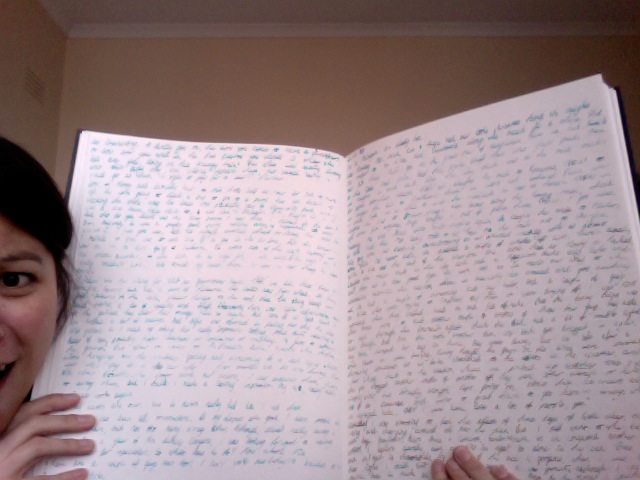
With various blogs, diaries and journals, I have an account of my life going back to 11 years old. Reading them is both hard, humiliating and hilarious, and in many instances, surprisingly dull for the drama being written about. Some find this dedication to documentation alarming, especially the fact that I keep it all. These are external memory devices. Just as you carry a USB stick about with all your photos and important documents on, I take cart these old books from home to home. One day my memory will start to fade, and I will have these as the back up of my mind.

That said, if ever I go into politics? They're going up in a bonfire.

Then I chatted to Ben Peek for a bit, and when the opportunity was presented I gleefully pointed out to him that I am not 32, 33, no, I am 29 years old. There's nothing quite so brattishly satisfying as pointing out to your older friends that you're not just younger than them, you're younger than them.

Having recorded my life since 11, that means I have 18 years worth of documentation. That's more than half my life.

Most of it has nothing to do with pants, either. How odd.

Sunday, February 13, 2011

Schrödinger's Tessa

Music that is loud, unrepentant and live, no, alive, and awesomely alive at that, music so loud it fills your mind and leaves no space for you to think even the smallest of thoughts, music that makes your hair shiver and your ribs ache and for which you cannot help but grin manically, shout incoherently, and be saturated by it, no, not saturated, by absorbed by the music until you are nothing and it is everything. That is catharsis. That is clensing, purging, hell, an enema for the mind as all the shit gets blasted out and lost in the bass line.

That's what I expect of live music, and perhaps sadly what I need of it as well.

I was standing in the Corner Hotel last week. It was a Tuesday night, and I was alone in the crush of bodies before the stage, too hot but armed with water, mindful of those around me, resigned to tall people in front of me, and the band was good, they were fantastic at what they did, an incredibly tight and smooth performance with unebbing energy, but-

But.


How to say this. My grip on my voice is uncertain of late, voice being such a slippery thing and I no longer have gentle confidant hands, I'm clutching and snatching too quick too tight and it's getting away from me.

How to say; I did not go away. How to say; I was neither saturated nor absorbed. How to say; I stood in the music, and apart from it.

I was waiting to be filled and full of something other than me, and so have some brief respite from the self-absorbed burden of being me. The spaces inside me were near quivering with anticipation of that storm of sound to come in and blow all the detritus of doubt and fear away and sweep all clean and clear, and those spaces waited, and waited, as the music beat in my bones and blood and came nowhere near me.

It's hard to control that little upwell of panic when one of your crutches breaks.

I kept moving. You can't help but respond to such volume when those around you answer the same call, but my hands were in fists and my teeth were clenched and I was already writing this post over and over, trying to define what it was that...what it was, what any of it was.

The invasion of living music into the mind serves not only as a clensing and purging process, it presents also the opportunity for a controlled instance of recognition. That is, the loss of self is defined as being the loss of the conscious and self-aware self, which in turns allows the unconscious and instinctive self a moment to rise to the surface and free of conscious oppression, be heard.

When the idea of Tessa is put aside, even for a moment, then foundations upon which that idea is constructed are bared.

That is my howling heart, resonating with the roar in my blood and bones, roaring free and uninhibited and anonymous in the roar of a hundred other voices.

I could almost feel it, almost, thrashing and gnashing and trying to get out get out get free. Here and there, in snatched moments, the music echoed something inside, for a moment there was synchronicity, but only for a moment. The show ended, and my howling heart had not surfaced.

This is perhaps an extreme example of the state of affairs of late. I find that I am fine, yes, I am fine. I feel solid and whole and well, and there are no undercurrents I am actively monitoring. But this being okay is, is, it isn't an illusion, it isn't a sham but it is. It is. It takes so little to rip everything out from beneath me, everything, with such swiftness and thoroughness and savagery I'm left gasping not only from the sting of whatever the world saw fit to slash me with, but with the seeming betrayal of my own self that it should collapse so easily, without even the semblance of resistance.

It is hard to trust myself, knowing that my limits are very much changed, yet still not being familiar with them, having as yet developed no understanding of how they lie and what weaknesses they possess, being now wary of anything and everything, for I do not know what will prove to be a fatal blow and set me back again and again and again.

Not knowing myself is a strange thing. It frightens me. A thorough understanding of myself and all my whys is the only certainty I've had, the only map and compass by which to navigate.

But it, I, it, that howling heart, it is still there. I felt it distant but straining in the music. I will feel it when looking at the carpet in my lounge room, or opening the fridge cabinet in the supermarket, or reaching for the phone at work. It is still there. It is still howling.

It is as though it is in a glass box. Double-glazed to keep the sound out in, of course. I'm sitting here at my desk, typing gingerly with my nerves sawing in my wrists, and this glass box sitting before me. It has no seams. Inside, my heart is a snarling, furious thing, all peeled lip and broken teeth. Thrashing and throwing itself against the glass when I fold my arms on the desk and rest my chin on them, trying to break that glass and have at me. It is so upset. There is such hurt, distress and rage in that wild mean little heart.

As it has always been, I suppose.

But.

I can't hear you, and so I don't know how to sooth you.

I've been trawling through my music trying to find something that will, without volume, let you out. Even just for a moment, even now, at 12.17 on a Monday with the sun out and lawnmowers in the distance. I think that, if I find the right music, if I find the right emotive harmonic that is the same frequency at which you howl, with combined resonance from inside and out we may shatter that glass box and set you free.

But that is wrong. It is old habit for me to assume that which is within me is mine to change. The glass box is an alien intervention. To remove it, I need only stop taking the medication.

I am afraid, my howling heart, of not being able to read you and interpret you, I'm afraid that not having that understanding and thus not having that control over you means you will find ways out over which I have no power. I am afraid of not knowing myself.

I am certain, if I were to remove the glass box, that the understanding would not help me at all. I am certain I would not be able to contain you by mere force of will alone. I am certain you would devour me.

Who is in the box, you or me? Are we dead when you are in the box, or when you are free?

I wanted the anguish to be gone, yes. I couldn't carry it any more. But not like this.

I didn't want you cut out. I wanted you to feel better.

Saturday, December 11, 2010

The Boom of Empty Minutes

The first thing Margo Lanagan did was give us writing exercises. Clarion South is six weeks of writing and criting and little else. Giving us more was a bold, some might say, reckless, move, but it paid off.

She handed out prompts and gave us five minutes to write. First we were given pictures. I don't entirely remember what mine was, I have the vague impression of an oil painting of wheat, or dry grass, and beside it some previous student had doodled a little bird in blue pen. I do recall staring at it blankly for the bulk of the five minutes. It gave me nothing.

The second prompt was a sentence, or half a sentence. Again, I don't remember what mine was, but I do recall it set my brain on fire and when Margo told us time was up, stop writing, I resented her immensely. I wasn't finished, the idea was still moving through me.

It confirmed something that perhaps was beginning to be recognised in my subconscious - the triggers for my inspiration are nested within the written word.

Knowing ones strengths is as important as knowing ones weaknesses.

Sometimes, they're the same thing.

In an effort not to create internal pressure to write, I have


had to

stop


reading.


When people discover this I am inevitably asked what I then do with my time.

I don't know.

I do not want to be at work. As soon as I sit in my cubicle I'm counting down the hours and minutes till I can leave.

I do not want to be at home. I get home, and I sit, and I stare out the window, at the wall, at the carpet, and count down the minutes till it is reasonable to go to bed.

Weekends are an interminable agony. I wake, but do not open my eyes, and lie as long as I can force myself to. I take my time in the shower, getting dressed, making a cup of tea. I linger over the dirty dishes, the washing, the ironing. The grocery shopping is a slow ambling excursion.

And then, I have run out of things that must be done, and my time is my own.

It is all empty time. I cannot write. I cannot read. There is nothing else in my life.

I sit, and stare out the window, at the wall, at the carpet, and count down the minutes till it is reasonable to go to bed. Most of the time, I do not last until 'reasonable'.

Empty time is not a trial I've ever had to navigate. It's...devastating. To quote Tyler Durden, "This is your life, and it's ending one minute at a time."

To be sure, I tested my suspicions, and while undertaking Operation: GTFO III I took The Book of Imaginary Beings by Jorge Luis Borges, as yet unread.


Because that's when you do on holiday; all the indulgences you normally deny yourself.

It was with trepidation and intense anticipation that I picked the book up, made a cup of tea and settled on the hostel couches. It took me some time to crack the cover. Fear of causing myself grief is no easy conquest.

And oh, it was wonderful. I read.

Read!


Read.


And oh, it was brutal. My notebook and pen never left my side, as I had to pause frequently to copy down quotes and jot down questions raised. It had be so long, too long since such nourishment. My mind devoured and tore up the paragraphs, sucked the marrow dry and demanded more, more, more, and as I had feared, eventually stopped taking, and started giving.

I scrawled down a short story idea, one that hit me like lemon juice on an open cut and left me shocked at its state of completeness despite its only having just arrived, and left me excited as only the smell of something new can do, and left me itching, itching, itching to write.

When I got home, I put the book back on the shelf, and stood there a moment surveying all the other glorious books awaiting my appetite.

And I had to walk away.

Logic is not without its loopholes. With so many writers in my life, there is always critiquing to do. I have persuaded and cajoled rough drafts out of a number of friends and acquaintances. That's okay, you see, because I'm doing it for someone else. It is a means of thinking about reading and writing without having to approach the subject head on. I can fool myself about what I am doing, and come at it sideways. Especially fortunate am I that I know so many fabulously talented writers; Rjurik Davidson, Deborah Kalin, Alistair Rennie, and Conrad Williams; the pleasure was all mine.

This loophole is not without its own shortcomings. Toward the end of this mad spree of critiquing some point of saturation was reached, the balanced tipped, and I found myself having to walk away frequently as a froth of bitter snarling jealousy threatened to taint my objectivity.

I do love criting, perversely so. But I love writing more, and to handle their brilliant beloved works with the aim of strengthening them when I can do nothing myself tests my altruism and the lengths of my denial.

As such, I have not sought out any further manuscripts, and empty time returned to me.

There are more loopholes to the logic. For many years I have maintained a strict philosophy regarding the rereading of books, ie, VERBOTEN. There are too many books in the world that I will never get to read, I cannot waste time rereading stories I have already known.

But, well, it is new words that trigger new ideas in me. Old words must therefore be safe.

Right? Right. Examining the argument closely would be counterproductive. It doesn't need to be airtight, just solid enough for me to fool myself.

I was tempted to do this properly, and leap on my old Dragonlance books, but couldn't quite bring myself to take it to such extremes. Instead I picked up Tad William's Otherland series, each book of which is a massive behemoth with its own gravitational pull. I have them all in lovely hardcover, and the first is signed by the man himself, in person when I first met him in LA.

I read.

Read!


Read.


And discovered that my copy was faulty, as page 81 was followed by page 52, before hitting 81 a second time and skipping on to 115.

Do you believe in signs? I try not to, but it was hard not to take that as an uncompromising statement that I am simply not meant to read.

I have borrowed a copy with the intention of reading those missing pages, but as yet have not returned to reading. Guess I'm afraid of being thwarted again. As such, empty time is returned to me.

The latest loophole I have crawled into acknowledges the difference I perceive between the written and spoken word. Most people nudge me toward voice-recognition software and I've explained many times over that in this case, it is the act of writing I need, not the end result. To speak is an entirely different action to undertake, and ignites different thought-matrices. Writing was cultivated because speaking is, for me, anathema. This blog is called Silence Without because I cannot say the things that require saying, and thus, I write them instead. Silence without, expression within. Over time, the act of writing has become an exercise of storm-appeasement like nothing else I have experienced. There is nothing that soothes the howling heart more than the formation of a sentences and the composition of a paragraph.

They are different. The words may be the same, but written or spoken, they are different.

Audiobooks and podcasts, you are my friends.

Now going to bed before the flying foxes have started their foraging is no longer unreasonable. I lay on my back with the curtains open and watch the sky change, flying foxes heading out for breakfast, and listening to stories. I do so love being read to. There may be no quicker way to get me into bed. I've found many marvellous stories (I recommend pillaging Clarkesworld, Dark Fiction Magazine (particularly Pinborough's Do You See?) and Podcastle) and equally marvellous readers (anything by Rajan Khanna).

The spoken word triggers nothing in me. It is safe.

My hands have been very bad of late. It has taken over a fortnight to write this.

Denials and distractions; none of them last forever.

Wednesday, September 15, 2010

The Dysfunctional Relationship Artists Have With...Everything

For this post to make sense you'll need to reference the previous and watch that video.

I spent the night, probably my sleep, and most of my snooze button soft crash into wakefulness chewing over the notion of 'having genius' instead of 'being genius'. I'm a little besotted with the idea.

At a glance I imagine it's distasteful to some, pushing, as it does, the idea of invisible entities be they called muse, daemon, genie, angel, faery, spirit, Fred. What Gilbert is trying to sell, however, is not belief in these things - that's a whole other conversation in which I admit I'm not much interested in - but the usefulness they serve as a mental construct.

She speaks of the emotional risks inherent in the creative process, which resonated with me. There are the obvious stresses associated with placing a work in the public eye; will it be liked, hated, understood, will it be successful, will it be rejected entirely and never be consumed by the public because you are the crappiest artist in all the history of all the cosmos; these are the natural doubts when you put yourself forward for anything.

However I choose to believe that she was speaking of the other risks that come well before considerations of audience reception come into play, the risks we take with ourselves while in the process of creating the work. We pour ourselves into it, we draw upon lessons, memory and knowledge that we may not wish to visit, we take on aspects that do not come naturally to us. I've always said that for writers in particular, the act of writing a story is not unlike forcing the literal definition of a split personality upon yourself.

And, I don't know, the creative process defies predictability and repetition, and I do not believe it is destructive, but it is not always nice, and doing these things to yourself because you love what you do, tearing yourself up because the work requires you to do so, they are hard things.

To then be able to say, "That kinda sucked, and you could have been a little gentler about it," in a disgruntled, passive-aggressive manner to some intangible thought construct and lay some of the responsibility for what happened upon it, well, any less ammunition for the artist to use upon themselves is a good thing, right?

It's this idea of distance. It smells fantastic, like freshly crushed coriander and cummin all mixed together. I'd eat it but I can't stop sniffing it. Distance not only from the work, but from the idea of talent as well.

To be talented is a crippling thing.

I have been told that I have talent. The people who have said this to me are not individuals with a vested interest in keeping me on side and gain nothing from stroking my ego. They were not speaking of craft, but of that part of art that cannot be learned, that essence of creativity that can't be picked up or passed on.

For the creative mind to consider the fact of its own talent is probably one of the most dangerous thought paths to follow. Might as well drive a steamroller over a minefield.

It's one thing to entertain dreams of grandeur and quite another to realise they could be a reality. That maybe you have something that is unique, and that others can see. Suddenly, there are ramifications to everything you do. Are you living up to your talent? Have you wasted it? Do you meet the expectations of those who have recognised it? By having this talent you did not earn are you bruising the already sensitive egos of the creators around you? Will there be a price for using something you haven't earned? Is it possible to exercise control over something entirely unconscious? What if you come to depend on it? What if it goes away?

This is not about any alleged talent I may have, but the weight and damage that merely considering it did. To consider talent left me terrified of using it. It has taken years to be reconcile myself with the idea, all of which has nothing to do with anything I've produced. The work goes on (or not) regardless.

But if someone had given me permission to disown the idea of talent, I daresay those years would have been spent being decidedly more relaxed about my writing.

There is a parallel with photography. I have absolutely no technique, skill, technical or theoretical knowledge, and so I don't feel I can claim ownership of any of the compliments my photographs garner. "I didn't do that," I say. "The world was there, I pressed the button and the camera did the rest."

Now of my stories I can say, "I didn't do that. The story was there, I opened to a new page and the [ ] did the rest."

The difference between being a vessel and a conduit. Gilbert's speech resonated so powerfully with me because she gave voice to a practice I've been slowly and stealthily ninjaing upon myself for some time. A space that is me, but not me. A trapdoor to the subconscious, down which I will deliberately shove stories and let whatever it is down there do whatever it is it does until it is ready to release the story back to me. There is something that is me, but not me. Something over which I have no control. Something that does not come from me.

I'm not going to call it Fred.

But, there is always a but. When you change the creative process from one of dictation to a conversation, then there must be another party with which to have the conversation, which means you are essentially engaging in a relationship with something that is Not Called Fred.

And when I turned this over in my mind, all I saw was a whole lot of issues. Like, not trusting NotFred to actually contribute. Feeling betrayed and rejected when NotFred does not produce the goods. Trying to make myself infinitely more attractive to NotFred, or NotFred's friends. Wondering what is wrong with me that NotFred&Friends talk to everyone else but not me. Deciding this is because I am hopeless and useless and worthless.

Etc, etc...

Which probably says more about me than anything else, but I believe that that poor, insecure, fragile, hopeful and despairing creative mind can find weapons to use against itself no matter what thought constructs are in place.

Still, I prefer NotFred to the thought of inspiration being sourced solely from within.

I find I disagree with the very end of Gilbert's speech. She has put forth the idea that creative transcendence - which we have all felt all too briefly - is not something we can find within ourselves but are graced to feel or not feel its touch according to the whims of something unknowable and unreasonable, and that a word for that something may as well be 'god'. When we are caught up in that passion which is equal parts exhilaration and desperation and in the paws of which we are tiny furious creatures, there, in our work, is god. And if god, the genie, NotFred has touched us...olé.

But then she says that even if god, the genie, NotFred never comes near us again, or never noticed us at all, yet still we labour at our craft...olé, she says, there is god anyway.

And by doing so, by putting god back in the artist when there is no god at work, she undermines that brilliant, necessary idea which was the point of her whole speech.

No. If god isn't there, then god isn't there.

Maybe god will only rip through us once, and never again. Maybe we will never channel god in our work. We can sit down and write, paint, design, draw, mould, stitch, whatever it is you are creating, and there will be no god in the end product. We can wait, and work, but diligence does not equal divine inspiration.

The work produced may be flawed, technically sound, thorough, clever, cliché, bold, unbalanced, dull, merely okay. The work produced may be the lewd loud shit of those who have not yet even begun to realise the challenges involved in creativity, or it could be the crisp precision of a master of the craft and years of rich experience.

It will not have that frightening fire to it, will not smell of freshly crushed coriander and cummin, and god won't know it exists.

It will be yours, and only yours.

And that is a thought construct worth taking pride in as well.

Tuesday, September 14, 2010

Elizabeth Gilbert on nurturing creativity

Pointed out by Ian McHugh.


We writers, we kind of do have that reputation, and not just writers, but creative people across all genres, it seems, have this reputation for being enormously mentally unstable. And all you have to do is look at the very grim death count in the 20th century alone, of really magnificent creative minds who died young and often at their own hands, you know? And even the ones who didn't literally commit suicide seem to be really undone by their gifts, you know. Norman Mailer, just before he died, last interview, he said "Every one of my books has killed me a little more." An extraordinary statement to make about your life's work, you know. But we don't even blink when we hear somebody say this because we've heard that kind of stuff for so long and somehow we've completely internalized and accepted collectively this notion that creativity and suffering are somehow inherently linked and that artistry, in the end, will always ultimately lead to anguish.
When I started watching the clip I became a little apprehensive, especially when she began drawing that line, that line I dislike immensely, between the creative process and mental illness. Much as I am not exactly a poster girl for disproving that mistaken assumption, I think that having wrassled with both monsters I'm in a position to say, with authority, "That is shit from a bull."

Thankfully, Gilbert continued on after the above, with this;

And the question that I want to ask everybody here today is are you guys all cool with that idea?

...I'm not at all comfortable with that assumption.

I think it's odious.
Fuck. Yeah.

And so, it seems to me, upon a lot of reflection, that the way that I have to work now, in order to continue writing, is that I have to create some sort of protective psychological construct, right? I have to, sort of find some way to have a safe distance between me, as I am writing, and my very natural anxiety about what the reaction to that writing is going to be, from now on. And, as I've been looking over the last year for models for how to do that I've been sort of looking across time, and I've been trying to find other societies to see if they might have had better and saner ideas than we have about how to help creative people, sort of manage the inherent emotional risks of creativity.

...ancient Greece and ancient Rome -- people did not happen to believe that creativity came from human beings back then, OK? People believed that creativity was this divine attendant spirit that came to human beings from some distant and unknowable source, for distant and unknowable reasons. The Greeks famously called these divine attendant spirits of creativity "daemons."...The Romans had the same idea, but they called that sort of disembodied creative spirit a genius. Which is great, because the Romans did not actually think that a genius was a particularly clever individual. They believed that a genius was this, sort of magical divine entity, who was believed to literally live in the walls of an artist's studio, kind of like Dobby the house elf, and who would come out and sort of invisibly assist the artist with their work and would shape the outcome of that work.

So brilliant -- there it is, right there that distance that I'm talking about -- that psychological construct to protect you from the results of your work...the ancient artist was protected from certain things, like, for example, too much narcissism, right? If your work was brilliant you couldn't take all the credit for it, everybody knew that you had this disembodied genius who had helped you. If your work bombed, not entirely your fault, you know? Everyone knew your genius was kind of lame. And this is how people thought about creativity in the West for a really long time.

And then the Renaissance came and everything changed, and we had this big idea, and the big idea was let's put the individual human being at the center of the universe above all gods and mysteries, and there's no more room for mystical creatures who take dictation from the divine. And it's the beginning of rational humanism, and people started to believe that creativity came completely from the self of the individual. And for the first time in history, you start to hear people referring to this or that artist as being a genius rather than having a genius.

And I got to tell you, I think that was a huge error. You know, I think that allowing somebody, one mere person to believe that he or she is like, the vessel you know, like the font and the essence and the source of all divine, creative, unknowable, eternal mystery is just a smidge too much responsibility to put on one fragile, human psyche. It's like asking somebody to swallow the sun. It just completely warps and distorts egos, and it creates all these unmanageable expectations about performance. And I think the pressure of that has been killing off our artists for the last 500 years.


I'm in danger of cutting and pasting the whole transcript. I just watched it, so I'm still processing and irrationally in love with what she said. There's a fabulous example of putting the creative essence on the outer that she gives later in the video, from none other than Tom Waits, which made me laugh. Now I'm thinking of it again, it's making me cry.

There have been times I've been afraid of my writing, because when I've looked back at it, it was too good for me.

Telling myself that perhaps it never came from me at all? That makes it okay to live with.

But then...what if that outer interference never interferes again? What if you're touched once, and then left alone to plod on after that moment of glory for the rest of your mortal life?

I don't think I've ever come across a more uplifting context for "just carry on" than this.