Thursday, January 12, 2006

Sunday, January 08, 2006
Quick Picks
The Lion, the Witch, and the Wardrobe (movie) - very pretty, quite well adapted, however, I had the same problems with this movie as I had with the book. The girls don't do anything, and while I'm perfectly happy to believe in magical worlds hidden in wardrobes, I will NOT believe that a boy can suddenly pick up sword fighting, in full plate armour, on horse back, and be good at it. Nor do I believe it's a brilliant idea to find the first random bunch of kids you can, and automatically assume they're going to make GREAT rulers. I'll believe in magic, but people are people.
King Kong (movie) - this film needs cutting. Someone needs to take to it with an axe and a big red pen. Too many action sequences for the sake of action sequences, which go too long. I mean, at the end, when he's up on top of the Empire State Building with no space to turn around let alone manoeuver, and the planes are coming at him and he can't get out of their way - that could have been a quarter of the length it was. But, beautiful film. Loved the dinosaurs.
Blood: The Last Vampire (movie) - well I say 'movie', but it's only half an hour long. Vampire is part of a secret organisation that hunts demons. She hunts some demons. That is all. Nothing new there. Animation was okay. Due to the lack of any originality, was bored most of the way through it, and waiting for the end. Did I mention it was only half an hour long?
Voices of a Distant Star (movie) - oh my god. Only half an hour long, but what a brilliantly crafted half hour. It was beautiful, and when I say that I'm not talking about the animation. Childhood friends finish school. She goes to join the army, he stays on earth. As the fleet she is with jumps from Mars, to Neptune, to Pluto, to the Sirrius Constellation, the time it takes for her messages to reach him is greater and greater, until he's waiting 8 years between messages, when she waited maybe a day between writing them. It's stunning. It broke my heart so tenderly. Very much worth your time.
Samurai Executioner (comic) - by the gentlemen responsible for Lone Wolf and Cub. Alas, no Ogami Itto, but this samurai is just as worth. Same brutal and wonderful writing. Same sex and violence. Possibly even more meaning and layers to this, although I've only read the first book.
Akira (comic) - again, I've only read the first book, but already everything that the film blurred makes So Much More Sense. It's all bigger, better, with more depth, more time, more space. When they say 'classic' and 'masterpiece', they're not talking about the movie, they're talking about this. Added bonus that these books are huge, as opposed to the vast majority of manga, which is small.
Battle Angel Alita (comic) - only first book. So far, very similar to the movie, haven't met an unfamiliar plot point yet. Very cool though. Cyberpunky, grotty, dingy. My sort of thing.
Battle Royale (comic) - oh em gi. If I had kids, I wouldn't want to know they were reading this. There's sex and violence, like with samurais, and then there's this. It squicked me out first time around, and now I'm hooked. The tension in the first two books is unbelievable. Even having read the novel, and knowing everything fate has in store, it's so hard to put down. The only thing that has slowed my consumption of this series is that the shops don't ever seem to have the next book in stock when I'm passing by. So good, but if you're a delicate flower...this isn't your thing.
The Red Star (comic) - this is THE prettiest colour comic out there. Don't believe me? Just flip through a book when you're passing through. It's stunning, and better yet, it's incredibly original. Addictive story, fantastic character dynamics. There aren't many colour comics, in fact there aren't ANY other colour comics I follow, yet this, I've bought several times. Single issues, collected trades, new editions, I have them. They'll stay with me forever.
Cowboy Bebop (comic) - the anime is genius. Love it. Get fangirl squealy about it. These comics? Not so genius. Not just lackluster writing, so-so art, but sloppy design. I don't like spending time trying to figure out what order to read the text boxes in.
Ghost in the Shell (comic) - manga, anime, movie; this is the original, and it does beat all the others hands down, and hands up. Good depth of the characters, flexible relations between them, and it trips over so many fascinating themes without losing the reader in heavy heavy philosophical Matrix-Puke. Go the Major.
The Lion, the Witch, and the Wardrobe (movie) - very pretty, quite well adapted, however, I had the same problems with this movie as I had with the book. The girls don't do anything, and while I'm perfectly happy to believe in magical worlds hidden in wardrobes, I will NOT believe that a boy can suddenly pick up sword fighting, in full plate armour, on horse back, and be good at it. Nor do I believe it's a brilliant idea to find the first random bunch of kids you can, and automatically assume they're going to make GREAT rulers. I'll believe in magic, but people are people.
King Kong (movie) - this film needs cutting. Someone needs to take to it with an axe and a big red pen. Too many action sequences for the sake of action sequences, which go too long. I mean, at the end, when he's up on top of the Empire State Building with no space to turn around let alone manoeuver, and the planes are coming at him and he can't get out of their way - that could have been a quarter of the length it was. But, beautiful film. Loved the dinosaurs.
Blood: The Last Vampire (movie) - well I say 'movie', but it's only half an hour long. Vampire is part of a secret organisation that hunts demons. She hunts some demons. That is all. Nothing new there. Animation was okay. Due to the lack of any originality, was bored most of the way through it, and waiting for the end. Did I mention it was only half an hour long?
Voices of a Distant Star (movie) - oh my god. Only half an hour long, but what a brilliantly crafted half hour. It was beautiful, and when I say that I'm not talking about the animation. Childhood friends finish school. She goes to join the army, he stays on earth. As the fleet she is with jumps from Mars, to Neptune, to Pluto, to the Sirrius Constellation, the time it takes for her messages to reach him is greater and greater, until he's waiting 8 years between messages, when she waited maybe a day between writing them. It's stunning. It broke my heart so tenderly. Very much worth your time.
Samurai Executioner (comic) - by the gentlemen responsible for Lone Wolf and Cub. Alas, no Ogami Itto, but this samurai is just as worth. Same brutal and wonderful writing. Same sex and violence. Possibly even more meaning and layers to this, although I've only read the first book.
Akira (comic) - again, I've only read the first book, but already everything that the film blurred makes So Much More Sense. It's all bigger, better, with more depth, more time, more space. When they say 'classic' and 'masterpiece', they're not talking about the movie, they're talking about this. Added bonus that these books are huge, as opposed to the vast majority of manga, which is small.
Battle Angel Alita (comic) - only first book. So far, very similar to the movie, haven't met an unfamiliar plot point yet. Very cool though. Cyberpunky, grotty, dingy. My sort of thing.
Battle Royale (comic) - oh em gi. If I had kids, I wouldn't want to know they were reading this. There's sex and violence, like with samurais, and then there's this. It squicked me out first time around, and now I'm hooked. The tension in the first two books is unbelievable. Even having read the novel, and knowing everything fate has in store, it's so hard to put down. The only thing that has slowed my consumption of this series is that the shops don't ever seem to have the next book in stock when I'm passing by. So good, but if you're a delicate flower...this isn't your thing.
The Red Star (comic) - this is THE prettiest colour comic out there. Don't believe me? Just flip through a book when you're passing through. It's stunning, and better yet, it's incredibly original. Addictive story, fantastic character dynamics. There aren't many colour comics, in fact there aren't ANY other colour comics I follow, yet this, I've bought several times. Single issues, collected trades, new editions, I have them. They'll stay with me forever.
Cowboy Bebop (comic) - the anime is genius. Love it. Get fangirl squealy about it. These comics? Not so genius. Not just lackluster writing, so-so art, but sloppy design. I don't like spending time trying to figure out what order to read the text boxes in.
Ghost in the Shell (comic) - manga, anime, movie; this is the original, and it does beat all the others hands down, and hands up. Good depth of the characters, flexible relations between them, and it trips over so many fascinating themes without losing the reader in heavy heavy philosophical Matrix-Puke. Go the Major.
Thursday, January 05, 2006
1984 - George Orwell
Mild spoilers? Who doesn't know this story in essence?
There was something of a validation that the copy I read was printed before 1984. 1979, to be exact. There was a (very old) 'collins book depot' bookmark - calendar still slotted in the cover.
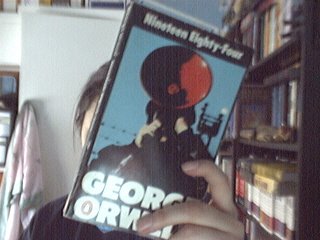
My initial motivation for picking up this book was, again, because it was small. Light. Oh so very light. Oh, I wanted to read it, but the driving force wasn't the best. I popped it open whilst waiting for a train. Good solid writing, easy to read, and I was enjoying myself until I came to the first reference to Big Brother.
Such is the conditioning of society, my reaction was "Pah. They're ripping off sci-fi classcis and destroy- oh. Shit." At that point, I remembered I was holding the actual original in my hands, and promptly got very embarassed in my head.
I admit, I've been procrastinating writing about this book. It has been studied and analysed for so long, by people with far high academic credentials than me, that I'm sure anything I have to say will have been said before, or be complete and utter crap. But that hasn't stopped me in the past, and I recommend books I like.
I loved this book, because it got me so worked up I stormed about the house making all sorts of outraged exclaimations at the state of the world Orwell proposes. The concept of Newspeak in particular horrified me, in a deep-in-the-bone way. Not only that Newspeak seeks to take away the ability to even think dissident thoughts in the comfort and privacy of one's own head, but that Newspeak seeks to abolish layers of meaning. That Newspeak seeks to destroy words. That's the writer in me screaming bloody murder.
Languages are messy things because humans are messy things. We're not the neat, concise and clear cut beings we wish we were, and unless we turn into the entirely emotionless automations of futuristic cliches, we never will be. To take away a means of expressing that mess seems to be setting the entire human race up for one massive implosion.
(I like words.)
Perhaps Newspeak disturbed me so deeply because of all the methods of maintaining a dictatorship, it seemed the most effective and brilliant way.
Unfortunately, there was one very large point in the story's politiics that I didn't buy. O'Brien, the incredibly obvious two-faced working-for-the-party traitor, goes into a lengthy explainations of why the Party has created the world it has, and why this system must be maintained. Unfortunately I can't find the quote I was looking for, having spent the last ten minutes flipping through the pages, but a basic paraphrase of what I understood the Party's goal to be was a world without happiness, joy, pleasure. A world built on fear, hatred, mistrust, and those other mean and lonely things. They were actively working towards that world.
Now, if O'Brien had been talking about working to a better world, I might have swallowed it. Hitler, even on his worst days, believed he was making a better world. He didn't think of himself as the root of all evil. That is my problem; I don't believe that people can actively work to make the world miserable. For everyone. For ever. Misery might be a means to an end, but never the end itself.
But I'm young, and dumb. I can take this comfortable life I have for granted, and tell myself that I would have never given in. (That small truthful and stomped on part of me says that I wouldn't have given in, because I wouldn't have had the courage to speak out in the first place.)
But now, I must share a terrible truth with you. The following is taken from the first page of the book, and describes a poster of Big Brother himself;
It depicted simply an enormous face, more than a metre wide: the face of a man of about forty-five, with a heavy black moustache and ruggedly handsome features.
GEORGE ORWELL IS BIG BROTHER.
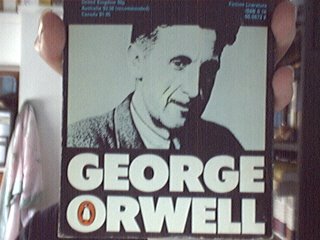
THERE IS NO HOPE FOR THE WORLD! DOOM! DOOM! DOOOOOOOOM!
Verdict: Books like this become classics because they are -that- good. They deserve the acclaim, and they really have the staying power. This will make you think, if only because it hightlights the fact that you can take for granted your ability to think.
PS: Orwell uses the word 'oftener'. Newspeak stomps on that word.
Mild spoilers? Who doesn't know this story in essence?
There was something of a validation that the copy I read was printed before 1984. 1979, to be exact. There was a (very old) 'collins book depot' bookmark - calendar still slotted in the cover.
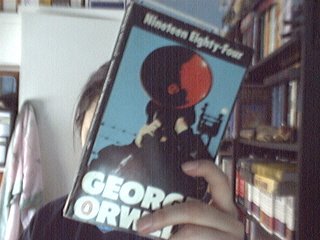
My initial motivation for picking up this book was, again, because it was small. Light. Oh so very light. Oh, I wanted to read it, but the driving force wasn't the best. I popped it open whilst waiting for a train. Good solid writing, easy to read, and I was enjoying myself until I came to the first reference to Big Brother.
Such is the conditioning of society, my reaction was "Pah. They're ripping off sci-fi classcis and destroy- oh. Shit." At that point, I remembered I was holding the actual original in my hands, and promptly got very embarassed in my head.
I admit, I've been procrastinating writing about this book. It has been studied and analysed for so long, by people with far high academic credentials than me, that I'm sure anything I have to say will have been said before, or be complete and utter crap. But that hasn't stopped me in the past, and I recommend books I like.
I loved this book, because it got me so worked up I stormed about the house making all sorts of outraged exclaimations at the state of the world Orwell proposes. The concept of Newspeak in particular horrified me, in a deep-in-the-bone way. Not only that Newspeak seeks to take away the ability to even think dissident thoughts in the comfort and privacy of one's own head, but that Newspeak seeks to abolish layers of meaning. That Newspeak seeks to destroy words. That's the writer in me screaming bloody murder.
Languages are messy things because humans are messy things. We're not the neat, concise and clear cut beings we wish we were, and unless we turn into the entirely emotionless automations of futuristic cliches, we never will be. To take away a means of expressing that mess seems to be setting the entire human race up for one massive implosion.
(I like words.)
Perhaps Newspeak disturbed me so deeply because of all the methods of maintaining a dictatorship, it seemed the most effective and brilliant way.
Unfortunately, there was one very large point in the story's politiics that I didn't buy. O'Brien, the incredibly obvious two-faced working-for-the-party traitor, goes into a lengthy explainations of why the Party has created the world it has, and why this system must be maintained. Unfortunately I can't find the quote I was looking for, having spent the last ten minutes flipping through the pages, but a basic paraphrase of what I understood the Party's goal to be was a world without happiness, joy, pleasure. A world built on fear, hatred, mistrust, and those other mean and lonely things. They were actively working towards that world.
Now, if O'Brien had been talking about working to a better world, I might have swallowed it. Hitler, even on his worst days, believed he was making a better world. He didn't think of himself as the root of all evil. That is my problem; I don't believe that people can actively work to make the world miserable. For everyone. For ever. Misery might be a means to an end, but never the end itself.
But I'm young, and dumb. I can take this comfortable life I have for granted, and tell myself that I would have never given in. (That small truthful and stomped on part of me says that I wouldn't have given in, because I wouldn't have had the courage to speak out in the first place.)
But now, I must share a terrible truth with you. The following is taken from the first page of the book, and describes a poster of Big Brother himself;
It depicted simply an enormous face, more than a metre wide: the face of a man of about forty-five, with a heavy black moustache and ruggedly handsome features.
GEORGE ORWELL IS BIG BROTHER.
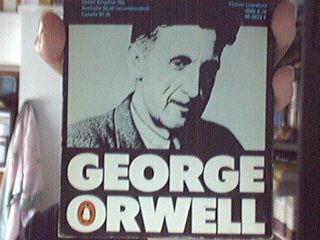
THERE IS NO HOPE FOR THE WORLD! DOOM! DOOM! DOOOOOOOOM!
Verdict: Books like this become classics because they are -that- good. They deserve the acclaim, and they really have the staying power. This will make you think, if only because it hightlights the fact that you can take for granted your ability to think.
PS: Orwell uses the word 'oftener'. Newspeak stomps on that word.
Sunday, January 01, 2006
2005: An Overview
(I had intended to do this yesterday, but if you think I'm turning the Decepticon on in the middle of a 45 degree day, well, you're mad. And I'm not.)
2005, in the Chinese calendar, marked the Year of the Rooster, a cocky bastard of a creature with a whole lot of strut and bugger all balls. Being a rooster myself, I made sure to let everyone know that it was my year, this year, if ever it came up in conversation.
That said, the Year of the Rooster was not slated to be a kind year for roosters, (how very typical), and it wasn't. It was a very, very up and down year. I suppose extremes are character building. (My character is built! Leave it alone or you'll poke a hole in it!)
The year began with Clarion South, which shall remain one of the quirkier experiences of my life. It was wonderful. For six weeks, seven days a week, twenty-four hours a day, I got to be a writer, and nothing but a writer, and hang around with writers, and talk shop with writers, and write, and have to worry about nothing but writing. I'll never have that luxury again. Although I learned scads of useful bits and pieces, and can exercise far more control over my writing because of my time there, the best thing I took away from Clarion South was a lump of new friends.
Love ya guys.
From there, till July, the year wasn't so great. I've blogged enough about the true trials of being unwillingly unemployed, and while I could go over it all again, I think only those who are in the middle of it, or have been there recently, will understand. It's a horrible place to be. When I flipped through my diary for 2005, and saw how many jobs I'd applied for (at least 2 a week), and counted how many interviews I was granted (I can count them on one hand), I was surprised I got through at all. Even now, after having held down a job for 5 months, I'm still getting job rejections from applications I sent out. It was not a good time, and my family bore the brunt of it.
Love you, family.
And then I got a job, at last, at freaking last. To be honest, I'm still waiting to be pulled aside, and be told it was all a rather silly mistake, and they don't have a place for me after all. After a year and a half of job hunting, this job is precious to me. It will be the ruin of my shoulders and wrists, possibly my eyes, but I'm going to cling to it like a limpet. I will not go back to being unemployed, never again.
That said, being employed full time isn't easy either. It would help if I didn't have a hour commute on either end of the day, but that can't be helped. I don't mind the shift work (although I do mind having only single days off at a time), and the work itself is wonderfully undemanding and will not follow me home, but so much time has been stolen away from me. My brother feels the same; how has society managed to get itself into a position where the majority of people have to work so much they have no time for any of the things they want to do? How have we come to work so much that we are perpetually tired? I regret losing time.
If I learned anything from the whole unemployed/employed experience, it is that I need validation. Something to measure myself against. Even if it is merely doing my quota of 40 reports a shift, that's enough. I can prove to myself that I'm worth it. Whatever it is.
There were conventions along the way. Conflux was fun, Continuum was...well, to be honest it was a lot of time spent waiting in signing queues, but that's my decision, and I got my signatures, dammit. I got to talk to Neil Gaiman about Quentin Blake, and I got to do possum impressions at Jeff Vandermeer. What else does a year need?
I read, but that's hardly surprising. It's a failing of mine that I don't have a particularly good memory of when I read a book, so I can't say what books I read this year without pouring back over this entire blog and hunting out reviews. In fact, I don't think I will mention any titles, as they've all been mentioned. Every book is worth it. (With the possible exception of The Phantom Menace by Terry Brooks.)
As for writing...My other regret. Although Clarion South ensured that I wrote probably 6 times more than I would have, I hardly wrote for the rest of the year. I've dribbed and drabbed here and there, but nothing serious. I pulled together the giant crab story (although I'm not sure if it I pulled enough, so to speak, and I'm afraid to go back and look at it), and secured myself a publication for early 2006, (see, that's me! If anyone can offer a better title, DO) and banged out a fun little piece for the Gastronomicon (which never fails to produce the reaction I was after), but I really don't feel that I wrote at all. I'm coming out of that, slowly. Although I have good (very good) intentions of fixing up a couple of Clarion stories, I've been swimming around in a spaceship world instead. I wanted to try a novella, to have some largish project that I could finish, and finish soonish, and thus be able to say "Huzzah! I am finish-ed!" but the more I drib and drab at it, the large the story seems to get, and the bloody thing is looking distinctly novelish. Still, I will stick with it. I've made a conscious effort to stay away from action and big monsters, and concentrate on relationships and the dynamics between people. Whether or not I can pull it off is another matter entirely.
Still, I feel I can still call myself a writer and not be called out as a fake.
I ushered in the new year at 5am. Midnight wandered past while I was sleeping. Yes, while you lot were comfortable in your beds (or not in your beds, as the case may be) I was staggering around in an overheated stupor getting ready for work. The house never actually cooled down after 45 degrees. Not fond of the burninating.
On the first day of 2006, I drove to work, alone, to the freaking city, for the very first time. Going in wasn't hard, the roads being 100% deserted, but driving out was horrible. To begin with, I had to do a 50 point turn to get out of the carpark it was that narrow, and I was that scared of scratching mum's car. Then, it shat down. To make up for 45 yesterday, the sky is trying to drown us. Torrential rain, like Melbourne never sees, and no! I haven't driven in the rain before! Alone! On the highway!
It was all rather traumatic, and I'm never driving ever again.
(Till next time.)
(I had intended to do this yesterday, but if you think I'm turning the Decepticon on in the middle of a 45 degree day, well, you're mad. And I'm not.)
2005, in the Chinese calendar, marked the Year of the Rooster, a cocky bastard of a creature with a whole lot of strut and bugger all balls. Being a rooster myself, I made sure to let everyone know that it was my year, this year, if ever it came up in conversation.
That said, the Year of the Rooster was not slated to be a kind year for roosters, (how very typical), and it wasn't. It was a very, very up and down year. I suppose extremes are character building. (My character is built! Leave it alone or you'll poke a hole in it!)
The year began with Clarion South, which shall remain one of the quirkier experiences of my life. It was wonderful. For six weeks, seven days a week, twenty-four hours a day, I got to be a writer, and nothing but a writer, and hang around with writers, and talk shop with writers, and write, and have to worry about nothing but writing. I'll never have that luxury again. Although I learned scads of useful bits and pieces, and can exercise far more control over my writing because of my time there, the best thing I took away from Clarion South was a lump of new friends.
Love ya guys.
From there, till July, the year wasn't so great. I've blogged enough about the true trials of being unwillingly unemployed, and while I could go over it all again, I think only those who are in the middle of it, or have been there recently, will understand. It's a horrible place to be. When I flipped through my diary for 2005, and saw how many jobs I'd applied for (at least 2 a week), and counted how many interviews I was granted (I can count them on one hand), I was surprised I got through at all. Even now, after having held down a job for 5 months, I'm still getting job rejections from applications I sent out. It was not a good time, and my family bore the brunt of it.
Love you, family.
And then I got a job, at last, at freaking last. To be honest, I'm still waiting to be pulled aside, and be told it was all a rather silly mistake, and they don't have a place for me after all. After a year and a half of job hunting, this job is precious to me. It will be the ruin of my shoulders and wrists, possibly my eyes, but I'm going to cling to it like a limpet. I will not go back to being unemployed, never again.
That said, being employed full time isn't easy either. It would help if I didn't have a hour commute on either end of the day, but that can't be helped. I don't mind the shift work (although I do mind having only single days off at a time), and the work itself is wonderfully undemanding and will not follow me home, but so much time has been stolen away from me. My brother feels the same; how has society managed to get itself into a position where the majority of people have to work so much they have no time for any of the things they want to do? How have we come to work so much that we are perpetually tired? I regret losing time.
If I learned anything from the whole unemployed/employed experience, it is that I need validation. Something to measure myself against. Even if it is merely doing my quota of 40 reports a shift, that's enough. I can prove to myself that I'm worth it. Whatever it is.
There were conventions along the way. Conflux was fun, Continuum was...well, to be honest it was a lot of time spent waiting in signing queues, but that's my decision, and I got my signatures, dammit. I got to talk to Neil Gaiman about Quentin Blake, and I got to do possum impressions at Jeff Vandermeer. What else does a year need?
I read, but that's hardly surprising. It's a failing of mine that I don't have a particularly good memory of when I read a book, so I can't say what books I read this year without pouring back over this entire blog and hunting out reviews. In fact, I don't think I will mention any titles, as they've all been mentioned. Every book is worth it. (With the possible exception of The Phantom Menace by Terry Brooks.)
As for writing...My other regret. Although Clarion South ensured that I wrote probably 6 times more than I would have, I hardly wrote for the rest of the year. I've dribbed and drabbed here and there, but nothing serious. I pulled together the giant crab story (although I'm not sure if it I pulled enough, so to speak, and I'm afraid to go back and look at it), and secured myself a publication for early 2006, (see, that's me! If anyone can offer a better title, DO) and banged out a fun little piece for the Gastronomicon (which never fails to produce the reaction I was after), but I really don't feel that I wrote at all. I'm coming out of that, slowly. Although I have good (very good) intentions of fixing up a couple of Clarion stories, I've been swimming around in a spaceship world instead. I wanted to try a novella, to have some largish project that I could finish, and finish soonish, and thus be able to say "Huzzah! I am finish-ed!" but the more I drib and drab at it, the large the story seems to get, and the bloody thing is looking distinctly novelish. Still, I will stick with it. I've made a conscious effort to stay away from action and big monsters, and concentrate on relationships and the dynamics between people. Whether or not I can pull it off is another matter entirely.
Still, I feel I can still call myself a writer and not be called out as a fake.
I ushered in the new year at 5am. Midnight wandered past while I was sleeping. Yes, while you lot were comfortable in your beds (or not in your beds, as the case may be) I was staggering around in an overheated stupor getting ready for work. The house never actually cooled down after 45 degrees. Not fond of the burninating.
On the first day of 2006, I drove to work, alone, to the freaking city, for the very first time. Going in wasn't hard, the roads being 100% deserted, but driving out was horrible. To begin with, I had to do a 50 point turn to get out of the carpark it was that narrow, and I was that scared of scratching mum's car. Then, it shat down. To make up for 45 yesterday, the sky is trying to drown us. Torrential rain, like Melbourne never sees, and no! I haven't driven in the rain before! Alone! On the highway!
It was all rather traumatic, and I'm never driving ever again.
(Till next time.)

Wednesday, December 21, 2005
Harry Potter and the Half-Blood Prince - JK Rowling
What is there to say about this book that hasn't already been said? Nothing!
She still needs an editor, although this book is superior to the last. The dynamics between all the school kids are fantastic; she knows how to do teenagers in the middle of puberty, and do them right.
That sounds wrong.
The end was spoiled for me long ago, which turned out to be a good thing. No shock involved. I would have regretted throwing the book across the room. It's the nice cloth-bound hardcover.
The end was, I think, pretty much inevitable from the beginning.
And that's all.
What is there to say about this book that hasn't already been said? Nothing!
She still needs an editor, although this book is superior to the last. The dynamics between all the school kids are fantastic; she knows how to do teenagers in the middle of puberty, and do them right.
That sounds wrong.
The end was spoiled for me long ago, which turned out to be a good thing. No shock involved. I would have regretted throwing the book across the room. It's the nice cloth-bound hardcover.
The end was, I think, pretty much inevitable from the beginning.
And that's all.
Friday, December 09, 2005
Vampire Hunter D: volume 1 - Hideyuki Kikuchi, translated by
kevin Leahy
After ploughing through Jonathon Strange & Mr Norrell the only thing I wanted my next book to be was small. Light. Not a physical strain to read. This was the smallest thing I had in reach. It isn't the most noble reason to choose a book, although it is quite nice to hold. It's a good shape, with nice heft, and flexible paper. I'm fond of the cover as well.
The first sentence made me cringe. 'stained', not 'was staining'! Blood and vermillion, you mean red? Long grass high enough to hide all to a man's ankles? That's not very high.
Quash the inner editor.
This isn't partictularly well written, however I'm not sure how much blame lies with the writer, and with the translator. I have no idea how much artist license a translator is allowed to exercise over a work, although it seems to me to be something that is entirely subjective and depends on writer and translator.
On a sentence level, I know the translator is responsible, and likes to show off what fancy words are in his vocabularly. He's particularly fond of 'vacillate', and uses it at every opportunity. No one in this book hesitates, deliberates, doubts, consideres, wavers, etc, they all vacillate. There are cliches everywhere, EVERYWHERE. But perhaps he was doing a very literal transaltion. I'll never know.
But, the writer is very, very guilty of all sorts of 'orrible things. Telling, for starters. Quite literally in most cases. He has a habit, in his fight scenes, of flashing through what happened, and then going back, and saying 'shall I tell you what happened?' (yes, that's in the book), and narrating, blow by blow, exactly how super fast and incredible and wow the fight was, and how brilliant and ingenious D was for defeating this enemy faster than the eye. This shat me more than anything else in the book, as all the thrill is stolen from any action sequence if you already know how it ends. (Sports playbacks have never interested me either.) It felt condescending. I was being told how I should react to these amazing astonishing feats, instead of actually being amazed and astonished.
Characterisation is poor. They're all cliches, and I'm pretty sure that D is a Mary Sue. I mean, everyone comments on how wonderfully beautifully gorgeous he is, everyone wants in his pants, he can't actually do anything wrong himself...(and he has no personality. He's too cool to have personality.)
The story itself was so-so.
And despite all this, I devoured it all, and I'll probably go and buy the second book soon. It's immature writing, it has so much potential that it squanders on cliches, yet that potential is still there. There are moments of raw wonder that I adored. The world he's imagined, a mix of gothic and cyberpunk, is so fresh and wide, I can forgive these things to take a stroll in it.
Sometimes, I think I forgive books such as these because I'm afraid that they're me. That I'm all imagination and no talent as well.
Verdict: It's a bit like popcorn. You won't be able to stop eating it, but you're not exactly drawing anything nutritional out of it either.
kevin Leahy
After ploughing through Jonathon Strange & Mr Norrell the only thing I wanted my next book to be was small. Light. Not a physical strain to read. This was the smallest thing I had in reach. It isn't the most noble reason to choose a book, although it is quite nice to hold. It's a good shape, with nice heft, and flexible paper. I'm fond of the cover as well.
The first sentence made me cringe. 'stained', not 'was staining'! Blood and vermillion, you mean red? Long grass high enough to hide all to a man's ankles? That's not very high.
Quash the inner editor.
This isn't partictularly well written, however I'm not sure how much blame lies with the writer, and with the translator. I have no idea how much artist license a translator is allowed to exercise over a work, although it seems to me to be something that is entirely subjective and depends on writer and translator.
On a sentence level, I know the translator is responsible, and likes to show off what fancy words are in his vocabularly. He's particularly fond of 'vacillate', and uses it at every opportunity. No one in this book hesitates, deliberates, doubts, consideres, wavers, etc, they all vacillate. There are cliches everywhere, EVERYWHERE. But perhaps he was doing a very literal transaltion. I'll never know.
But, the writer is very, very guilty of all sorts of 'orrible things. Telling, for starters. Quite literally in most cases. He has a habit, in his fight scenes, of flashing through what happened, and then going back, and saying 'shall I tell you what happened?' (yes, that's in the book), and narrating, blow by blow, exactly how super fast and incredible and wow the fight was, and how brilliant and ingenious D was for defeating this enemy faster than the eye. This shat me more than anything else in the book, as all the thrill is stolen from any action sequence if you already know how it ends. (Sports playbacks have never interested me either.) It felt condescending. I was being told how I should react to these amazing astonishing feats, instead of actually being amazed and astonished.
Characterisation is poor. They're all cliches, and I'm pretty sure that D is a Mary Sue. I mean, everyone comments on how wonderfully beautifully gorgeous he is, everyone wants in his pants, he can't actually do anything wrong himself...(and he has no personality. He's too cool to have personality.)
The story itself was so-so.
And despite all this, I devoured it all, and I'll probably go and buy the second book soon. It's immature writing, it has so much potential that it squanders on cliches, yet that potential is still there. There are moments of raw wonder that I adored. The world he's imagined, a mix of gothic and cyberpunk, is so fresh and wide, I can forgive these things to take a stroll in it.
Sometimes, I think I forgive books such as these because I'm afraid that they're me. That I'm all imagination and no talent as well.
Verdict: It's a bit like popcorn. You won't be able to stop eating it, but you're not exactly drawing anything nutritional out of it either.
Monday, December 05, 2005
Sunday, December 04, 2005
Tuesday, November 22, 2005
Jonathan Strange & Mr Norrell - Susanna Clarke
I wanted to like this book.
(I'm very tempted to stop and leave it at that, but that would be lazy.)
Set in London, in the early 1800s, with Napoleon skirting around the edges; a period and area I'm rather fond of. And magicians. This should have been my sort of book.
But...
I do not believe that a book should be a test of endurance, either of my mental stamina or the strength of my wrists. 782 pages is a long time, for both of these things. It could just be that the book didn't gel with me, but before it even came into my possession I'd been told by multiple people whose opinions I trust that 'the first 500 pages are a bit slow but then it picks up'. 500 pages of slow is a lot of slow.
By the time I'd waded my way through that 500, I no longer cared, not about the characters or the outcome of the story. Not caring is probably the worst reaction I can have to a book. There are plenty of terrible books I've read that I've cared about, in a rabid frantic frustrated sort of way, which worlds more love than this received. I reached the end, and thought "hoo-bloody-rah".
Which isn't to say it had this affect all the way through. I was enjoying myself at the beginning. Clarke has good control over her voice, and it is consistent throughout the entire book. Norrell, despite being one of the most annoying characters I have ever come across, is incredibly well drawn, and has more depth than all the other characters combined. (I felt a particular empathy to his concerns about his books, and the fact that people might touch them. I'm also now more aware of how ridiculous such concern looks from the outside, not that this will change my attitudes.)
I was also fond of Strange's adventures in Spain, if only because he was protaging.
(I'd almost go as far to say that Clarke didn't write a book set in the 1800s, but wrote an 1800s book. But, not having read many books from that period, it's entirely possible that that statement is a load of horse shit.)
(Still, she did work hard at it, but I do wonder at the wisdom of it. It's quite an accomplishment to write a book from another century, but it is THIS century's audience which will read it. The mindset is...different now.)
Having had a couple of days distance from the book, I'm left wondering exactly what the point was. The ending didn't satisfy me. There were loose ends, large ones, messy ones. It didn't end, it just stopped. Was there a point? I'm not sure of the message. Given that a prophecy was involved, one that had some sort of purpose behind it...I still can't see what was actually achieved. This, more than anything else, makes me resent 782 pages.
Doors have been opened, however. I will read her again.
Verdict: Make up your own mind.
I wanted to like this book.
(I'm very tempted to stop and leave it at that, but that would be lazy.)
Set in London, in the early 1800s, with Napoleon skirting around the edges; a period and area I'm rather fond of. And magicians. This should have been my sort of book.
But...
I do not believe that a book should be a test of endurance, either of my mental stamina or the strength of my wrists. 782 pages is a long time, for both of these things. It could just be that the book didn't gel with me, but before it even came into my possession I'd been told by multiple people whose opinions I trust that 'the first 500 pages are a bit slow but then it picks up'. 500 pages of slow is a lot of slow.
By the time I'd waded my way through that 500, I no longer cared, not about the characters or the outcome of the story. Not caring is probably the worst reaction I can have to a book. There are plenty of terrible books I've read that I've cared about, in a rabid frantic frustrated sort of way, which worlds more love than this received. I reached the end, and thought "hoo-bloody-rah".
Which isn't to say it had this affect all the way through. I was enjoying myself at the beginning. Clarke has good control over her voice, and it is consistent throughout the entire book. Norrell, despite being one of the most annoying characters I have ever come across, is incredibly well drawn, and has more depth than all the other characters combined. (I felt a particular empathy to his concerns about his books, and the fact that people might touch them. I'm also now more aware of how ridiculous such concern looks from the outside, not that this will change my attitudes.)
I was also fond of Strange's adventures in Spain, if only because he was protaging.
(I'd almost go as far to say that Clarke didn't write a book set in the 1800s, but wrote an 1800s book. But, not having read many books from that period, it's entirely possible that that statement is a load of horse shit.)
(Still, she did work hard at it, but I do wonder at the wisdom of it. It's quite an accomplishment to write a book from another century, but it is THIS century's audience which will read it. The mindset is...different now.)
Having had a couple of days distance from the book, I'm left wondering exactly what the point was. The ending didn't satisfy me. There were loose ends, large ones, messy ones. It didn't end, it just stopped. Was there a point? I'm not sure of the message. Given that a prophecy was involved, one that had some sort of purpose behind it...I still can't see what was actually achieved. This, more than anything else, makes me resent 782 pages.
Doors have been opened, however. I will read her again.
Verdict: Make up your own mind.
Thursday, November 17, 2005
Thud! - Terry Pratchett
This will be another short musing, as I generally feel with someone as popular as Pratchett, everyone knows already anyway. They already have and have read the book, and my opinion is worth bleargh.
For me, this book was largely miss. There were a few very lovely instances where he hit the spot, but overall, it was miss. This was surprising considering his last few books have, for me, been very hit. I felt that the themes didn't resonate, including weirdly enough, prejudice. It was there, it was clear, but I didn't feel it. The Summoning Dark didn't hit a nerve, and I wondered through the length of the book what it's actual purpose was.
Regardless, it's still a well written book, as Pratchett seems incapable of writing a bad book. I daresay I'll go back and read it at some stage, and wonder why it didn't work for me the first time around.
Verdict: It's Pratchett. You've already made up your mind.
And now, I am caught up on verdicts. Go me. (Which was why I chose to read Johnathon Strange & Mr Norrell as I knew it would take me a while to get through.)
This will be another short musing, as I generally feel with someone as popular as Pratchett, everyone knows already anyway. They already have and have read the book, and my opinion is worth bleargh.
For me, this book was largely miss. There were a few very lovely instances where he hit the spot, but overall, it was miss. This was surprising considering his last few books have, for me, been very hit. I felt that the themes didn't resonate, including weirdly enough, prejudice. It was there, it was clear, but I didn't feel it. The Summoning Dark didn't hit a nerve, and I wondered through the length of the book what it's actual purpose was.
Regardless, it's still a well written book, as Pratchett seems incapable of writing a bad book. I daresay I'll go back and read it at some stage, and wonder why it didn't work for me the first time around.
Verdict: It's Pratchett. You've already made up your mind.
And now, I am caught up on verdicts. Go me. (Which was why I chose to read Johnathon Strange & Mr Norrell as I knew it would take me a while to get through.)
Tuesday, November 15, 2005
Midshipwizard Halcyon Blithe - James M. Ward
I didn't intent to buy this book. In fact, before I saw it in a bookshop, I'd never even heard of it. There are hundreds of books I've been meaning to buy for a very long time, but when I saw this, and that it combined His Majesty's Royal Navy and dragons, I couldn't very well not buy it. One of those Sir Tessa's dream come true books.
I'd like to say it is well written, but it's hit and miss. The first page made me cringe significantly, and I wondered if I hadn't made a rather large mistake. It comes from trying, and not quite suceeding, to affect a narrating voice reflective of the time. Formal, full of 'quite' and 'splendid'. Sometimes, Ward succeeds with this, other times it wobbles quite drastically. Having attempted to write a story with a strong and unfamiliar vernacular myself, I fully understand how hard it is, and even more the importance of maintaining it consistantly throughout the book.
Aside from that, he is also guilty of sentences that are wrong. Just wrong. He and possibly his editor need a smake for basic sentence structure.
In terms of overall structure, the story is quite simple. It is Midshipwizard Fifth Class Halcyon's Blithe first assignment to a naval ship, none other than on of the great dragonships, the Sanguine. He arrives, makes friends, makes enemies, learns the ropes, and inevitably saves the entire ship from certain destruction, because he's special. Yes, he's from a family famous for its accomplishments in the royal navy, a family with demon blood, he's the seventh son of a seventh son, a rope speaker, a dragon speaker, knows the articles of war inside out, good with a sword, etc etc etc. Everything he does, he does brilliantly. Every now and then, it got a little sickening.
This isn't Ward's first book, as I'd assumed. He has previously written for TSR, which explains why his world building is pretty damn good. Although the enemy, a race of evil shapeshifters, were fairly generic, the dragonships were truly magnificent. A lot of though has gone into their creation and utility (and ultimate destruction, which is a red herring that never comes about), and I probably took more joy in reading about the ship than anything else. Ships have souls, this I do believe, and to see one personified as a dragon that looked after the crew as the crew looked after it was wonderful, and struck a very true note.
Yes, red herrings. There are a great many of those. All sorts of things are hinted at, not at all subtly, only to never, ever, be mentioned again, let alone actually happen. This I found entirely vexing, as I waited to be surprised, all anticipation, for things that never occurred. Instead, all my expectations (which weren't high) were filled. I'm never fond of books which, while refusing to state outright who the antagonist is, will make absolutely no effort to hide their identity. If it's so obvious to me, the reader, it should be obvious to the characters as well.
Despite all this, I had an absolutely brilliant time in the book. I know most writers have a hard time turning off the inner editor while reading, which isn't a problem I seem to have. This book is incredibly rough, but at its core it is something author had a great deal of fun writing, and that comes through. For a book that isn't trying to revolutionise the industry, giving the reader a good time is all you can ask for, and in this, Ward succeeded wonderfully. I hope he will continue to write stories about Halcyon Blithe and the world he lives in, because I will continue to read them.
Verdict: will grate on your inner editor, and delight your inner sailor. Yar. I know ships aren't everyone's cup of tea, but if you have the sea bug, it's well worth it.
I didn't intent to buy this book. In fact, before I saw it in a bookshop, I'd never even heard of it. There are hundreds of books I've been meaning to buy for a very long time, but when I saw this, and that it combined His Majesty's Royal Navy and dragons, I couldn't very well not buy it. One of those Sir Tessa's dream come true books.
I'd like to say it is well written, but it's hit and miss. The first page made me cringe significantly, and I wondered if I hadn't made a rather large mistake. It comes from trying, and not quite suceeding, to affect a narrating voice reflective of the time. Formal, full of 'quite' and 'splendid'. Sometimes, Ward succeeds with this, other times it wobbles quite drastically. Having attempted to write a story with a strong and unfamiliar vernacular myself, I fully understand how hard it is, and even more the importance of maintaining it consistantly throughout the book.
Aside from that, he is also guilty of sentences that are wrong. Just wrong. He and possibly his editor need a smake for basic sentence structure.
In terms of overall structure, the story is quite simple. It is Midshipwizard Fifth Class Halcyon's Blithe first assignment to a naval ship, none other than on of the great dragonships, the Sanguine. He arrives, makes friends, makes enemies, learns the ropes, and inevitably saves the entire ship from certain destruction, because he's special. Yes, he's from a family famous for its accomplishments in the royal navy, a family with demon blood, he's the seventh son of a seventh son, a rope speaker, a dragon speaker, knows the articles of war inside out, good with a sword, etc etc etc. Everything he does, he does brilliantly. Every now and then, it got a little sickening.
This isn't Ward's first book, as I'd assumed. He has previously written for TSR, which explains why his world building is pretty damn good. Although the enemy, a race of evil shapeshifters, were fairly generic, the dragonships were truly magnificent. A lot of though has gone into their creation and utility (and ultimate destruction, which is a red herring that never comes about), and I probably took more joy in reading about the ship than anything else. Ships have souls, this I do believe, and to see one personified as a dragon that looked after the crew as the crew looked after it was wonderful, and struck a very true note.
Yes, red herrings. There are a great many of those. All sorts of things are hinted at, not at all subtly, only to never, ever, be mentioned again, let alone actually happen. This I found entirely vexing, as I waited to be surprised, all anticipation, for things that never occurred. Instead, all my expectations (which weren't high) were filled. I'm never fond of books which, while refusing to state outright who the antagonist is, will make absolutely no effort to hide their identity. If it's so obvious to me, the reader, it should be obvious to the characters as well.
Despite all this, I had an absolutely brilliant time in the book. I know most writers have a hard time turning off the inner editor while reading, which isn't a problem I seem to have. This book is incredibly rough, but at its core it is something author had a great deal of fun writing, and that comes through. For a book that isn't trying to revolutionise the industry, giving the reader a good time is all you can ask for, and in this, Ward succeeded wonderfully. I hope he will continue to write stories about Halcyon Blithe and the world he lives in, because I will continue to read them.
Verdict: will grate on your inner editor, and delight your inner sailor. Yar. I know ships aren't everyone's cup of tea, but if you have the sea bug, it's well worth it.
Wednesday, November 09, 2005
Anansi Boys - Neil Gaiman
Is there anything to say about this book that hasn't already been said a thousand time before?
It's a good book. Well-written, and Gaiman does absurdist comedy quite well. I was very fond of the lime in particular. But I don't think he stretched his story-creating muscle much, and I didn't feel like I was reading anything new.
The 'special features' at the back startled me. As Peek said, it's not a DVD. With DVDs, just having the movie isn't enough, there needs to be extras as well. Books are there for the sake of having a story. From a writer's point of view, I quite enjoyed the cut scene, and the notebook, as it provided insight into Gaiman's writing process...but reader discussion questions? I dug my hooves in there. It's enough that I read the book and enjoyed it. I don't need to be told what I should be analysing about it, thank you very much.
And then, the dedication. I thought it was lovely. I also thought he asks for every shark-woman groupie he gets, from here on it.
Verdict: Yeah, I know. Short innit? But as I said, it's all been said before. It's a good book, well worth your time and money, but I don't know that it will open new doors in your mind.
Is there anything to say about this book that hasn't already been said a thousand time before?
It's a good book. Well-written, and Gaiman does absurdist comedy quite well. I was very fond of the lime in particular. But I don't think he stretched his story-creating muscle much, and I didn't feel like I was reading anything new.
The 'special features' at the back startled me. As Peek said, it's not a DVD. With DVDs, just having the movie isn't enough, there needs to be extras as well. Books are there for the sake of having a story. From a writer's point of view, I quite enjoyed the cut scene, and the notebook, as it provided insight into Gaiman's writing process...but reader discussion questions? I dug my hooves in there. It's enough that I read the book and enjoyed it. I don't need to be told what I should be analysing about it, thank you very much.
And then, the dedication. I thought it was lovely. I also thought he asks for every shark-woman groupie he gets, from here on it.
Verdict: Yeah, I know. Short innit? But as I said, it's all been said before. It's a good book, well worth your time and money, but I don't know that it will open new doors in your mind.
Friday, November 04, 2005
I'd Forgotten That Colour
I had a moment of insecurity the other day. It came poncing up out of nowhere, sat down, made itself real comfortable, and didn't budge. Took me by surprise. Partly due to the extremely non-existent sleep I've been getting, partly due to the monthly rag time, and mostly completely uninvited.
Tiredness makes me crabby. This is generally inflicted upon other people.
Hormones make me glum. This is generally inflicted upon myself.
But insecurity? I can't remember when I last felt insecure. Hopeless, useless, apathetic and full of despair, but not insecure.
I'd forgotten quite how crippling it was. One of my main supports is that I know I'm a strong person, and the price of being strong is to be strong. My two feet are all I stand on and other such prideful sayings. To have that foundation up and disappear left me a bit shaken.
(But of course, the price of being strong is that I can never be weak, not to others nor myself, so I will not call friends at midnight for the sole purpose of reassuring myself that I'm not a waste of meat.)
It left quickly. It had no reason to stay. And it brought to my attention that I'm not an insecure person, not inside or out.
Chalk that up to one of the year's sucesses.
I had a moment of insecurity the other day. It came poncing up out of nowhere, sat down, made itself real comfortable, and didn't budge. Took me by surprise. Partly due to the extremely non-existent sleep I've been getting, partly due to the monthly rag time, and mostly completely uninvited.
Tiredness makes me crabby. This is generally inflicted upon other people.
Hormones make me glum. This is generally inflicted upon myself.
But insecurity? I can't remember when I last felt insecure. Hopeless, useless, apathetic and full of despair, but not insecure.
I'd forgotten quite how crippling it was. One of my main supports is that I know I'm a strong person, and the price of being strong is to be strong. My two feet are all I stand on and other such prideful sayings. To have that foundation up and disappear left me a bit shaken.
(But of course, the price of being strong is that I can never be weak, not to others nor myself, so I will not call friends at midnight for the sole purpose of reassuring myself that I'm not a waste of meat.)
It left quickly. It had no reason to stay. And it brought to my attention that I'm not an insecure person, not inside or out.
Chalk that up to one of the year's sucesses.
Wednesday, November 02, 2005
The Historian - Elizabeth Kostova
Here is a case where marketing actually worked on me. An excerpt of the book was sent in the mail with a newsletter, and because it was there, I read it, and was completely suckered in. How could I not be, when it ends on such words "Vlad Tepes is still alive." The fact that it was beautifully written didn't hurt at all, as I've been known to pick up excerpts for the sole purpose of reading out the horrid bits to annoy mum.
This is not a vampire book. It contains vampires, just as some foods may contain nuts, but don't taste like nuts at all. The vampires are a subtle menace, thwarting the protagonists, but not poncing around as stories tend to make vampires do. They remain unreachable, a mystery, and as such work incredibly well.
The protagonists themselves aren't tough, macho vampire hunters, or heros of any description. They're scholars, all of them, and aside from a remarkable intelligence, they're ordinary people, and remain ordinary people. This is, I think, one of the key succeses of the book.
I'm very guilty of pitting my characters against monsters that are unlikely to afflict anyone walking this earth, and I'm also guilty of having those characters become heros. Of being able to cope with it all, not necessarily well, but being able to come out the end in one piece, on top. I'm guilty, in my head, of being a hero. Ordinary people aren't. Ordinary people don't have armies, swords, BFG's, etc at their disposal, and ordinary people don't wound, let alone kill. That Kostova pitted her characters against some of the greatest monsters of time, and had them remain ordinary people, is a marvellous feat. It gives the book a grounding and an air of validity that drew me in much deeper than I would have otherwise gone.
As well as not being a vampire story, it isn't really a family story either. It's more of a travel book than anything else. As various characters travel to various cities in Europe and the Middle-East, each destination is a marvellous treasure that the character falls in love with, and I had no choice but to do so as well. Everything was wonderful, beautiful, a perfect individual day that would never be replicated. Food was magnificent. People were blessed. Everything had a history I can't even begin to imagine. If you're given to itchy feet, as I am, be warned; this book will make them itchier. I rue the current situation of the Middle East, as I now have a strong desire to see Istanbul, among other things. Kostova is incredibly evocative, and all her settings become characters themselves.
But...she gets a bit carried away with the story. To begin with, I don't know that she can cope with anything but first person. There are multiple POVs within, from the daughter, to the father, to the professor, to her mother, to monks who died in centuries ago - and they're all written in first person. This wouldn't be so bad if there were distinct voices between them, but for the most part, there aren't. The same measured, educated and refined voice dominates all, and so for a book that contains several POV characters, it reads as only one character. There were several times when I forgot exactly whose eyes I was reading through, and what year it was.
Then, her supposedly intelligent characters make assumptions that appear to be there for the sole purpose of the writer being able to pull back the curtain and shock them later. I'm not fond of situations in which the reader has information that the character needs, as it makes me impatient with the character and the story, as there's nothing left to reveal. That the characters don't possess this information for no very good reason at all makes it worse.
Ah, and then we come to the miraculous coincidences. There's nothing else to call the meeting of Turgut and James but out of the blue 'oh what luck!' to get the story moving along. Once I can handle, twice is far too often and smacks of laziness.
The reason for Helen's disappearance, and her continued disappearance, didn't work for me at all. At all.
Finally, the book is too long for the story. I don't usually say that, but with 100 pages to go, I was heartily sick and tired of them digging up one supposedly pointless clue after another, jumping from one dusty library to another, which is what they were doing for the majority of the book. It was interesting for the first part, then it got repetative, then boring. I just wanted them to hurry up and find Vlad's tomb, and get it over and done with. I shouldn't come to the end of the book with relief that it is finally over, I should approach it quickly, to know what happens, and sadly, knowing that I'll never be able to read it for the first time ever again.
It is still, however, a beautifully written book, and refreshingly different. It's full of love and mystery, with just the right amount of menace.
Verdict: Well worth the time, just remember about the last few pages.
Here is a case where marketing actually worked on me. An excerpt of the book was sent in the mail with a newsletter, and because it was there, I read it, and was completely suckered in. How could I not be, when it ends on such words "Vlad Tepes is still alive." The fact that it was beautifully written didn't hurt at all, as I've been known to pick up excerpts for the sole purpose of reading out the horrid bits to annoy mum.
This is not a vampire book. It contains vampires, just as some foods may contain nuts, but don't taste like nuts at all. The vampires are a subtle menace, thwarting the protagonists, but not poncing around as stories tend to make vampires do. They remain unreachable, a mystery, and as such work incredibly well.
The protagonists themselves aren't tough, macho vampire hunters, or heros of any description. They're scholars, all of them, and aside from a remarkable intelligence, they're ordinary people, and remain ordinary people. This is, I think, one of the key succeses of the book.
I'm very guilty of pitting my characters against monsters that are unlikely to afflict anyone walking this earth, and I'm also guilty of having those characters become heros. Of being able to cope with it all, not necessarily well, but being able to come out the end in one piece, on top. I'm guilty, in my head, of being a hero. Ordinary people aren't. Ordinary people don't have armies, swords, BFG's, etc at their disposal, and ordinary people don't wound, let alone kill. That Kostova pitted her characters against some of the greatest monsters of time, and had them remain ordinary people, is a marvellous feat. It gives the book a grounding and an air of validity that drew me in much deeper than I would have otherwise gone.
As well as not being a vampire story, it isn't really a family story either. It's more of a travel book than anything else. As various characters travel to various cities in Europe and the Middle-East, each destination is a marvellous treasure that the character falls in love with, and I had no choice but to do so as well. Everything was wonderful, beautiful, a perfect individual day that would never be replicated. Food was magnificent. People were blessed. Everything had a history I can't even begin to imagine. If you're given to itchy feet, as I am, be warned; this book will make them itchier. I rue the current situation of the Middle East, as I now have a strong desire to see Istanbul, among other things. Kostova is incredibly evocative, and all her settings become characters themselves.
But...she gets a bit carried away with the story. To begin with, I don't know that she can cope with anything but first person. There are multiple POVs within, from the daughter, to the father, to the professor, to her mother, to monks who died in centuries ago - and they're all written in first person. This wouldn't be so bad if there were distinct voices between them, but for the most part, there aren't. The same measured, educated and refined voice dominates all, and so for a book that contains several POV characters, it reads as only one character. There were several times when I forgot exactly whose eyes I was reading through, and what year it was.
Then, her supposedly intelligent characters make assumptions that appear to be there for the sole purpose of the writer being able to pull back the curtain and shock them later. I'm not fond of situations in which the reader has information that the character needs, as it makes me impatient with the character and the story, as there's nothing left to reveal. That the characters don't possess this information for no very good reason at all makes it worse.
Ah, and then we come to the miraculous coincidences. There's nothing else to call the meeting of Turgut and James but out of the blue 'oh what luck!' to get the story moving along. Once I can handle, twice is far too often and smacks of laziness.
The reason for Helen's disappearance, and her continued disappearance, didn't work for me at all. At all.
Finally, the book is too long for the story. I don't usually say that, but with 100 pages to go, I was heartily sick and tired of them digging up one supposedly pointless clue after another, jumping from one dusty library to another, which is what they were doing for the majority of the book. It was interesting for the first part, then it got repetative, then boring. I just wanted them to hurry up and find Vlad's tomb, and get it over and done with. I shouldn't come to the end of the book with relief that it is finally over, I should approach it quickly, to know what happens, and sadly, knowing that I'll never be able to read it for the first time ever again.
It is still, however, a beautifully written book, and refreshingly different. It's full of love and mystery, with just the right amount of menace.
Verdict: Well worth the time, just remember about the last few pages.
Saturday, October 29, 2005
Dead in the West - Joe R. Lansdale
I'd almost caught up on verdicts. Then I went and read three books in as many days.
After reading something that had as much impact as City of Saints & Madmen, any book that follows has its work cut out for it. So, I deliberately chose something that wasn't trying to be genius (not that I wanted a repeat of The Phantom Menace experience) and this one had 'pulp' written all over it. As well as 'zombie western'. Really, I couldn't go wrong.
It always takes me a couple of pages to adjust my gears for a book that is shooting for pulp. The initial metaphors and similies make my inner editor cringe, until said inner editor realises that they're totaly deliberate and unshamefully so, and shuts up. Didn't take long to do that, in this case, as I spent a while staring at the cover.
Big bosomed young lady clings screaming to big muscled hero who is fending hordes of zombies off with a shotgun. (Although he's not actually using the shotgun the traditional way, he's swinging it around like a club, which I can't imagine is nearly as effective.) Brilliant!
The small town of Mud Creek is cursed, oh woe, and they asked for that curse, what they did to the medicine man and his woman. And only one man can save the town! Reverend Jebediah Mercer! Who's currently having a severe crisis of faith! And drinks! And kills! And oooooooooh! His troubled soul! God has sent him to this forsaken town to test him, in several different ways if his reaction to Abby, the Doctor's daughter is anything to go by.
I had a lot of fun with this book. Lansdale is consistent with his pulp and cheesy, and mixes it in with horror quite well. Zombies don't frighten me. It's hard to work up fear about some that shambles, that even I can easily out run. But damn, these ones grossed me out. Bits hanging out, bits of goop and ick everywhere. Ick. Ick ick ick.
The end did surprise me, because I'd forgotten exactly how zombie stories worked. It's okay, I remember now.
Verdict: Much fun, although not for everyone. I know I have a very high tolerance for cheese (I enjoyed Van Helsing after all), and this is cheese very well done.
I'd almost caught up on verdicts. Then I went and read three books in as many days.
After reading something that had as much impact as City of Saints & Madmen, any book that follows has its work cut out for it. So, I deliberately chose something that wasn't trying to be genius (not that I wanted a repeat of The Phantom Menace experience) and this one had 'pulp' written all over it. As well as 'zombie western'. Really, I couldn't go wrong.
It always takes me a couple of pages to adjust my gears for a book that is shooting for pulp. The initial metaphors and similies make my inner editor cringe, until said inner editor realises that they're totaly deliberate and unshamefully so, and shuts up. Didn't take long to do that, in this case, as I spent a while staring at the cover.
Big bosomed young lady clings screaming to big muscled hero who is fending hordes of zombies off with a shotgun. (Although he's not actually using the shotgun the traditional way, he's swinging it around like a club, which I can't imagine is nearly as effective.) Brilliant!
The small town of Mud Creek is cursed, oh woe, and they asked for that curse, what they did to the medicine man and his woman. And only one man can save the town! Reverend Jebediah Mercer! Who's currently having a severe crisis of faith! And drinks! And kills! And oooooooooh! His troubled soul! God has sent him to this forsaken town to test him, in several different ways if his reaction to Abby, the Doctor's daughter is anything to go by.
I had a lot of fun with this book. Lansdale is consistent with his pulp and cheesy, and mixes it in with horror quite well. Zombies don't frighten me. It's hard to work up fear about some that shambles, that even I can easily out run. But damn, these ones grossed me out. Bits hanging out, bits of goop and ick everywhere. Ick. Ick ick ick.
The end did surprise me, because I'd forgotten exactly how zombie stories worked. It's okay, I remember now.
Verdict: Much fun, although not for everyone. I know I have a very high tolerance for cheese (I enjoyed Van Helsing after all), and this is cheese very well done.
Friday, October 28, 2005
In the morning, ninjas try to garotte me.
They have, dare I say, an unholy alliance formed with the spiders of suburbia. In the night, the spiders drift down across the foot path, casting a line of thread which resides perfectly at throat height for someone of my stature. No one else walks these footpaths until I do, on my way to work. I feel the threads break on my throat. They're trying to lure me into false sense of security. It won't work. I'm onto them. In winter, I wear a scarf, and now summer is coming, the sun is at just the right angle to reveal those infernal lines.
In the evening, ninjas try to cripple me with caltraps.
They have, dare I say, a blasphemous alliance formed with the snails of suburbia. They creep out after dark, crossing from one side of the footpath to the other, just like the metaphorical chicken. It is dark. There are few street lights. The walk home is crunch, crunch, crunchy. I rue that these snails sacrifice themselves for so useless a cause, for my guard will never be lowered.
In the afternoon, the ninjas get fed up and try to kill me with a swarm of bees.
Well...shit.
I don't know why they decided a swarm of bees hanging around a street light at the end of the road was an efficiant way to do me in, because it wasn't. Bee swarms are pretty easy to see, and thus, easy to avoid. But ninjas must know they've failed, so I walked through the swarm. Bees don't really fuss me. They were just buzzing around, doing their thing, which had nothing to do with me.
Which I think has lulled me into a false sense of security, because when I walked home that night, I passed the lamp post and they were all there. All of them. Huddled in a tight clump. Still. All of them, watching me. It turned my heart, in that instance I caught it out of the corner of my eye. They've been there for a few days now.
My time is coming. Doom is at hand.
They have, dare I say, an unholy alliance formed with the spiders of suburbia. In the night, the spiders drift down across the foot path, casting a line of thread which resides perfectly at throat height for someone of my stature. No one else walks these footpaths until I do, on my way to work. I feel the threads break on my throat. They're trying to lure me into false sense of security. It won't work. I'm onto them. In winter, I wear a scarf, and now summer is coming, the sun is at just the right angle to reveal those infernal lines.
In the evening, ninjas try to cripple me with caltraps.
They have, dare I say, a blasphemous alliance formed with the snails of suburbia. They creep out after dark, crossing from one side of the footpath to the other, just like the metaphorical chicken. It is dark. There are few street lights. The walk home is crunch, crunch, crunchy. I rue that these snails sacrifice themselves for so useless a cause, for my guard will never be lowered.
In the afternoon, the ninjas get fed up and try to kill me with a swarm of bees.
Well...shit.
I don't know why they decided a swarm of bees hanging around a street light at the end of the road was an efficiant way to do me in, because it wasn't. Bee swarms are pretty easy to see, and thus, easy to avoid. But ninjas must know they've failed, so I walked through the swarm. Bees don't really fuss me. They were just buzzing around, doing their thing, which had nothing to do with me.
Which I think has lulled me into a false sense of security, because when I walked home that night, I passed the lamp post and they were all there. All of them. Huddled in a tight clump. Still. All of them, watching me. It turned my heart, in that instance I caught it out of the corner of my eye. They've been there for a few days now.
My time is coming. Doom is at hand.
Thursday, October 27, 2005
While ZZZ Hunting
I dreamed that terrorists blew up the World Trade Centre in Melbourne. This was a bit of a drag, considering I actually work in the WTC. Thankfully, I wasn't there at the time. I'd swapped my 9-5 shift for a 3-11.
Instead, I was in a shopping centre, deadling with an idiot. Not a terrorist, just an idiot opportunist with a gun, who wanted everyone's money, as they do. But hey, I'm a hero. I ran around the shops grabbing their big canvas sale banners, threw them on him, tackled him, and had a mad wrestle for the gun, which I won. No one else helped though, of course not.
Then the alarm went off.
And I went back to sleep, and dreamed that I had to spend the night in a haunted church. Naturally, this freaked me right out, until I saw the ghost. Who happened to be a four inch tall blue-glowing dancing baby.
Still, it upset the dogs.
I dreamed that terrorists blew up the World Trade Centre in Melbourne. This was a bit of a drag, considering I actually work in the WTC. Thankfully, I wasn't there at the time. I'd swapped my 9-5 shift for a 3-11.
Instead, I was in a shopping centre, deadling with an idiot. Not a terrorist, just an idiot opportunist with a gun, who wanted everyone's money, as they do. But hey, I'm a hero. I ran around the shops grabbing their big canvas sale banners, threw them on him, tackled him, and had a mad wrestle for the gun, which I won. No one else helped though, of course not.
Then the alarm went off.
And I went back to sleep, and dreamed that I had to spend the night in a haunted church. Naturally, this freaked me right out, until I saw the ghost. Who happened to be a four inch tall blue-glowing dancing baby.
Still, it upset the dogs.
Wednesday, October 26, 2005
While ZZZ Hunting
I went to Mars in my dream this morning. Although I've never been to Mexico, Mars reminded me of it. Red dirt. Dirty shopping strips. Put-put-bang cars. It was always night there, always a sky full of stars.
I can't quite remember why I was there. I think I was part a space shuttle mission, testing out a new-old spaceship. We arrived. My parents weren't at the base to pick me up, so I had to get a lift with one of the other astronaughts. It turned into a school camp of sorts, full of people I have no real desire to see again. Even in my dreams, my High School people happen around me, not to me.
But I couldn't stay long. I had to get home, to earth. For some reason, instead of taking a space ship, I was expected to accomplish this with a cream coloured toyoto corolla as old as I am, which didn't actually start.
Mars, quite clearly, is a hole.
I went to Mars in my dream this morning. Although I've never been to Mexico, Mars reminded me of it. Red dirt. Dirty shopping strips. Put-put-bang cars. It was always night there, always a sky full of stars.
I can't quite remember why I was there. I think I was part a space shuttle mission, testing out a new-old spaceship. We arrived. My parents weren't at the base to pick me up, so I had to get a lift with one of the other astronaughts. It turned into a school camp of sorts, full of people I have no real desire to see again. Even in my dreams, my High School people happen around me, not to me.
But I couldn't stay long. I had to get home, to earth. For some reason, instead of taking a space ship, I was expected to accomplish this with a cream coloured toyoto corolla as old as I am, which didn't actually start.
Mars, quite clearly, is a hole.
Subscribe to:
Posts (Atom)